• New
  • Features
  • Reviews
  • Texas
  • Teaching
  • Digital
  • Watch & Listen
  • Authors
  • About

The past is never dead. It's not even past

Not Even Past

The Brands of Garrison Hall at its Centennial

Banner for The Brands of Garrison Hall by J. R. Campos

As the Roaring Twenties hummed on, a brand-new building was erected on the grassy slopes of central campus at The University of Texas at Austin. A crew of around 50 to 60 people, working with eight car loads of stone, six stone cutters, and ten lathers, pieced together what would become Garrison Hall at breakneck speed.[1] On December 9, 1925, the building’s ceremonial cornerstone, still visible today, was laid, at a time when faith in science and its capacity to uncover objective facts was in full bloom. It was to be, according to renowned economist and then-president Dr. Walter Splawn, a place “free and unhampered in the search of truth” for the social sciences. The building was named after George Pierce Garrison, the first chair of the History Department and one of the founders of the Texas State Historical Association. The faculty building committee, led by philosopher William J. Battle from 1920 to 1949, chose to feature thirty-two cattle brands on the frieze beneath the building’s cornices and upper-floor window frames. No one on the committee could claim sole credit for an idea that seemed to have emerged from the broader cultural atmosphere of the period.[2]
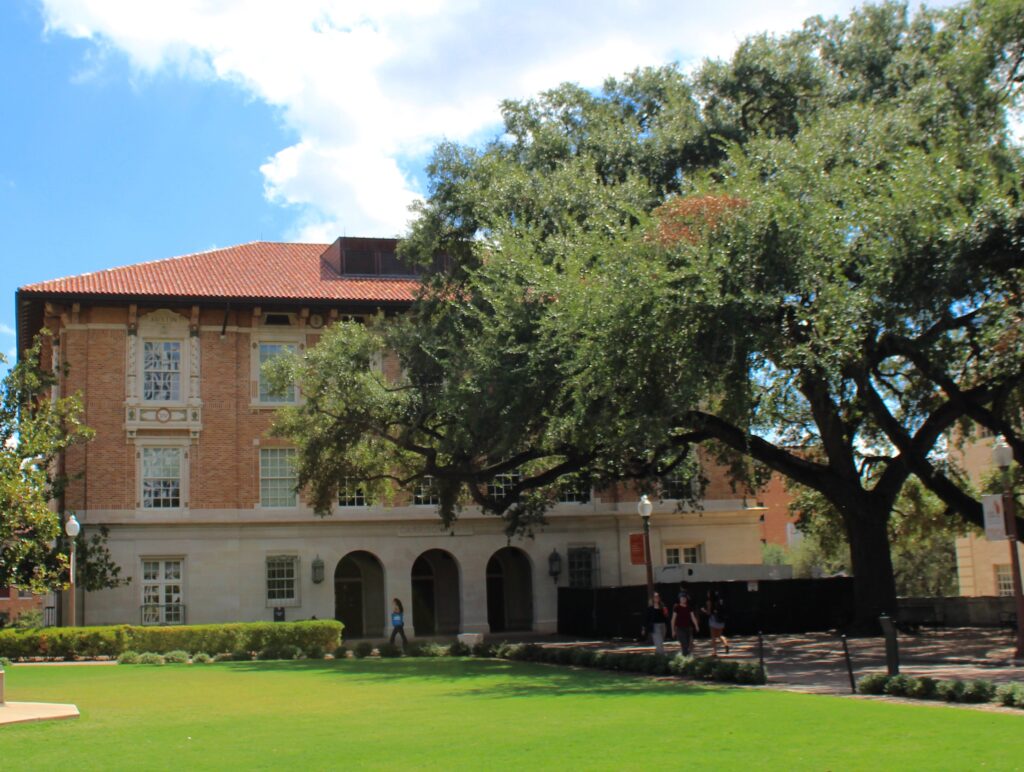
Garrison Hall as it looks today, one hundred years after its construction. Photograph by the author.

Garrison Hall as it looks today, one hundred years after its construction. Photograph by the author.

Those cattle-brand medallions are more than architectural flourishes of what became the History Department building. The building was to be a “permanent monument to immortalize the history of the Southwest” through one of the region’s defining economic activities and cultural symbols: cattle ranching.[3] They were meant to symbolize what had been the beating heart of Texas, just as that era gave way to barbed wire, industrial livestock, and iron horses. By the 1920s, industrial modernization, agricultural crisis, and the rise of the oil industry were reshaping Texas. Agricultural and animal product prices collapsed after Europe’s recovery following World War I, while oil extraction emerged as one of Texas’s defining economic forces. It was under these circumstances that, in 1922, the University of Texas, then just a handful of brick buildings with temporary wooden shacks, began planning an expansion. Those plans received an unexpected boost the following year, when an oil reserve was discovered on university lands in the Permian Basin of West Texas. Santa Rita Well No. 1, now memorialized on the southern edge of campus, began producing oil, generating revenue that helped propel the University’s ongoing expansion. The most significant example was the construction of Memorial Stadium in 1924, named in honor of World War I veterans.[4] That same year, renowned New York architect Cass Gilbert was ousted amid pressure from local firms to hire a Texas architect, and a new architectural team was brought in to redesign the 1922 expansion plan. Garrison Hall therefore began its construction under two Texas architects, Herbert M. Greene of Dallas and Robert Leon White of Austin, and the Illinoisan James White.[5]

The pressure to oust Gilbert was part of a broader, emerging regionalism and a growing confidence that Texas itself could and should shape the University’s development. The American Southwest, long viewed as a backward periphery of the United States, was beginning to assert itself. With growing pride in its identity, history, and culture, Texas began to recast itself less through its Southern and Civil War associations and more as a western frontier society defined by ranches, cowboys, longhorns, and open ranges.[6] While UT professors Garrison, Eugene Barker, and Walter Prescott Webb were laying the bricks of the now traditional, and rather Anglo-centric, history of the Lone Star State, western dime novels were pouring into the market. Zane Grey, a writer of western adventure novels, by far outsold the more prestigious modernist authors of the time, including James Joyce, William Faulkner, and Scott Fitzgerald.[7] “Westerns, westerns and more westerns,” read a Burlington Hawk Eye of Iowa in 1926, as “a western a day makes good movie paid” became the motto of the burgeoning Hollywood film industry.[8] These western stories helped make longhorns, ranching, and cattle brands recognizable and popular icons of Texas identity.
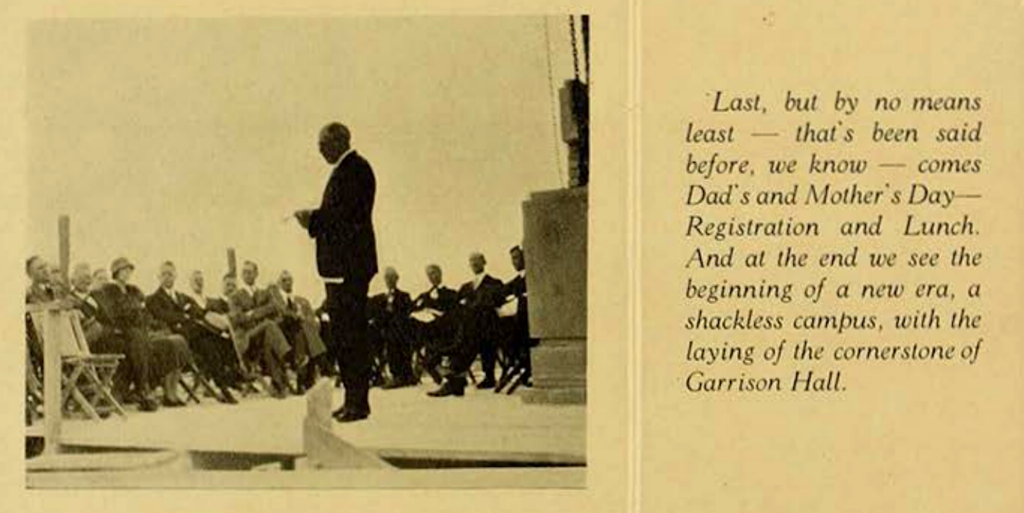
The laying of the cornerstone of Garrison Hall, 1925. Source: The Cactus, University of Texas at Austin, 1926

The laying of the cornerstone of Garrison Hall, 1925. Source: The Cactus, University of Texas at Austin, 1926.

For these symbols to appear in westerns and popular fiction, however, they first had to exist in oral memory and the folklore movement. J. Frank Dobie led the Texas Folklore Society alongside his friend John Lomax. Together, they provided the raw material for the construction of an increasingly nostalgic vision of the Southwest. Dobie spent his childhood on a ranch near the Nueces River and grew up to become a Master of Literature at Columbia University. But he fell short of a Ph.D., since he never adapted to a New York culture he saw as snobbish for disdaining his cattle-ranching background. He came back to UT as an English instructor from 1914 to 1916, only to find himself marginalized again. After serving in World War I without seeing active combat, he returned to Texas and pursued folklorism, the study of local legends, stories, and oral traditions, which had long been his passion. By 1923, Texas folklorism had gained wider public recognition, with Dobie emerging as one of its leading figures. He was subsequently hired without a doctoral diploma as a full professor at the Oklahoma A&M College (now Oklahoma State University) and appointed chair of its English Department. In 1925, however, UT Austin successfully recruited him back.[9] He went on to build his career writing about the fading world of Texas ranching, producing works such as Vaquero of the Brush Country, Coronado’s Chickens, The Longhorns, and The Mustangs.
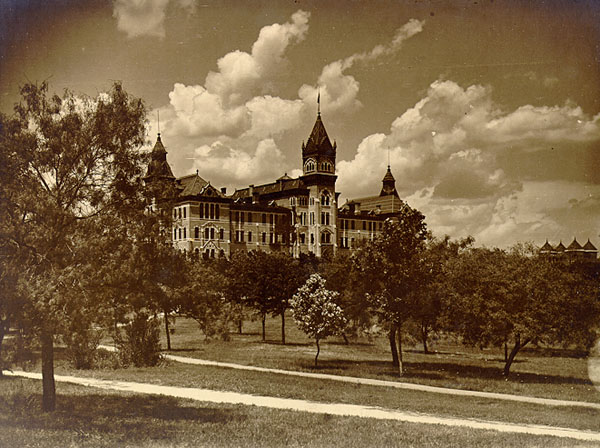
The Old Main Building at The University of Texas at Austin in 1903

The Old Main Building at The University of Texas at Austin in 1903. Source: Wikimedia Commons
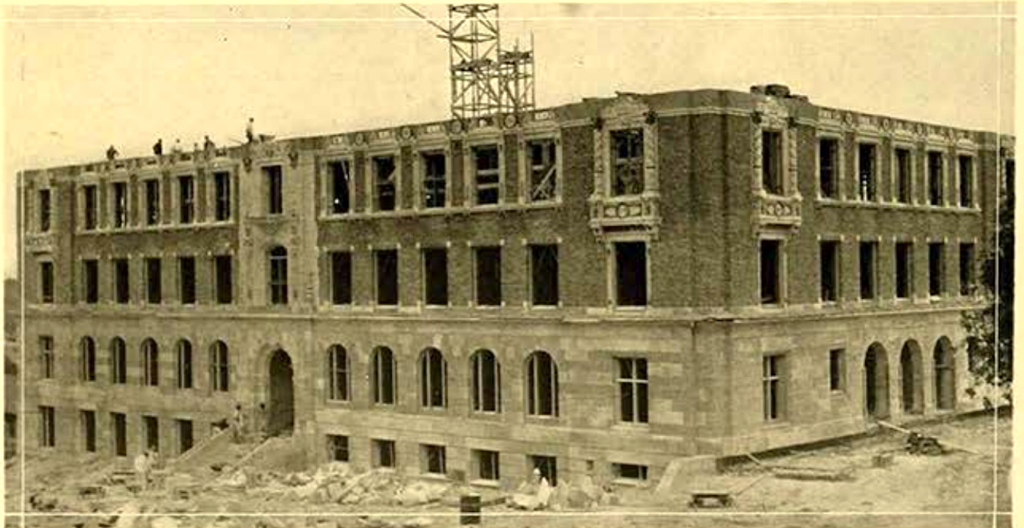
Garrison Hall under construction, pictured in the 1926 Cactus yearbook. Source: The Cactus, University of Texas at Austin, 1926.

Garrison Hall under construction, pictured in the 1926 Cactus yearbook. Source: The Cactus, University of Texas at Austin, 1926.

As modernization advanced, nostalgia for the world left behind kept growing. This enabled figures like Dobie to become spokespeople for a bygone era, revaluing regional history and tradition as worthy of academic study. In a lecture to a large crowd in the summer of 1926, when the facade of Garrison Hall was just completed, he argued that folklore is the fabric through which literature and culture are made. He then pointed to the cattle brands at Garrison Hall as an example of folklore and tradition naturally growing into art and culture.[10] Viewed through Dobie’s career, we can see that Garrison Hall’s cattle brands were more than a casual decorative choice. They were part of a larger cultural moment when Texans made ranching folklore a central symbol of their identity, just as the old frontier that had produced that world faded into the past. It was only fitting that the university’s new history building would try to preserve that past by turning it into stone.

The building committee assigned UT’s librarian and Texas historian Ernest William Winkler, student of Garrison, Eugene Barker, and Frederick Jackson Turner, to survey and select the brands for Garrison Hall.[11] After an exhaustive six months of reviewing twenty thousand brands, he selected thirty-two. He balanced four criteria: historical periods, regional representation, visual appeal, and donors and benefactors. Readers can identify each one using the brand locator at the end of the article.
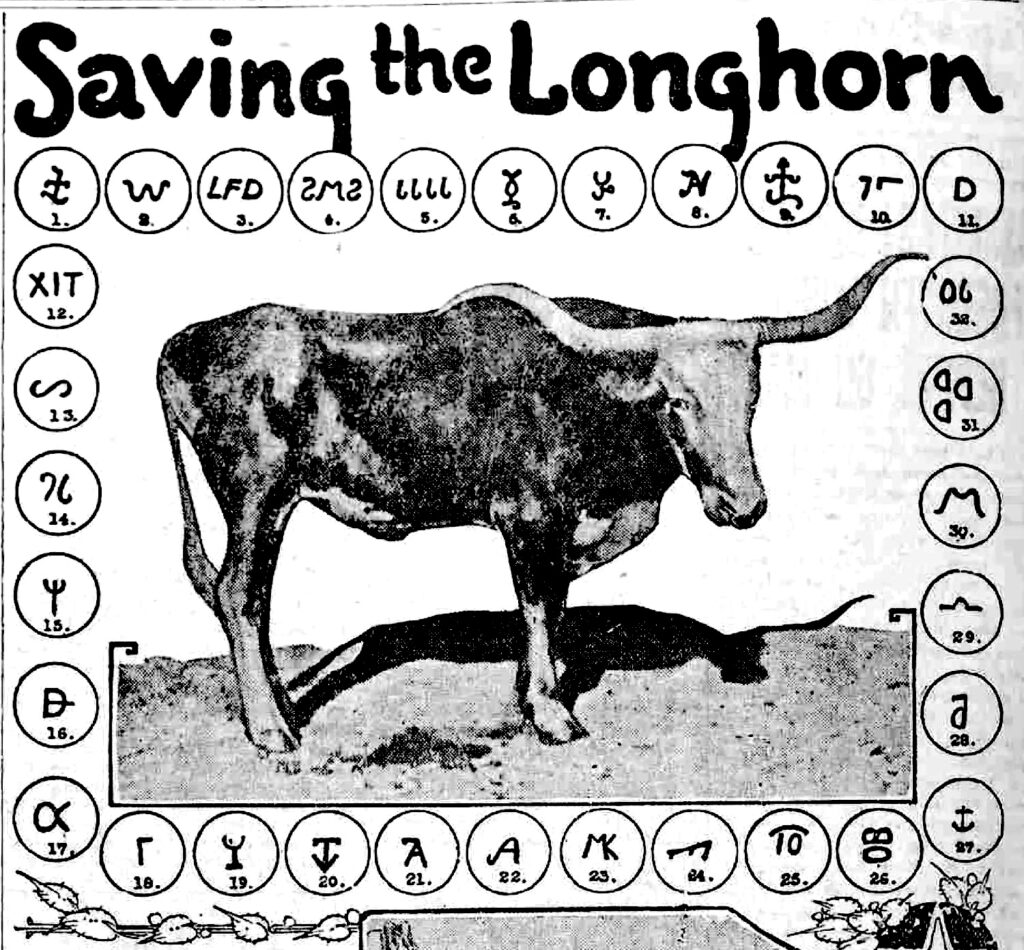
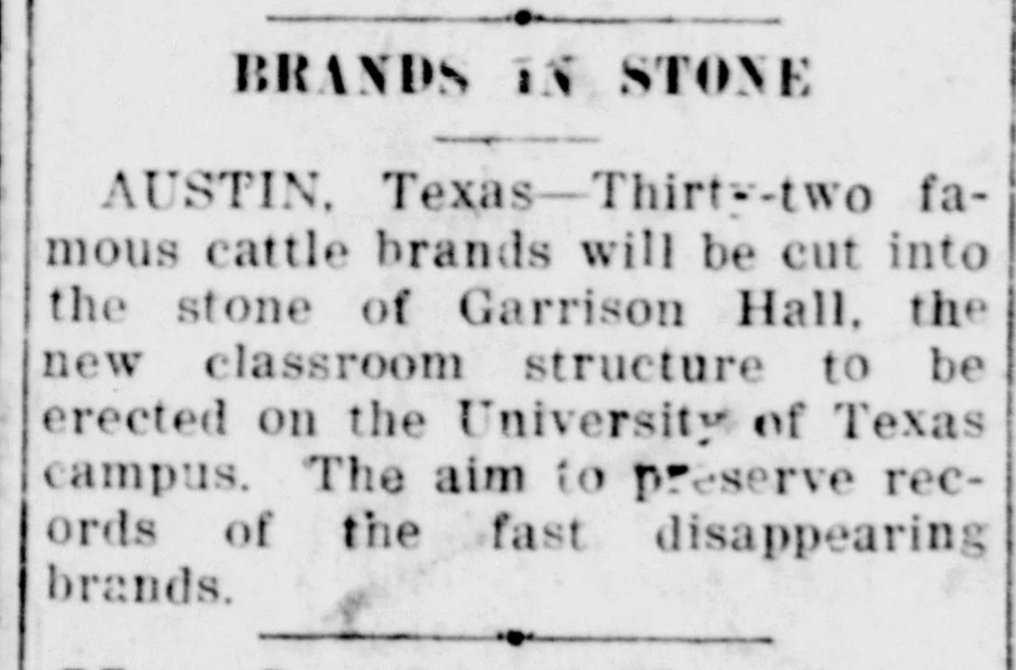
Newspaper coverage of Garrison Hall’s cattle brands in 1926: “Brands in Stone,” Brownwood Bulletin, May 13, 1926 (left)
“Saving the Longhorn,” Mt. Pleasant Pyramid, October 15, 1926 (right).

Newspaper coverage of Garrison Hall’s cattle brands in 1926: “Brands in Stone,” Brownwood Bulletin, May 13, 1926 (left), and “Saving the Longhorn,” Mt. Pleasant Pyramid, October 15, 1926 (right). Source: NewspaperArchive.

The first period was defined as the Spanish and Tejano “pioneers” who introduced ranching to Texas, such as the Pedro Ibarbo and Mariano Sanchez brands. Notable among this group is the oldest of the thirty-two brands, that of José Antonio de la Garza, known as el flaco (the skinny one), who lived through the tumult of Mexico’s independence wars of the 1810s. The rebellion against the Spanish Crown reached Texas in 1813, followed by the brutal pacification by royalist commander Joaquín de Arredondo. As a result, ranches were ravaged, and large numbers of cattle were dispersed. Many of the ranches that survived the mayhem also changed hands. But de la Garza did more than preserve his estate. He became one of the leaders who organized roundups to recover and redistribute cattle that had been scattered and intermingled for years, many of them completely unbranded.[12] His brand is the first one, from right to left, on the upper northern side of the Hall.

The second period was meant to represent the first American ranching brands, most notably Stephen Austin’s, which was placed on the west-side main entrance, below the right upper-floor window. His brand was also known as the “Spanish Austin Brand” since its shape follows the traditional Hispanic style, very similar to de la Garza’s. Stephen Austin inherited his father Moses’s contract from the Spanish Crown, and later from Mexico, to settle families in Texas in the 1820s. When Santa Anna’s army invaded Texas in 1836, the main body of the Mexican army reached the Brazos River and survived by eating scattered cattle it found along the way, some of which probably bore Austin’s brand. Many colonists fled toward Louisiana or Galveston Island in what became known as the Runaway Scrape. Austin, meanwhile, was in the United States advocating for Texas independence after his imprisonment in Mexico. He returned to Texas later in 1836 and died that December. Many cattle dispersed into the wild again, adding to the already substantial feral herds that would later become associated with Texas Longhorns.
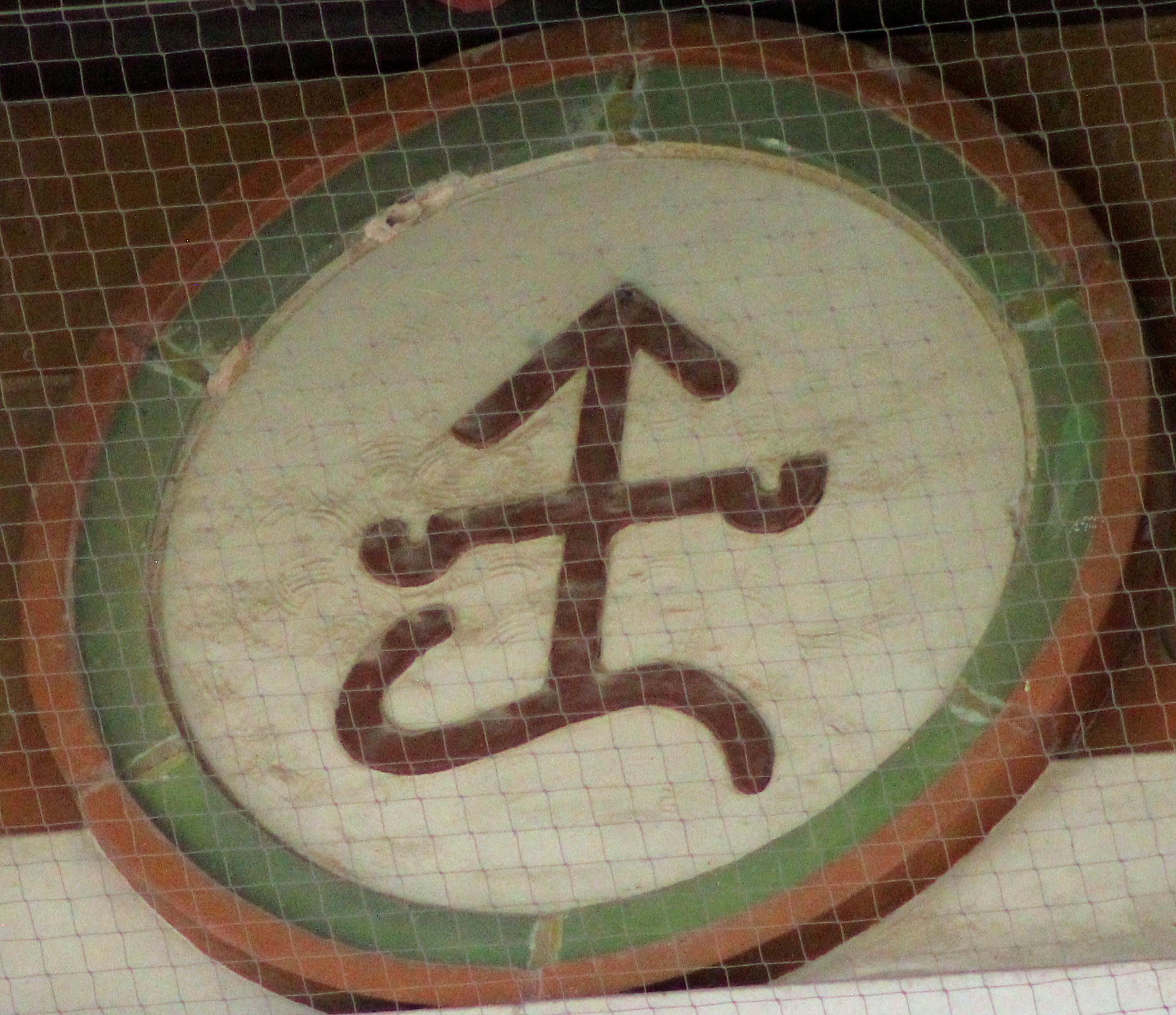

Cattle brands of José Antonio de la Garza (left)
Brand of Stephen F. Austin (right)

Cattle brands of José Antonio de la Garza (left) and Stephen F. Austin (right) on Garrison Hall. Photographs by the author.

The third period highlighted the trail-driving era, which flourished after the Civil War, when cowboys drove herds hundreds of miles to northern markets. These trails became legendary because they required immense skill to control large Longhorn herds, many of which had been rounded up from a semi-feral state. Cowboys also had to contend with all kinds of rustlers and raiders along the routes. Ike T. Pryor, who helped Winkler in his search, belonged to this group. He began driving Longhorns to Kansas as a young man and later built his career around the 77 brand, located on the north side of Garrison Hall.

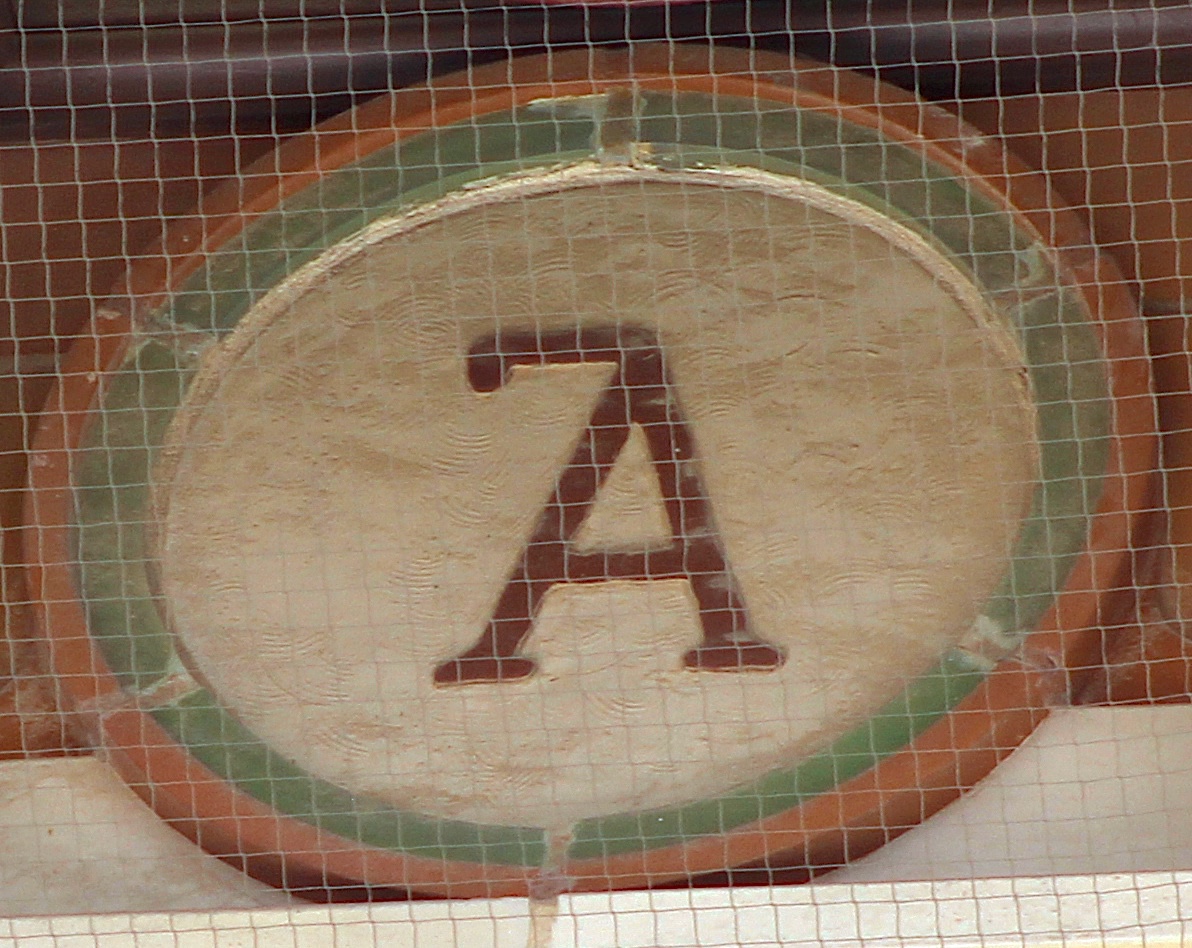
Preston R. Rose, whose 7-A brand was placed on the south-side frieze, introduced methods such as fencing and breeding that became the norm by the time Garrison Hall was built. By 1926, with the arrival of barbed wire and the introduction of “improved” breeds, such as Angus, the once-abundant feral and semi-feral herds of Longhorns were on the edge of extinction. That same year, the Texas Folklore Society pushed for the preservation of “pure blood Longhorns”, which led to the first protected herd on the Wichita National Forest Wildlife Refuge.[13] Garrison Hall followed the same impulse to preserve that mythologized vanishing ranching world, as the widely reprinted press release about its construction put it: “The aim is to preserve records of the fast disappearing brands.”
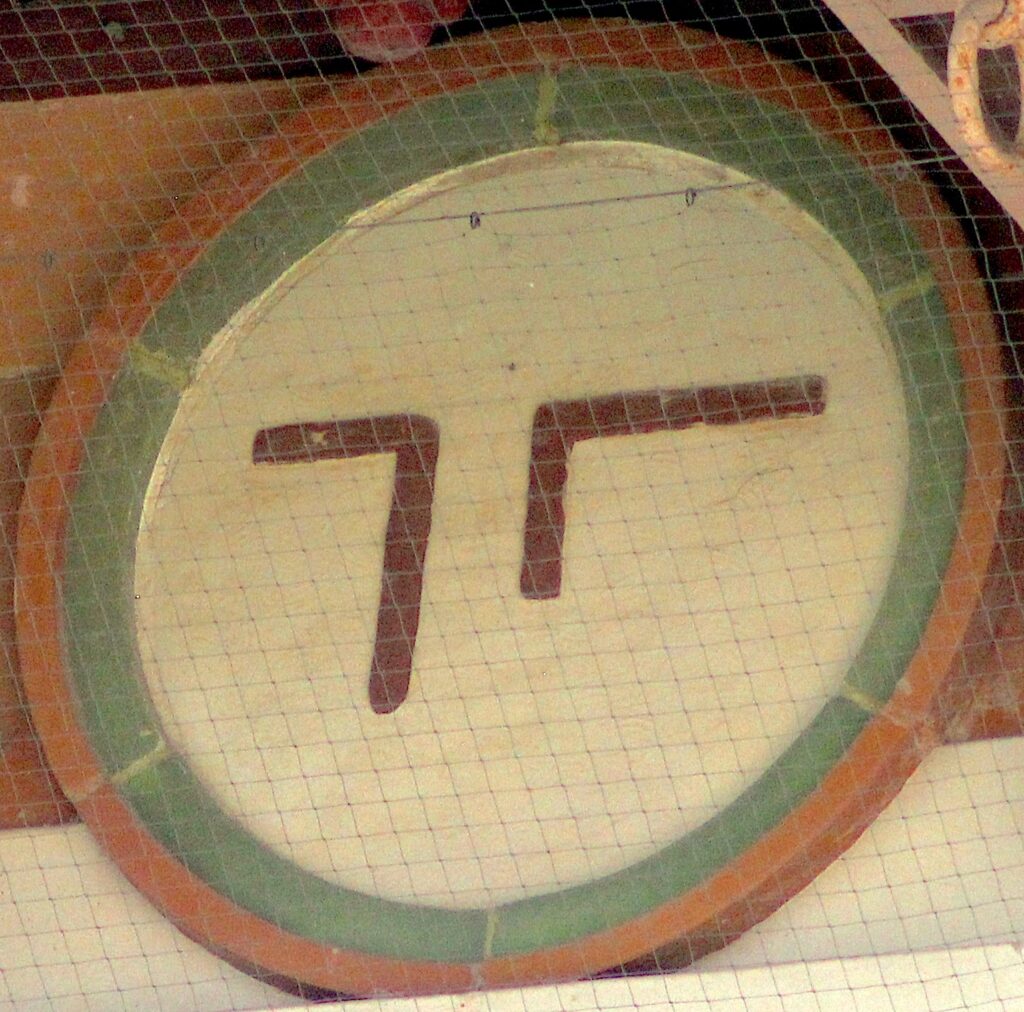
Cattle brands of Ike T. Pryor (left)
Cattle brands of Preston R. Rose (right)

Cattle brands of Ike T. Pryor (left) and Preston R. Rose (right) on Garrison Hall. Photographs by the author.

According to Dobie, one “can look at the buildings on the campus and trace the development of culture in Texas”.[14] But how representative were these brands really? Most of the thirty-two are trail-driving brands or belong to the century after 1836. The sample overrepresents late-nineteenth-century Anglo-American Texas ranching, even though Franciscan friars introduced ranching in the first half of the eighteenth century. Garrison Hall was built when Texas history was still heavily skewed towards the post-1836 period. Hispanic roots were acknowledged but marginalized. Dobie himself wrote about the Spanish period mostly as the background context for what later became Texas. In 1936, Carlos Castañeda began publishing his multivolume Our Catholic Heritage in Texas, which gave greater historical weight to the Hispanic legacy, along with the classic Borderlands scholarship of Herbert Bolton, leading the way for later historians like Jack Jackson, Jesús “Frank” de la Teja, and Andrés Tijerina.

Nevertheless, despite the curatorial bias, those Hispanic roots still made it into the Hall through style and shape. Hispanic brands used circular shapes and more intricate designs than the Anglo style of straight lines, sharp angles, and numbers. Some brands even blend both styles, reflecting the deep entanglements among peoples that characterize Texas history.

Yet, notable groups are absent, including Indigenous peoples such as the Caddo, Karankawa, Jumano, Lipan Apache, and Comanche, as well as enslaved and free Black communities. But they too should be invoked and remembered when looking at Garrison Hall and its cattle brands, because they were also knotted to Texas’s larger social fabric through cattle and horses. While the selection was based on a biased idea of Texas history, it still represents a way of life in which many peoples were involved: cowboys, owners, workers, raiders, traders, captives, fugitives, and neighbors. Ranching, as it developed in Texas, was not only an economic system but also a cultural and social web connecting the many peoples of the region.

Brand locator. On each side of Garrison Hall, the brands are listed from right to left as you face the building. All photographs by the author.

West side
Below the roofline: José Antonio de la Garza, José Antonio Navarro, Pedro Ibarbo, Mariano Sánchez.
Upper-floor windows: Stephen Austin, Richard King.
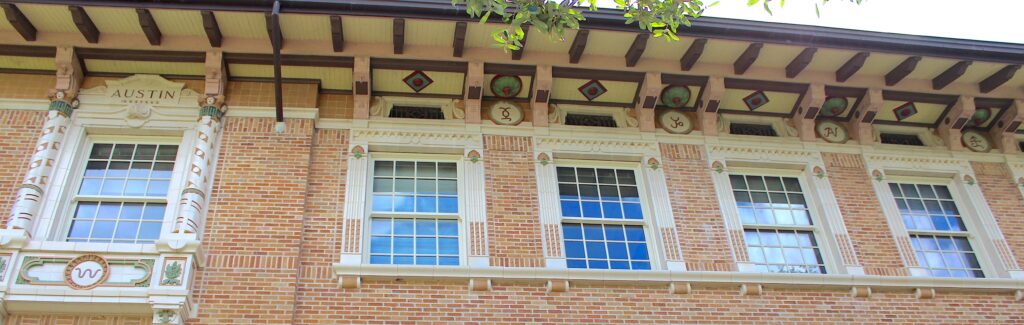
West side brands. picture by the author

North side
Below the roofline: Herbert L. Kokernot, William T. Waggoner, Anna Martin and Sons, Al E. McFadden, George W. Saunders, Ike T. Pryor, Christopher C. Slaughter, John R. Blocker.
Upper-floor windows: George Littlefield, Swante M. Swenson.


North side brands 1. picture by the author

North side brands 2. picture by the author

East side
Below the roofline: Capitol Land Syndicate, Joe Hunter.

East Side brands. picture by the author

South side
Below the roofline: Dudley H. Snyder, E. B. Millett, Mark Withers, Dillard R. Fant, John T. Lytle, Martha Rabb (Cattle Queen of Texas), Ellison and Dewees, J. J. Myers, A. H. (Shanghai) Pierce, Oliver Loving and Sons, Charles Goodnight, Preston Rose, Samuel A. Maverick.
Upper-floor window: Samuel B. Burnett.


South side brands 1. picture by the author

South side brands 2. picture by the author

South side brands 3. picture by the author


[1] Austin Daily Texan, October 28, 1925, p. 3, Austin, Texas, US https://newspaperarchive.com/austin-daily-texan-oct-28-1925-p-3/

[2] Austin Daily Texan, December 09, 1925, p. 5, Austin, Texas, US https://newspaperarchive.com/austin-daily-texan-dec-09-1925-p-5/

[3] Austin Daily Texan, March 14, 1926, Pg. 7, Austin, Texas, US https://access.newspaperarchive.com/austin-daily-texan/1926-03-14/page-7/

[4] Jim Nicar, “The Big Enormous Building,” The UT History Corner, February 10, 2017, accessed August 14, 2026, https://jimnicar.com/2017/02/10/the-big-enormous-building/

[5] Henry Wiencek, “An Architectural History of Garrison Hall,” Not Even Past, October 12, 2012, https://notevenpast.org/architectural-history-garrison-hall/

[6] Cummins, Light Townsend. “History, Memory, and Rebranding Texas as Western for the 1936 Centennial.” This Corner of Canaan: Essays on Texas in Honor of Randolph B. Campbell, vol. 9781574415179, 2013, pp. 37–57.

[7] Steven L. Davis, J. Frank Dobie, A Liberated Mind, Austin, UT Austin Press, 2009, pp. 75-78.

[8] Burlington Hawk Eye, May 09, 1926, Pg. 26, Burlington, Iowa, US

https://access.newspaperarchive.com/burlington-hawk-eye/1926-05-09/page-26

[9] Steven L. Davis, J. Frank Dobie, A Liberated Mind, Austin, UT Austin Press, 2009, pp. 63-81.

[10] Austin Daily Texan, June 20, 1926, Pg. 1, Austin, Texas, US https://newspaperarchive.com/austin-daily-texan-jun-20-1926-p-1/

[11] Llerena Friend, “Winkler, Ernest William,” Handbook of Texas Online, accessed August 14, 2026, https://www.tshaonline.org/handbook/entries/winkler-ernest-william.

[12] Jack Jackson, Los Mesteños, College Station, Texas A&M Press, 2006, pp. 540-542 and 562-565.

[13] Mt Pleasant Pyramid, October 15, 1926, Pg. 5, Mount Pleasant, Utah, US https://newspaperarchive.com/mt-pleasant-pyramid-oct-15-1926-p-5/

[14] Austin Daily Texan, June 20, 1926 Pg. 2, Austin, Texas, US https://newspaperarchive.com/austin-daily-texan-jun-20-1926-p-2/


José Roberto Campos Cordero is a Ph.D. student in History at The University of Texas at Austin. He holds an M.A. in Modern and Contemporary History from the Instituto de Investigaciones Dr. José María Luis Mora and a B.A. in International Relations from El Colegio de México. His research focuses on the U.S.-Mexico borderlands and Texas, drawing on environmental, global, and cultural approaches. He is currently writing an environmental history of Texas centered on cattle and horses.

The views and opinions expressed in this article or video are those of the individual author(s) or presenter(s) and do not necessarily reflect the policy or views of the editors at Not Even Past, the UT Department of History, the University of Texas at Austin, or the UT System Board of Regents. Not Even Past is an online public history magazine rather than a peer-reviewed academic journal. While we make efforts to ensure that factual information in articles was obtained from reliable sources, Not Even Past is not responsible for any errors or omissions.

Filed Under: 1900s, Art/Architecture, Education, Features, Material Culture, Memory, Texas, Texas Histories, United States Tagged With: Architecture, Cattle Brands, Garrison Hall, material culture, Public History, Ranching, Texas History, Texas Longhorns, University of Texas at Austin, UT Austin

The Battles of the Alamo and the Myth of Southern Exceptionalism

Banner for The Battles of the Alamo and tthe myth of Southern Exceptionalism by Nina Gilden Seavey

This is an essay about country music. While the narrative may not initially seem like it’s headed in that direction, trust me, it gets there; after passing through Texas, the story eventually arrives at the hallowed doorstep of contemporary country music: Music Row, Nashville, TN. There, I was welcomed by a clarifying insight not just about the world of country music, but about the Southern storytelling traditions at its core. It goes like this. . .

Over two decades ago, I produced and co-directed a documentary film about the Alamo. It was, not surprisingly, named “The Battle of the Alamo.” My partner, Paul Wagner, and I made the film for the Discovery Channel. It was a noteworthy piece for several reasons—not least of which is that we were (and still are) the only film crew ever allowed to shoot inside the shrine itself. I don’t know what led Paul and me to believe that we would ever be granted such access, but it was part of our grand plan, and we had such utter confidence in our own self-worth that we simply would not be denied.

To garner this permission, we were required to appear in front of a board of inquisitors—the “Daughters of the Republic of Texas”— the organization tasked with managing the shrine. We pled our case to this august, intimidating panel of women—all stolidly built, most north of 60 years old, and each one well-weathered by the Texas sun. They sat rigidly guarded in front of us, as if embodying the ghost of William Travis himself, taking the last stand in defense of the shrine’s legacy.

We were very persuasive. Paul and I spoke about the importance of authenticity in documentaries and how television would connect with audiences around the world, reaffirming the importance of the Alamo as the cornerstone of Texas history and a testament to the principles upon which it is still revered. We had top credentials: Paul had won an Oscar. I was a college professor with joint appointments in the departments of both history and media. We both had many film and television credits to our names. We were well-financed by the people at Discovery, as this was to be their first large, commissioned documentary ever. The Daughters had many questions, and we had many confident answers. Timing in life is everything, and they approved our request, despite having denied the same petition from scores of filmmakers who had previously appeared before them.  

Photo of theThe Cradle - Birthplace of The Daughters of the Republic of Texas.

The Cradle – Birthplace of The Daughters of the Republic of Texas. Source: Wikimedia Commons

From the Daughters’ perspective, we had been given the keys to the kingdom, and they expected us to deliver an honorific pean to the moment of Texas’s birth. And quite honestly, for the most part, we did just that. It wasn’t all that hard, actually. The Alamo itself is so filled with the awe that visitors and docents alike breathe into its walls that all we had to do was inhale. We shot the film’s intimate scenes inside the shrine itself. The stories so often repeated there gave us inspiration, both in the style and content of our work. We filmed the larger battle scenes on the set of John Wayne’s 1959 Alamo film constructed in Brackettville, TX, near the Texas-Mexican border. The house rule for the location was “if you build it, you can blow it up”—a credo that we had a good bit of fun executing upon. But it was the site of the Alamo itself in San Antonio that gave the film its heart. Authentic places have a way of imbuing a special aura that can drive documentary storytelling forward.

Everything was going extraordinarily well. The Daughters were satisfied with the care we took to preserve the sanctity of the Alamo as a production location (except for one young production assistant who unwittingly spread dirt on an uncovered floor). We were on time, on budget, and in those early years of documentary that employed reenactors, we had the benefit of working with people who fully believed they were the modern-day incarnations of Jim Bowie, Davey Crockett, and William Travis. Indeed, it was uncanny how closely they resembled their characters – in looks, thought, and action – and we learned a lot from them. They had studied far more deeply into the intricate details of the Alamo narrative than we ever could. So, without hesitation, we pretty much gave them free rein to help us plan the action playing out in front of our cameras.  The Discovery Channel was so pleased with the film we made that they rented the IMAX Theater adjacent to the Alamo and hosted a premiere screening with a gala reception attended by hundreds of Texas dignitaries, including the Lieutenant Governor, Bob Bullock. Everything was great. Until it wasn’t.

Something occurred that has become an object lesson to me about Southern culture that I have never since forgotten. In introducing the film, Paul commented that the Alamo is the “creation myth of Texas.” The narrator of the film, Hal Holbrook, convincingly read the script that had uttered those same words as the summative statement at the end of the film. For us, those words were both poetic and true. In many ways, the fact of the Alamo’s mythology is what had made it so easy for us to make the film—it is a simple story, with well-defined characters who have a lot at stake, and the narrative is emboldened with such strong emotional thematic undercurrents that all we had to do was follow its lead. The fact of its mythic importance in Texas history was as incontrovertible to us as it has been to others for generations.

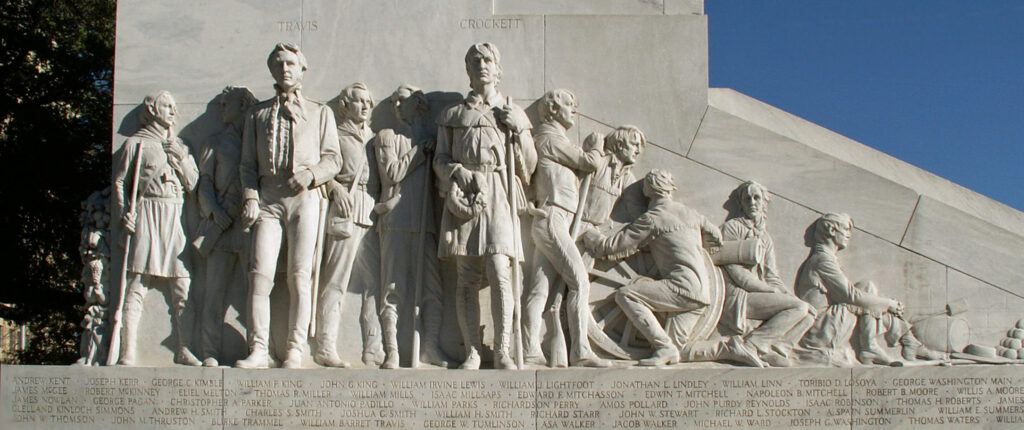
Cenotaph of the Alamo defenders, San Antonio, Texas.

Cenotaph of the Alamo defenders, San Antonio, Texas. Source: Wikimedia Commons

So, there we were standing, cocktails in hand, basking in our success when one of the most stolid of those Daughters came flying across the room—green chiffon flapping and blue bouffant hair trailing in the windstorm she created with her speed. She stopped short in front of us and said, “What do you mean the Alamo is the created myth of Texas?!?!”  Paul and I paused. We didn’t know what she was talking about. As we were planted in the middle of a beehive of Discovery executives, neither of us wanted to make a misstep. I gently said, “I’m sorry. We’re not sure what you’re referring to. Can you help us out here?” And again, she repeated, “He” (pointing accusingly at Paul), “said that the Alamo is the created myth of Texas.” And then it clicked with us that what she was referring to were Paul’s opening remarks and the conclusion in Holbrook’s narration. Paul looked relieved when he could report to her, “Oh no, you must have misheard. I said, ‘the creation myth of Texas, not the created myth of Texas.’” Her fury mounted. “You mean you think the story isn’t true?!?!?” she charged. Neither Paul nor I said anything. She continued her attack, “You called it a “myth,” which means you don’t think it’s true!” She wasn’t focused on the creation or created part of the sentence; she was focused on the word myth.  

Neither Paul nor I had ever considered that portraying the Alamo story as myth would be a problem. We didn’t think for a moment that the story was factually true. There were but a few survivors of the siege, and their accounts had long been considered suspect. But the “emotional truth” of the story was absolute, and we felt it merited the heraldic treatment we had given it on screen. But for the Daughters, to portray the story as “myth” was tantamount to calling it a “lie.”

The evening devolved from there as the realization of our lack of belief in the Alamo story as historical fact quickly made its way through the grapevine of chiffoned, high-haired ladies in attendance—each one of whom now felt she had been studiously duped by us and by the sleek network executives who had very quickly and unceremoniously fled the room.

Mind you, this wasn’t just a simple Yankee/Southerner cultural misunderstanding. Paul has a lilting accent that betrays his Kentucky roots, and I am a long-time border state girl, born and bred in Missouri. We understood—and have even culturally embraced—the passions that Southerners have with many of their histories, which—like the Alamo— frequently feel so outsized that they can defy credulity. In this case, however, we had never even considered making a film that portrayed the story as true. They had never queried us about our belief (or faith, as they would call it), and we would never have contemplated rendering the story as fact; our innate, unspoken assumptions were simply entirely different from theirs.

Our impulse for using the Alamo itself for production was a search for inspiration conveyed by authenticity, not a commitment to factual depiction. Indeed, the visual style of the film intentionally veered away from reality towards dream-like, ephemeral moments of collective memory. For our part, we found the “truth” of the story in the Alamo as a rich parable depicting tenacity in the face of adversity. Since we never even considered its truth as an option, what we presented on screen was our visual representation of that intention: that it be experienced as myth. Our perceived high-minded stylistic approach notwithstanding, in the view of the Daughters—and to the men who believed themselves to be contemporary incarnations of Bowie, Crockett, and Travis—we were traitors. They had been hoodwinked in plain sight. Of course, that had never been our intention, but there we were—on opposite sides of a cultural belief system as gaping as the Rio Grande itself.

Obviously, we never did cross that divide. They wanted us to believe the story that legions of history lovers and visitors to the shrine have held as true, and we simply didn’t. We felt no remorse about that, and they felt nothing but anger from our dismissal. The film aired, and it was a huge hit for Discovery because it captured, in all its authentic glory, the spirit of the Alamo. At its heart, the film asked the audience to ponder what it would be like to live under siege, when death for your beliefs was all but inevitable. We wanted the audience to posit what that circumstance would be like, and to consider whether there would ever be a cause for which they would make such a sacrifice. That approach seemed sufficient for most general viewers who were less concerned (or, in the case of Southern audiences, didn’t know) about our allegiances; our commitment to the story having been proven by our attentiveness to historical detail and to the genuine spirit of the story. But the controversy taught me something about making films in the South that I have carried forward with me into other projects – and into the world of country music.

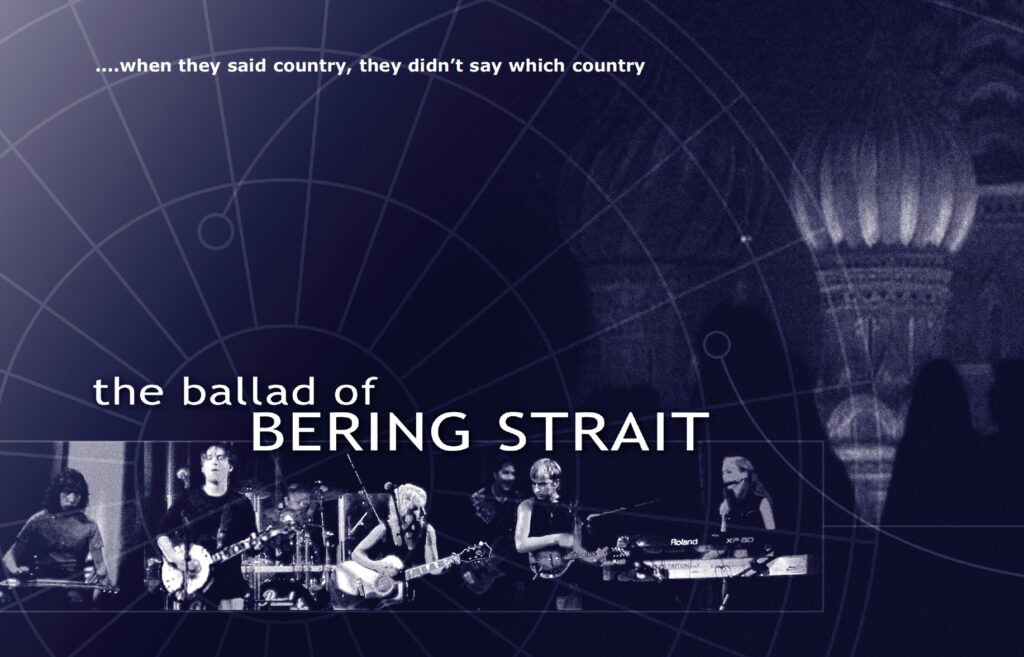
The Ballad of Bering Strait promotional.

The Ballad of Bering Strait promotional. © Nina Gilden Seavey, 2003.

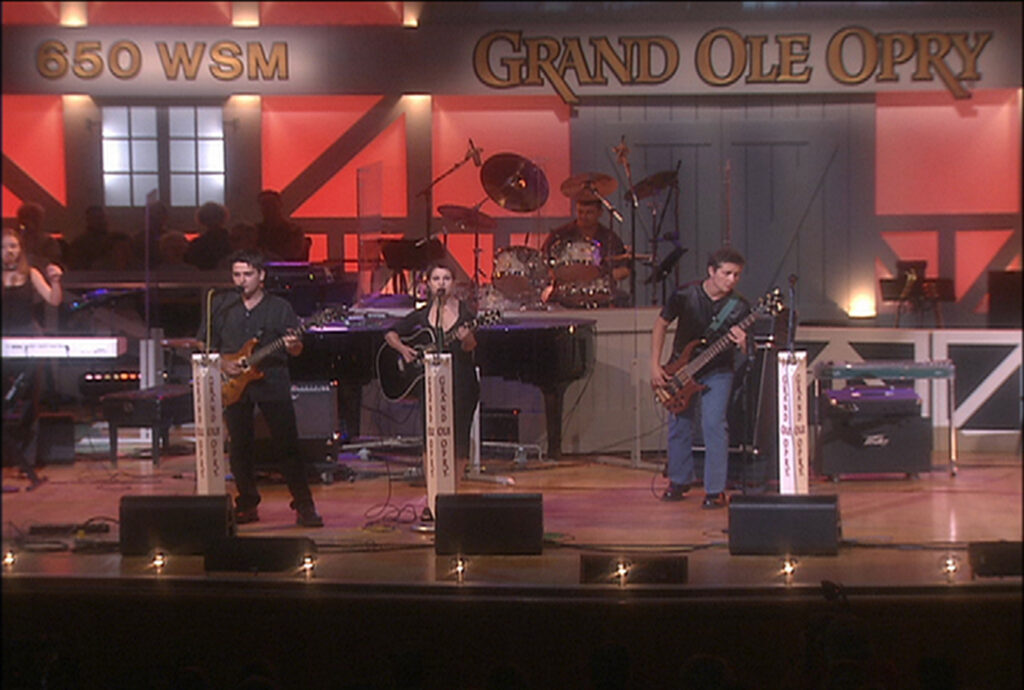
Some number of years later, I made another film, “The Ballad of Bering Strait.” This time it wasn’t a historical story, but rather one that unfolded in front of the camera (what we call cinéma-vérité). The story explored the musical and emotional journey of seven Russian teenagers who came to America to become country music stars. My experience nearly a decade prior gave me a hook upon which to hang my filmmaker’s hat: could a group of young musicians walk onto Music Row, indeed, perform on the sacred stage of the Grand Ole Opry, and be considered “true country” even if their twang had a Russian accent? Was this only a novelty, almost circus-like endeavor, or was it possible that country music could be exported across the continents, reimagined under the tutelage of the sons and daughters of the Russian intelligentsia, and reimported back to America, particularly Southern country music fans?

Mind you, this wasn’t just any country music group. Each member of the ensemble was a conservatory-educated, classically trained musician who had been brought under the wing of a music teacher who, in the 1990s, had fallen under the spell of American bluegrass and country music. The band’s teacher had found a few cassette tapes in the band’s hometown of Obninsk, a small city about 100 kilometers south of Moscow. Obninsk was a “closed city” in the post-Soviet era, so the tapes were manna from a far-off, inaccessible land. Over several years, the young players learned to imitate every note and its particular tone to perfection.

I found out about the group just as they had been discovered by an American art dealer who finagled a record deal for them with Arista Records in Nashville. As preposterous as the whole set-up sounds, the group’s musical ability was authentic even if their country music roots were decidedly not. The president of Arista Nashville bet on that talent. But the hard-won lesson learned from my battles at the Alamo suggested to me that the question of what was true about the band might become more important than the spirit that they carried with them upon their arrival on Music Row. Within that cultural divide, I bet that an interesting documentary film would emerge.

Picture of Bering Strait at the Grand Ole Opry in Nashville

Bering Strait at the Grand Ole Opry in Nashville. © Nina Gilden Seavey, 2003.

I followed the band for three years, from 1999-2001. Their story, like most country music sagas, was full of unanticipated twists and turns and emotional sturm and drang. But that’s no different than the paths of nearly all musical artists. As they say in Nashville, “it takes 10 years to create an overnight sensation.” But this group’s challenges were unique.

In a world where “believing the story of the storyteller” was as important to Southern audiences as its technical delivery, that cultural chasm as large as the Rio Grande that I had met at the Alamo reappeared. In Being Strait’s songs of “lyin’ and ‘cheatin’ and fast cars, and beer” the truth (or the perception of truth) became paramount, specifically to the critical arbiters of success—audiences listening to country music radio. DJ Dan Hollinger of WLX Radio in Lawrenceburg, TN, summed it up best: “I don’t think music by a Russian artist would go in the United States. It’s not so much their vocals, nor the music, nor the lyrics, but the fact that they would be accepted as being from Russia.” This wasn’t a case of xenophobia. This was a question of authenticity, of belief, of faith, and of true stories told by true storytellers. Forget that most musicians don’t necessarily fall into that social or cultural box either. But in the case of Bering Strait, the challenge to the myth of Southern exceptionalism was simply too brazen to ignore.

Granted, some artists have crossed the cultural divide across oceans; most notably Australian phenom Keith Urban. But the outback of Australia shares a pioneer spirit that makes Urban a potentially acceptable stand-in for his small-town country-born musical contemporaries. But Bering Strait? Even their name suggests a bridge to America too far.

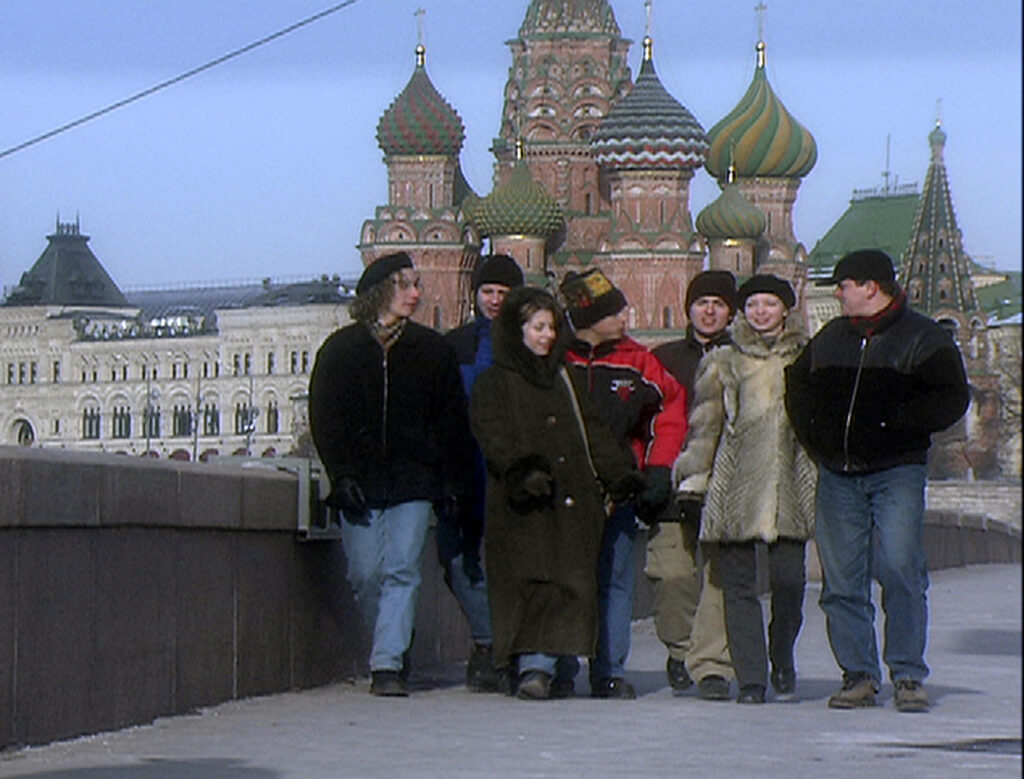
Picture of Bering Strait in front of St. Basil’s Basilica in Moscow.

Bering Strait in front of St. Basil’s Basilica in Moscow. © Nina Gilden Seavey, 2003.

When the band dissolved in 2006, only one band member went back to Russia. Their musical acumen was undeniable. They became, in the parlance of the music industry, “session players and sidemen,” musicians who play in recording sessions and appear on stages backing up the more home-grown artists who don’t challenge the “creation myth” of Southern audiences and country radio. These ancillary players are considered Nashville’s best musicians, so the band members have fared well as consistent contributors to the country music sound. Some of them have won major awards for producing and instrumental work. You can regularly see the names Ilya Toshinski, Lydia Salnikova, and Sasha Ostrovsky on the liner notes and in the programs of the biggest acts in country music. But, as a band, the truth of their origin stories was too great a challenge to the stolid belief in the mythology of Southern exceptionalism.

What I hadn’t known was that ours was a losing battle from the outset. Bering Strait’s very existence and Paul’s and my interpretation of the siege of the Alamo were essentially one and the same: a challenge to a traditionalist view of Southern culture and history. Not surprisingly, we encountered the same immutable mountain of core belief in Southern exceptionalism held by a powerful faithful that seek no interference, no revisioning, nor any reinterpretation. It is hard to move civilization forward with such an obstacle so firmly standing at the gate.


Nina Gilden Seavey is an Emmy Award-winning documentary filmmaker, writer, and educator. She is Research Professor Emerita of History and Media and Public Affairs at George Washington University, where she founded and directed The Documentary Center from 1990 to 2020. She is the president of Seavey Media, LLC, and the author of The Documentary Filmmaker’s Workbook.

The views and opinions expressed in this article or video are those of the individual author(s) or presenter(s) and do not necessarily reflect the policy or views of the editors at Not Even Past, the UT Department of History, the University of Texas at Austin, or the UT System Board of Regents. Not Even Past is an online public history magazine rather than a peer-reviewed academic journal. While we make efforts to ensure that factual information in articles was obtained from reliable sources, Not Even Past is not responsible for any errors or omissions.
Filed Under: 1800s, 2000s, Features, Film/Media, Memory, Texas, United States Tagged With: Alamo, Documentary Film, Music Row, Nina Gilden Seavey, Southern Exceptionalism, Texas History

Faculty Spotlight: Dr. Kate Imy

Banner of Faculty Spotlight about Dr. Kate Imy

Formation

What first drew you toward the study of history?

My very uncool, non-academic answer is that my first historical obsession was the film Titanic. This resulted not only in seeing the film multiple times in theaters and being there at midnight for the VHS (!) release but collecting each piece of ephemera—from replicated relics to Titanic-themed computer games. As an MA student, I was a docent at the Molly Brown House Museum in Denver, which commemorates the famous Titanic survivor. When I traveled to the UK for my PhD research, I stopped at each “Titanic” point of interest—from the shipyards in Belfast to the port of departure at Southampton and final stop at Cobh (formerly Queenstown), Ireland. These early experiences shaped my understanding of the relationship between public and academic history and how entertainment can make and shape historical arguments.

Research

What are the core problems or questions that organize your research?

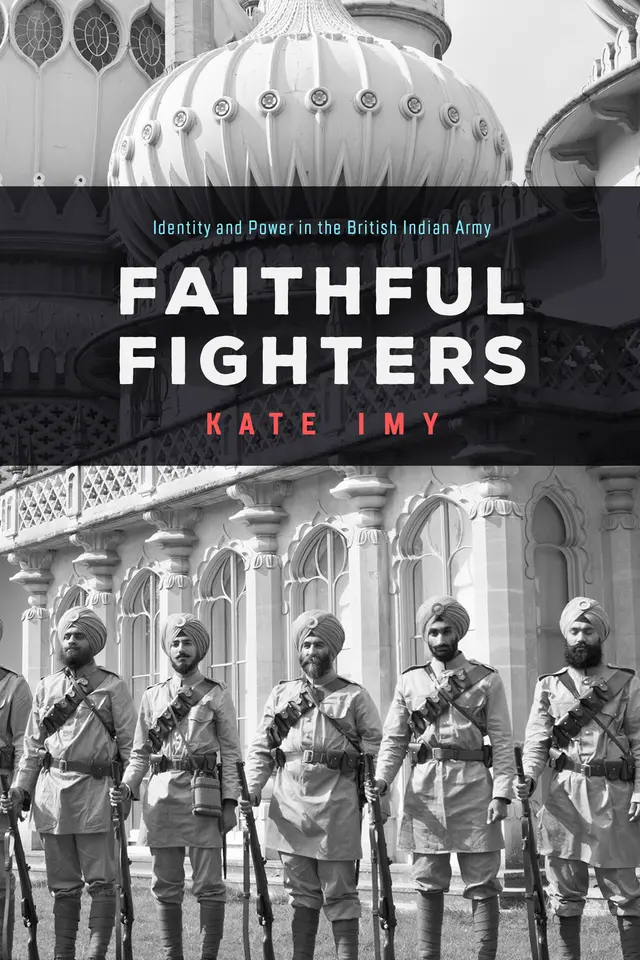
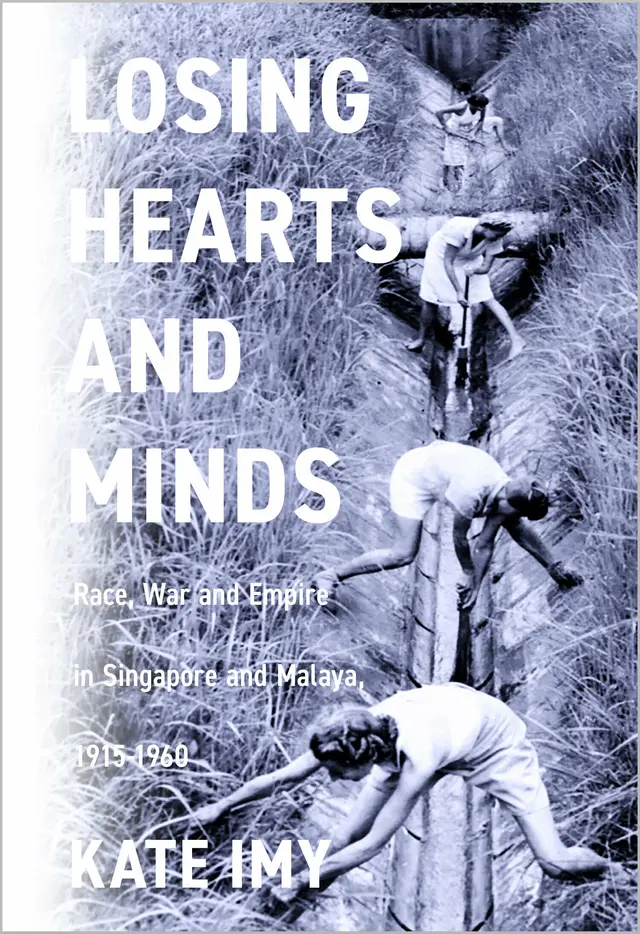
I am very concerned with how individuals navigate inclusion and exclusion through embodied experiences with power. My first book, Faithful Fighters, examined the South Asian troops of the colonial Indian Army who fought for the British Empire in both World Wars. These colonial soldiers were recruited in part because of British perceptions of how soldiers’ religious beliefs contributed to both martial strength and pro-British loyalty. In reality, these soldiers used their proximity to British power, and their religious communities and practices, to challenge the imperial state. My second book, Losing Hearts and Minds, explored the soldiers’ and civilians’ growing disillusionment with colonial power in Southeast Asia among populations considered most loyal— from South Asian soldiers to Eurasian Christians. My in-progress third book, Disabling Divinity, uses a disability lens to explore the unexpected global connections between white settler colonialism and fringe religious networks in a tiny woman’s commune. Each work considers how people benefit from, and are burdened by, proximity to state power that forces them to navigate and often internalize marginalization and exclusion based on race, gender, and disability.

Book cover of Kate Imy’s Faithful Fighters: Identity and Power in the British Indian Army.
Book cover of Kate Imy's Losing Hearts and Minds: Race, War, and Empire in Singapore and Malaya.

How would you describe your methodological approach?

I am a story-driven historian and obsessive archival researcher. I tend to gather early seeds of ideas from secondary sources, then search the archive for unique stories that challenge my assumptions. I love finding individual people whose lives cross multiple boundaries—be it racial, ethnic, or gender—or who interact with the world in ways I would not expect.

Is there a book, scholar, or intellectual tradition that has been especially formative for your work?

I have been deeply shaped by postcolonial theory and feminist scholarship on the military. At the moment, I am interested in histories of settler colonialism and disability studies.

Have there been moments, whether through engagement with other scholarship or through your own evidence, when your thinking shifted in a significant way?

Having served briefly in the military, I was certain that I would not do a PhD project related in any way to the military. My initial dissertation questions focused on religious interactions between South Asian spiritual leaders and British civilians. I assumed that this would have an exclusively leftist, pacifist, anti-colonial political orientation. Imagine my surprise when I found a British Fascist—Francis Yeats-Brown—who served in India and became a devotee of yoga. Even more interesting, I found another one—J.F.C. Fuller—who served in India and loved yoga and Fascism. While Fuller’s papers were held at Rutgers, where I was working on my PhD, Yeats-Brown’s were held in the Harry Ransom Center, making one of my first PhD research trips to UT! These archival experiences got me to ask deeper questions about violence and conservatism within military institutions and how the racialization of religion shaped both colonial and anticolonial cultures.

Is there an archival or research experience that stayed with you—even if it never made it into your published work?

When researching in the British Library, requesting “files” can mean that you get a giant bound volume containing both your file and files that you did not request. Once, as a graduate student, I decided to flip through the whole volume rather than focus on the one file I requested. There, I found a story of R.A.L. Moysey, a British officer in 1920s India who plotted to kidnap a general’s daughter as leverage to free his Indian male lover from police custody. This story ended up being a cornerstone of my dissertation and first book. It also inspired a screenplay that earned me a place in the Outfest Screenwriting Lab and won the Austin Film Festival’s Josephson Entertainment fellowship. It was a good lesson about being open to finding things where you never expected to look.

Have you ever encountered something in the archives or in your research that was genuinely funny, strange, or unexpectedly human?

As an animal lover, I always appreciate cat prints on documents, or authors who complain about a cat playing with their pencils as they try to write. All of my published work has been completed with numerous cat companions sitting on computers, attacking my notes, or stealing attention away from work. I appreciate sharing cross-time animal antics.


Photograph of a cat sitting alongside books and a computer.

The Cat: Wikimedia Commons

Teaching & Mentorship

How does your research inform your teaching?

Both my research and teaching emphasize the multiplicity of perspectives within war and the British Empire. To facilitate this, I assign an array of written, visual, and audio material ranging from personal memoirs of wartime nurses to the letters and diaries of Indian soldiers, British propaganda films, and oral history interviews with combatants and non-combatants. I want students to gain hands-on experience crafting original arguments with primary source material, and I assign them research-driven assignments. These enable students to familiarize themselves with and use resources such as the Imperial War Museum (UK), the National Archives of Singapore, or the National Army Museum (UK).

How would you characterize your classroom practice?

My classrooms are dynamic spaces where students practice skills by working individually or in groups. Since most undergraduate students lack a background in Britain and the British Empire, I include contextual lectures and readings to guide them through the discussion materials. Discussions take place over visual, written, and auditory primary sources. I also enjoy hosting in-class debates that require students to use primary sources to make the strongest argument possible.

What forms of historical thinking do you most want students to develop, and what do you hope they take away from working with you?

I am an avid researcher always inspired by a good story. I always encourage my students to cast the widest net possible in research and to use multiple types of sources (visual, written, film, oral history) from multiple archives. Most importantly, I want students to feel like they are agents in control of understanding and shaping how history is made through evidence and arguments. This, I believe, makes them more attuned to the various types of media – from films to political speeches – that make historical arguments. I want students to feel empowered to search for, understand, and interpret the past and present with clarity and precision.

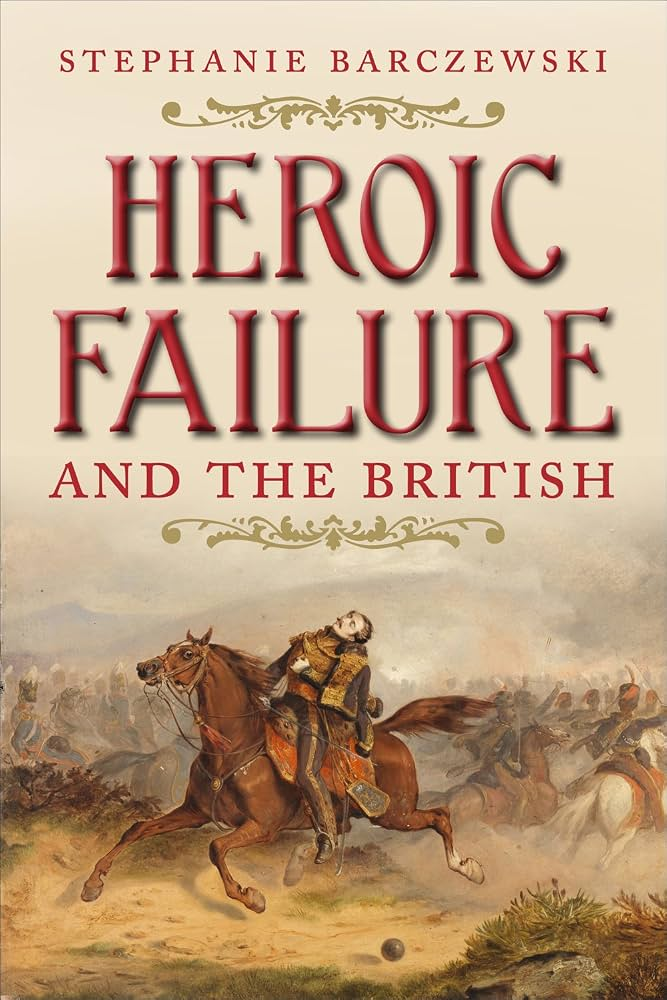
Book cover of Stephanie Barczewski's Heroic Failure and the British.

Are there books in your field that you would recommend to readers who want to explore it further?

A book I often assign for my Victorian-era courses is Stephanie Barczewski’s Heroic Failure. Undergraduate students tend to enjoy working with this material because it is grounded in good stories. Barczewski uses each chapter to highlight a famous failure in British imperial history—from the Charge of the Light Brigade to the search for David Livingstone. She makes a compelling yet accessible argument—that failure gave British society more sympathetic and sentimental ways to connect to the empire at the height of its power than tales of triumph. Students can often track the argument across multiple case studies. In class, we pair these stories with artistic, photographic, and written primary source materials depicting each individual incident. It is a great springboard for discussion as well as a useful introduction to the British Empire.


Kate Imy is Associate Professor of History at the University of Texas at Austin. She is a historian of war, empire, race, religion, and disability, with a focus on the British Empire, South Asia, and Southeast Asia. She is the author of Faithful Fighters: Identity and Power in the British Indian Army and Losing Hearts and Minds: Race, War, and Empire in Singapore and Malaya.

The views and opinions expressed in this article or video are those of the individual author(s) or presenter(s) and do not necessarily reflect the policy or views of the editors at Not Even Past, the UT Department of History, the University of Texas at Austin, or the UT System Board of Regents. Not Even Past is an online public history magazine rather than a peer-reviewed academic journal. While we make efforts to ensure that factual information in articles was obtained from reliable sources, Not Even Past is not responsible for any errors or omissions.
Filed Under: Asia, Education, Empire, Empire, Europe, Features, Gender/sexuality, Gender/Sexuality, Race/Ethnicity, Race/Ethnicity, Spotlight, Teaching Methods, War, War Tagged With: Disability History, Faculty Spotlight, Kate Imy, religion, Teaching History, War and Society

La Historia del Tiempo Presente en México: un campo en construcción

Portada de artículo La Historia del Presente en México de Josué Portillo Motte, versión en español

This article has an English version

La Historia del Tiempo Presente[1] en nuestro país se perfila como un campo historiográfico en formación, aún abierto y en proceso de definición, el cual constituye un espacio de reflexión indispensable para comprender las fracturas, continuidades y violencias que atraviesan la realidad nacional. A diferencia de la historiografía tradicional, centrada en el pasado clausurado y en el documento oficial como fuente privilegiada, la HTP se ocupa de lo inacabado: de procesos sociales cuya historicidad está aún abierta porque sus actores, víctimas y testigos permanecen vivos. Desde esta perspectiva, se cuestiona la división lineal del tiempo histórico (pasado-presente-futuro) para privilegiar la coetaneidad, la experiencia generacional y la convivencia simultánea de múltiples temporalidades.

            La relevancia del estudio de la HTP en México trasciende las fronteras geográficas, consolidándose como una necesidad para investigadores, locales y extranjeros por igual. La experiencia de México ilustra que la HTP es mucho más que una crónica del pasado inmediato; es una herramienta analítica que otorga densidad histórica a los desafíos contemporáneos más apremiantes. Problemas estructurales como el narcotráfico, los feminicidios, las desapariciones o las violencias de Estado suelen ser analizados casi exclusivamente a través de la inmediatez del periodismo o la visión sincrónica de la sociología. Si bien estas disciplinas son valiosas, sus propias naturalezas epistémicas priorizan el aquí y ahor a, lo que a menudo invisibiliza las raíces profundas, las continuidades y los procesos de larga duración que han dado forma a estos conflictos.

Las interpretaciones dadas por el periodismo y las ciencias sociales resultan relevantes, señala Carmen Collado, pero “hace falta en este panorama una visión que contenga la densidad que aporta el conocimiento diacrónico y sincrónico que puede ofrecer la historia”.[2] Al integrar una perspectiva historiográfica, es posible trascender la coyuntura y comprender estos fenómenos no como eventos aislados, sino como resultados de procesos complejos que requieren una visión histórica para ser explicados.

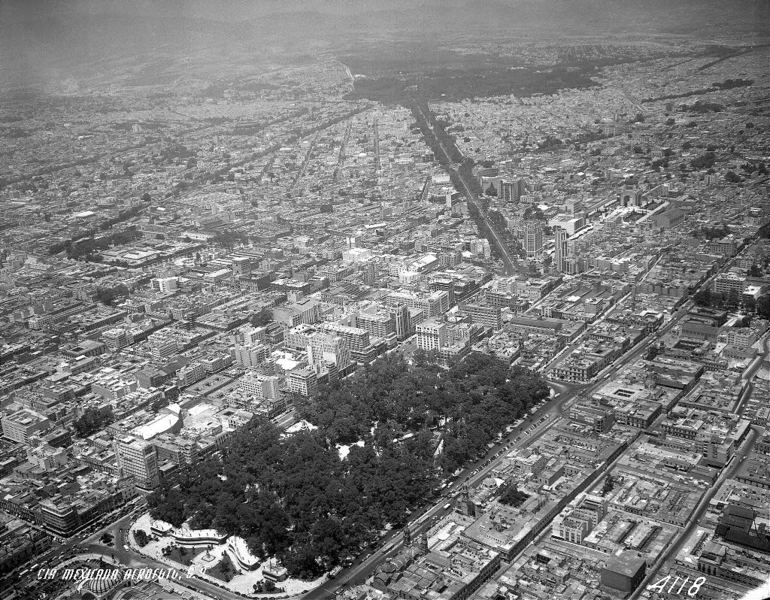
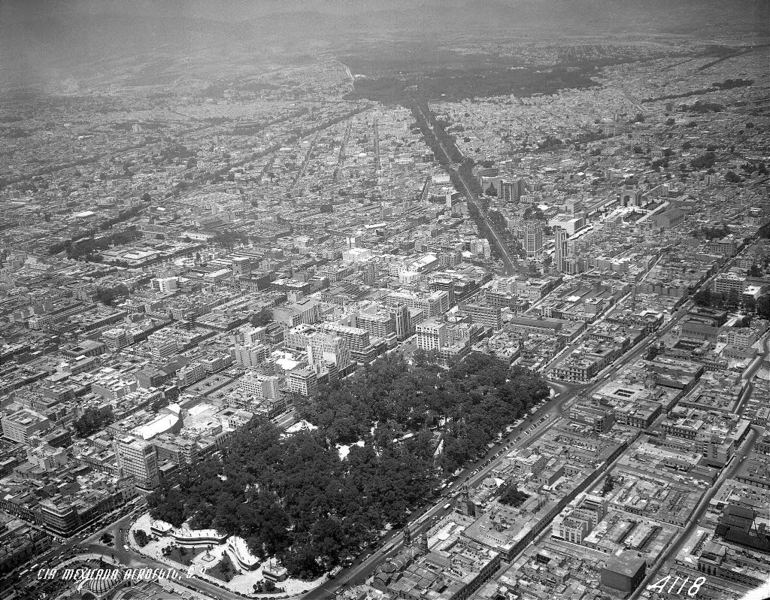
Panorama de la Alameda Central de la Ciudad de México

Alameda Central 20th century. Ciudad de México. Fuente: Wikimedia Commons

No obstante, para comprender el caso mexicano resulta imprescindible situarlo en contraste con otros desarrollos regionales y globales. En Europa, la HTP se institucionalizó a partir de la década de 1970, con hitos como la creación del Institut d’Histoire du Temps Présent en Francia (1978), impulsada por la necesidad de procesar los traumas de la Segunda Guerra Mundial, el Holocausto y el régimen de Vichy. En este contexto, la HTP emergió vinculada a la experiencia de la “última catástrofe”: un acontecimiento deflagrador que fracturó el orden histórico previo y redefinió la conciencia colectiva.

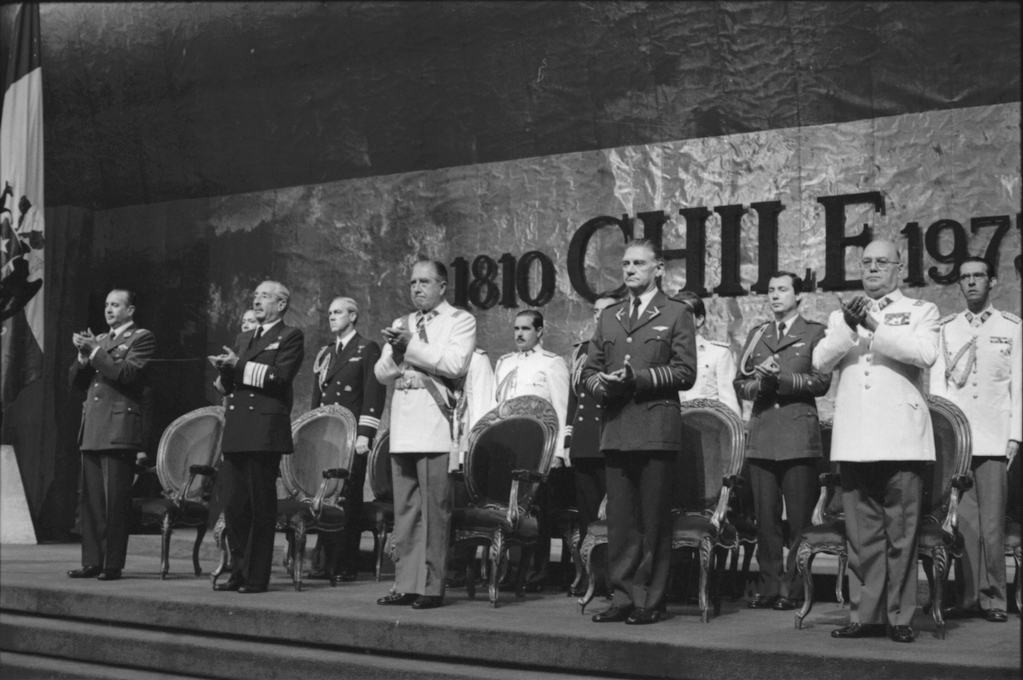
En el Cono Sur, particularmente Argentina, Chile y Uruguay, el campo, frecuentemente denominado Historia Reciente, surgió de la urgencia política y moral de denunciar, documentar y comprender los crímenes de las dictaduras cívico-militares. Se trata de una historiografía hija del dolor[3], estrechamente ligada a la militancia, a las luchas por la verdad y la justicia, y a la visibilización de prácticas sistemáticas de violencia estatal como la desaparición forzada, la tortura y el terrorismo de Estado.

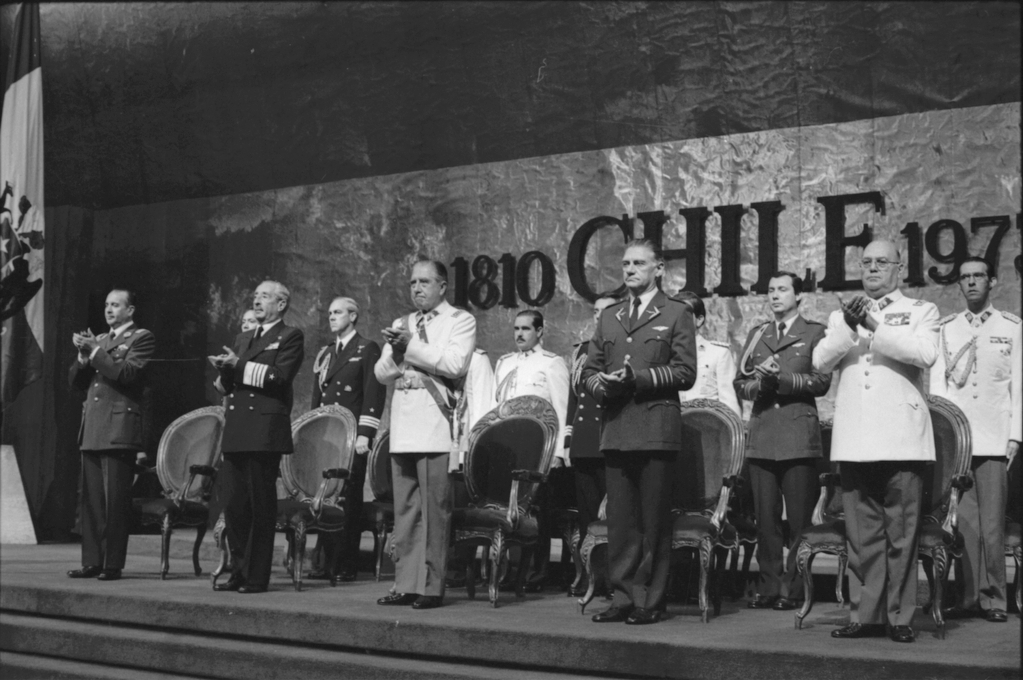
Junta militar y Augusto Pinochet Ugarte, en el edificio Diego Portales, para una nueva celebración de la Constitución. En primera fila, de izquierda a derecha: César Mendoza, José Toribio Merino, Augusto Pinochet, Fernando Matthei, y Humberto Gordon.

Junta Militar de Pinochet. Fuente: Wikimedia Commons

Así, el desarrollo de la HTP en México presenta rasgos distintivos. A diferencia de los casos europeos y sudamericanos, no se articula en torno a una ruptura abrupta, sino a una violencia persistente inscrita en un sistema autoritario de larga duración. Las investigaciones coinciden en identificar al menos dos momentos clave en su configuración:

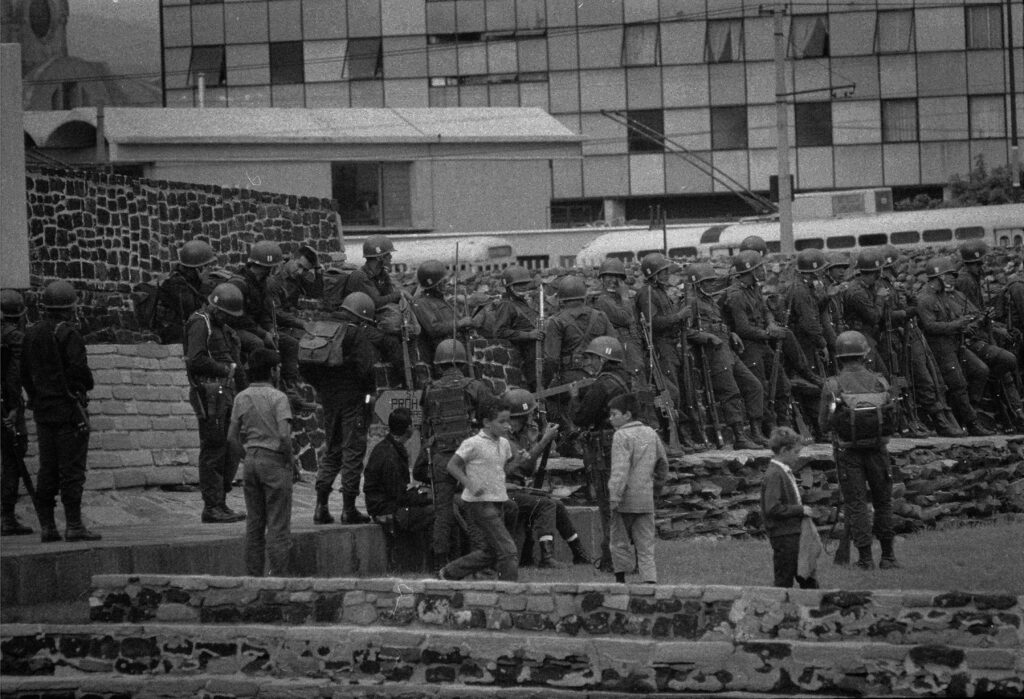
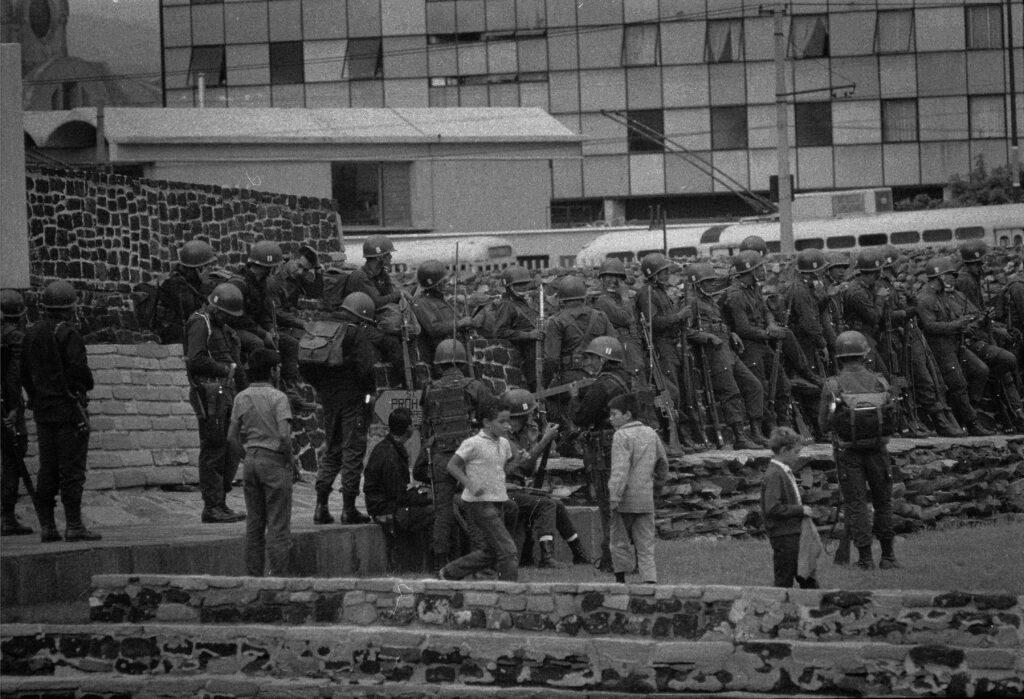
  1. El movimiento estudiantil de 1968. Considerado el punto de inflexión nodal, el 68 no solo reveló el agotamiento del relato oficial de la Revolución Mexicana, sino que generó a sus propios historiadores. La masacre de Tlatelolco evidenció la capacidad represiva del Estado y abrió una grieta irreversible en la legitimidad del régimen, impulsando nuevas preguntas sobre el poder, la memoria y la violencia.
  2. La transición política del año 2000. La derrota electoral del PRI tras más de siete décadas en el poder obligó al Estado mexicano a confrontar, al menos parcialmente, su pasado represivo. La creación de la Fiscalía Especial para Movimientos Sociales y Políticos del Pasado (FEMOSPP) y la apertura limitada de los denominados archivos de la represión en 2002 legitimaron al presente como un campo de intervención historiográfica.

No obstante, en México la violencia no se percibe como una anomalía circunscrita a un periodo cerrado, sino como una constante que enlaza la Guerra sucia, la cual se periodizó entre 1965 y 1990, con tragedias contemporáneas como Ayotzinapa, los feminicidios y la violencia asociada al narcotráfico. El presente aparece así como un “tiempo suspendido”, en palabras de Camilo Vicente Ovalle,  o inconcluso, donde la persistencia del mal radical y la impunidad impiden la clausura simbólica del pasado.

Fotografía de soldados montando guardia en la plaza de Tlatelolco durante el movimiento estudiantil de 1968

Movimiento estudiantil 68. Fuente: Wikimedia Commons

De esta manera, uno de los principales obstáculos para la HTP en México es la opacidad institucional. Si bien en 2002 se transfirieron fondos de la Dirección Federal de Seguridad (DFS) al Archivo General de la Nación (AGN), una parte sustantiva de la documentación permanece bajo control discrecional de los aparatos de inteligencia del Estado. A ello se suma un retroceso legal significativo: la Ley Federal de Archivos de 2012 introdujo la figura del “documento histórico-confidencial”, que permite restringir el acceso a información relativa a violaciones de derechos humanos bajo el argumento de proteger la intimidad de las personas, incluso cuando se trata de perpetradores. Para numerosos investigadores, esta categoría jurídica opera como un mecanismo de administración archivística de la impunidad, encubriendo los secretos del poder, bajo un lenguaje formal de transparencia y protección de datos.

Sin embargo, esta perspectiva historiográfica ofrece diversas salidas. Ante las restricciones de los archivos oficiales, el historiador del presente se enfrenta a la hiperabundancia de fuentes alternativas: prensa, televisión, plataformas digitales y redes sociales. La expansión de dispositivos como celulares, tabletas, además del internet ha transformado radicalmente los regímenes de producción de información, permitiendo que los ciudadanos se conviertan en productores de fuentes al registrar abusos policiales, actos de violencia o escenas de la vida cotidiana. Sin embargo, esta riqueza documental plantea desafíos técnicos de verificación, conservación y análisis, agravados por la volatilidad de lo digital y la ausencia de políticas sólidas de preservación audiovisual.

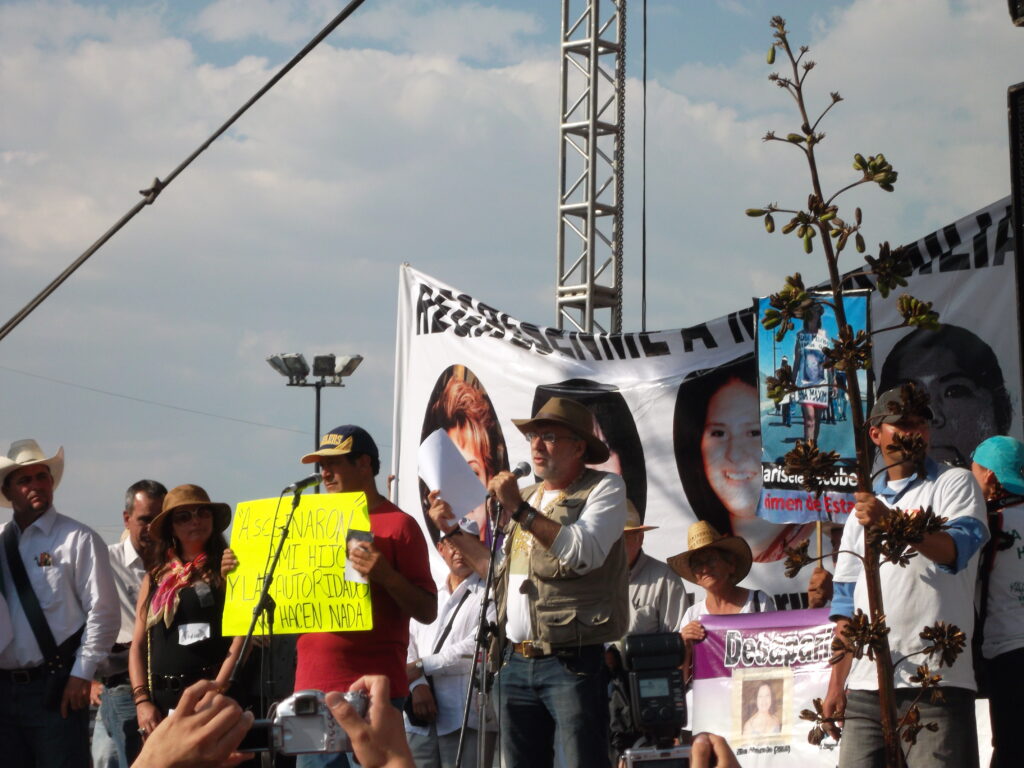
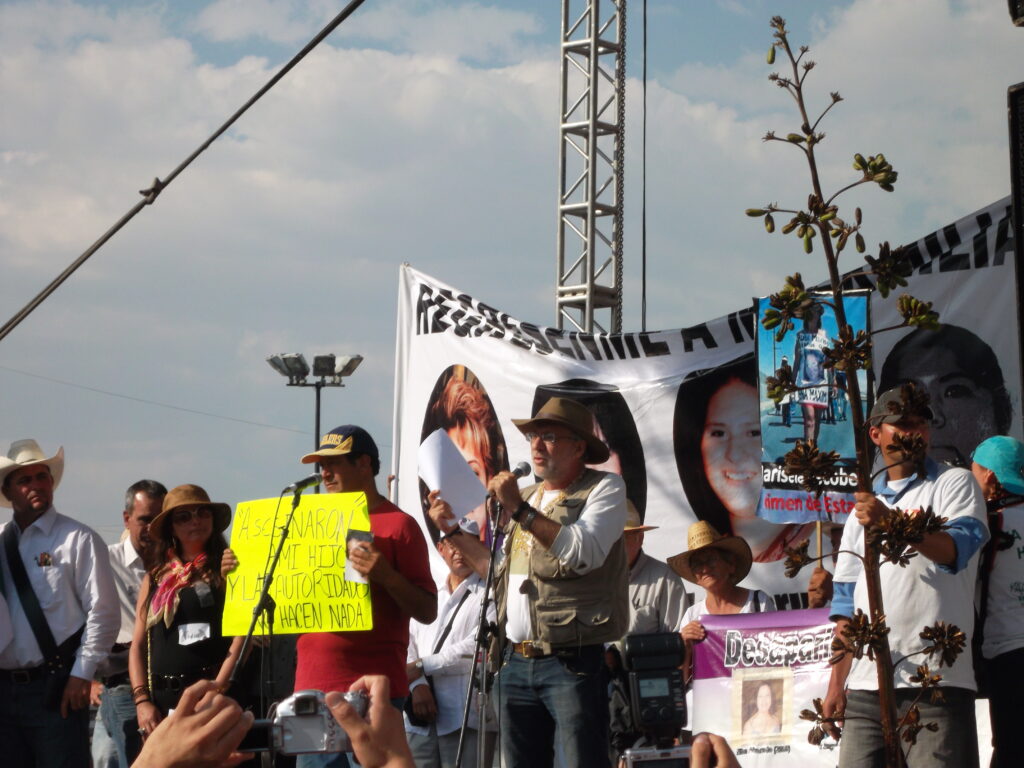
En este escenario, la historia oral ocupa un lugar central como herramienta para rescatar memorias subalternas y otorgar voz a quienes han sido históricamente silenciados. No obstante, trabajar con un personas coetáneas a nosotros implica dilemas éticos profundos: desde la entrevista a perpetradores, con el riesgo de banalizar o normalizar la violencia, hasta la responsabilidad de confrontar el testimonio con el rigor crítico del método histórico. En México, el historiador del presente asume con frecuencia el rol de testigo experto, interviniendo en los usos públicos de la historia y contribuyendo a la construcción de una conciencia crítica en una sociedad que, como advirtió Javier Sicilia, ha sido deshabitada por la violencia extrema.[4]

Javier Sicilia pronunciando su discurso tras la marcha por la paz desde Cuernavaca a Ciudad de México el 8 de mayo de 2011.

Javier Sicilia. Fuente: Wikimedia Commons

Investigar el presente en México no constituye únicamente un ejercicio académico, sino un compromiso ético y político. La HTP responde a una demanda social por dotar de inteligibilidad histórica a fenómenos dolorosos que la historia oficial ha tendido a silenciar, fragmentar o despolitizar. Desde espacios como el Instituto Mora o la Universidad Nacional Autónoma de México (UNAM), diversos investigadores han impulsado seminarios y proyectos orientados a pensar estas historias de los vivos, reconociendo al presente como un laboratorio para nuevas formas de escritura histórica, más sensibles a la complejidad, la incertidumbre y la densidad de la experiencia humana.[5]

Como campo en construcción, la HTP en México posee un enorme potencial para complejizar los problemas más urgentes del país. A pesar de los obstáculos legales, archivísticos y emocionales que implica trabajar con la persistencia de la violencia, este enfoque abre la posibilidad de explorar “archivos vírgenes” y de narrar la historia mientras está ocurriendo. En última instancia, como coinciden numerosos especialistas, se trata de una historia viva que busca impedir que la mecánica del olvido se imponga sobre la experiencia de las generaciones actuales.

En nuestro contexto, este ejercicio historiográfico no puede limitarse a una observación distante ni a una mera actualización cronológica de la historiografía. Investigar el presente implica disputar activamente los sentidos del pasado en un país donde la violencia, la impunidad y el silencio institucional no son residuos de una etapa superada, sino dispositivos vigentes. Frente a un Estado que administra el olvido mediante el control de los archivos, la fragmentación de la memoria y la normalización de la violencia, la HTP se constituye como una práctica de resistencia intelectual.

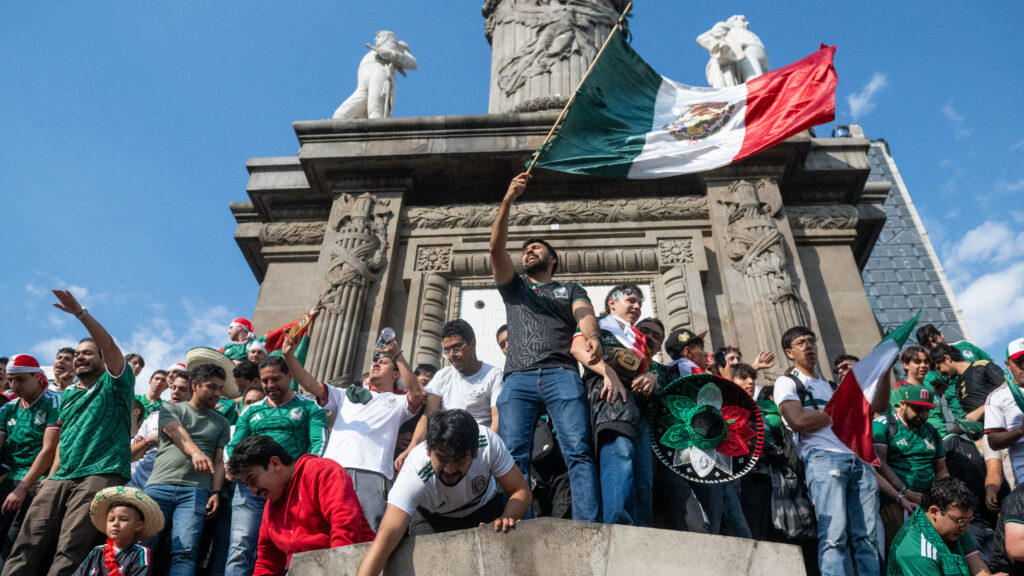
Episodios recientes, como los estallidos de violencia en Culiacán o Guadalajara a raíz de la captura de figuras clave del Cartel de Sinaloa o El Cartel Jalisco Nueva Generación, no deben leerse como eventos aislados, sino como síntomas de una crisis de seguridad más profunda. A esto se suma el alarmante recrudecimiento de la violencia de género, cuya persistencia se hace patente en casos como el de Kimberly Ramos, estudiante de la Universidad Autónoma del Estado de Morelos, o el reciente feminicidio de Edith Guadalupe en Mixcoac, Ciudad de México. Esta realidad, caracterizada también por un incremento sostenido en las cifras de personas desaparecidas, revela una preocupante negligencia por parte de las autoridades, quienes a menudo priorizan la gestión de la imagen pública, incluso en contextos de proyección internacional como el próximo mundial de fútbol, por encima de la protección de la vida y la justicia. El estudio de estas realidades sienta las bases para desarrollar una tercera línea de investigación sobre la HTP en México.

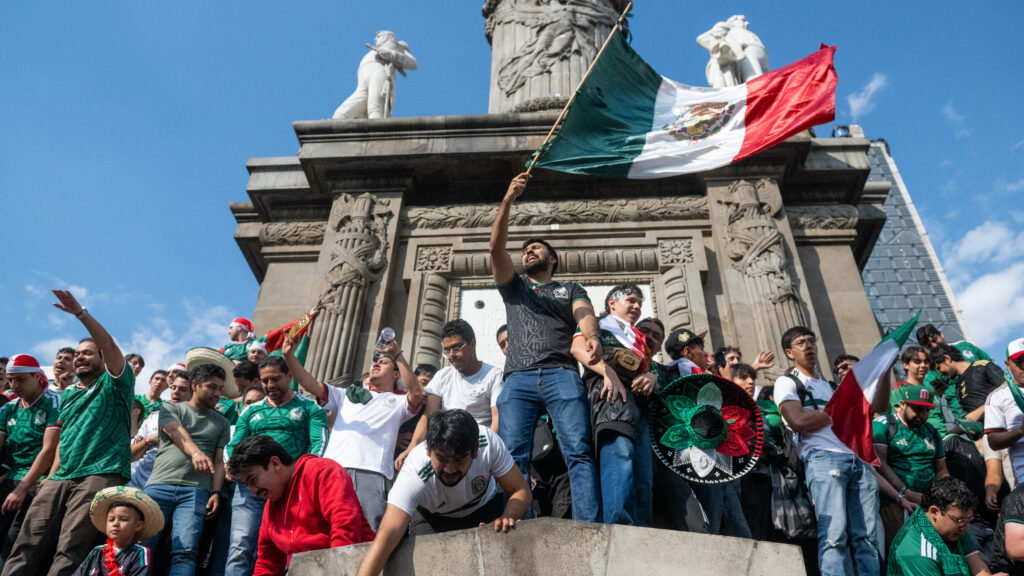
Los aficionados mexicanos ondean la bandera nacional y celebran a los pies del Ángel de la Independencia.

World Cup 2026-Celebración en el Ángel de la Independencia. Fuente: Wikimedia Commons

Ante este panorama, resulta imperativo desplazar la mirada más allá de la crónica inmediata. A diferencia de otras ramas como la sociología, la antropología y el periodismo, resulta necesario revisar y analizar el pasado reciente con el fin de desentrañar las estructuras, lógicas y dispositivos de poder que han permitido la permanencia y avanzada de estas problemáticas. La HTP, lejos de ser un ejercicio retrospectivo, se erige como una herramienta analítica indispensable para comprender las continuidades, rupturas y transformaciones que han dado forma a nuestra coyuntura actual. Solo a través de este ejercicio crítico e historiográfico, que evidencie cómo se han tejido las complicidades y cómo han operado las instituciones en las últimas décadas, será posible dotar de sentido a lo que vivimos y, en última instancia, ofrecer bases sólidas para transformar el horizonte político y social de México.

Así, asumir el presente como objeto histórico significa rechazar la comodidad de los cierres narrativos y confrontar la persistencia de un pasado que se niega a pasar. En este sentido, el historiador del presente no produce conocimiento desde la neutralidad: interviene en la batalla por las vidas que no quieren desaparecer, por las violencias que el poder busca borrar y por las responsabilidades históricas que el presente debe reclamar. En un país atravesado por la repetición y normalización de la violencia, la escritura de la historia se vuelve una forma de insubordinación frente a la impunidad: un acto que busca impedir que el terror se naturalice y que la experiencia de las generaciones sea absorbida por la lógica del olvido


[1] HTP de ahora en adelante

[2] Collado Herrera, María del Carmen, “Historia del tiempo presente: algunas reflexiones metodológicas” en Presente y Pasado. Revista de Historia, Universidad de Los Andes, Mérida, 2021, p. 18.

[3] De acuerdo con Eugenia Allier, esta es una sentencia de las investigadoras Marina Franco y Florencia Levín en relación con este campo historiográfico en Argentina. Allier Montaño, Eugenia, “El tiempo presente en la historia: generaciones, memoria y controversia” en Allier Montaño, Eugenia, César Iván Vilchis Ortega y Camilo Vicente Ovalle (coords.), En la cresta de la ola. Debates y definiciones en torno a la historia del tiempo presente, México, Instituto de Investigaciones Sociales, UNAM, Bonilla Artigas, 2020, p. 59.

[4] Gamiño Muñoz, Rodolfo, “La historia vivida y el estudio de la violencia en México: conflictos historiográficos y dilemas metodológicos” en Allier Montaño, Eugenia, César Iván Vilchis Ortega y Camilo Vicente Ovalle (coords.), En la cresta de la ola. Debates y definiciones en torno a la historia del tiempo presente, México, Instituto de Investigaciones Sociales, UNAM, Bonilla Artigas, 2020, p. 418.

[5] Para mayor información véase “Introducción” en Collado H, María del Carmen (coord.), Nueve ensayos sobre historia del tiempo presente, México, Instituto Mora, 2021, pp. 7-26.


Josué Portillo Motte es licenciado en Historia por la Facultad de Filosofía y Letras de la UNAM, tiene un máster en Historia por la Universidad Autónoma Metropolitana y, en la actualidad, es estudiante de doctorado en Historia Moderna y Contemporánea en el Instituto de Investigaciones «Dr. José María Luis Mora». Su investigación se centra en los movimientos estudiantiles, las fuerzas de policía política y los servicios de inteligencia mexicanos durante la segunda mitad del siglo XX.

Autor de la imagen de la portada: Santarrana Wikimedia Commons


The views and opinions expressed in this article or video are those of the individual author(s) or presenter(s) and do not necessarily reflect the policy or views of the editors at Not Even Past, the UT Department of History, the University of Texas at Austin, or the UT System Board of Regents. Not Even Past is an online public history magazine rather than a peer-reviewed academic journal. While we make efforts to ensure that factual information in articles was obtained from reliable sources, Not Even Past is not responsible for any errors or omissions.
Filed Under: Uncategorized Tagged With: América Latina, Historia del tiempo presente, historial oral, memoria, Violencia

The History of the Present Time in Mexico: A Field in Formation

Banner for The History of the Presnt Time in Mexico by Josué Portillo Motte.

This article has a Spanish version

The History of the Present Time (HPT) in Mexico is emerging as a historiographical field in formation—open, evolving, and still being defined. It constitutes an essential space of reflection for understanding the fractures, continuities, and forms of violence that shape contemporary national reality. Unlike traditional historiography, which focuses on a closed past and privileges official documentation as its primary source, the HPT is concerned with the unfinished: social processes whose historicity remains open because their actors, victims, and witnesses are still alive. From this perspective, linear divisions of historical time (past–present–future) are questioned in favor of contemporaneity, generational experience, and the simultaneous coexistence of multiple temporalities.

The relevance of the HPT in Mexico extends beyond national borders, establishing itself as a necessary framework for both local and international scholars. The Mexican case demonstrates that the HPT is far more than a chronicle of the recent past; it is an analytical tool that provides historical depth to some of today’s most pressing challenges. Structural problems such as narcotrafficking, feminicide, forced disappearances, and state violence are often analyzed primarily through the immediacy of journalism or the synchronic lens of sociology. While these disciplines are valuable, their epistemological orientations tend to privilege the “here and now,” often obscuring deeper roots, long-term continuities, and historical processes that have shaped these conflicts.

As Carmen Collado notes, interpretations offered by journalism and the social sciences are important, but “what is missing in this panorama is a perspective that contains the density provided by both diachronic and synchronic knowledge that history can offer.”[1] By incorporating a historiographical approach, it becomes possible to move beyond the immediate conjuncture and understand these phenomena not as isolated events but as outcomes of complex processes that require historical explanation.

Panoramic view of Alameda Central of Mexico City during the 20th century.

Alameda Central 20th century. Mexico City. Source: Wikimedia Commons

To fully grasp the Mexican case, however, it is essential to situate it in relation to broader regional and global developments. In Europe, the HPT was institutionalized beginning in the 1970s, marked by milestones such as the creation of the Institut d’Histoire du Temps Présent in France (1978), driven by the need to process the traumas of World War II, the Holocaust, and the Vichy regime. In this context, the HPT emerged in connection with the experience of the “last catastrophe”—a defining event that shattered the previous historical order and reshaped collective consciousness.

In the Southern Cone—particularly Argentina, Chile, and Uruguay—the field, often referred to as “Recent History,” arose from the political and moral urgency to denounce, document, and understand the crimes of civil-military dictatorships. This historiography is born of pain,[2] closely tied to activism, struggles for truth and justice, and the effort to make visible systematic forms of state violence such as forced disappearance, torture, and state terrorism.

The military junta and Augusto Pinochet Ugarte at the Diego Portales Building for another celebration of the Constitution. In the front row, from left to right: César Mendoza, José Toribio Merino, Augusto Pinochet, Fernando Matthei, and Humberto Gordon.

Pinochet’s Military Junta. Source: Wikimedia Commons

The development of the HPT in Mexico, however, displays distinctive features. Unlike the European and South American cases, it is not structured around a single abrupt rupture but rather around persistent violence embedded in a long-standing authoritarian system. Scholars generally identify at least two key moments in its formation:

  1. The student movement of 1968. Widely considered a pivotal turning point, 1968 not only exposed the exhaustion of the official narrative of the Mexican Revolution but also generated its own historians. The Tlatelolco massacre revealed the repressive capacity of the state and opened an irreversible fracture in the regime’s legitimacy, prompting new questions about power, memory, and violence.
  2. The political transition of 2000. The electoral defeat of the PRI after more than seventy years in power compelled the Mexican state to confront, at least partially, its repressive past. The creation of the Special Prosecutor’s Office for Social and Political Movements of the Past (FEMOSPP) and the limited opening of the so-called “archives of repression” in 2002 legitimized the present as a field of historiographical intervention.

In Mexico, however, violence is not perceived as an anomaly confined to a closed period, but as a constant linking the Dirty War (periodized between 1965 and 1990) with contemporary tragedies such as Ayotzinapa, feminicide, and narcotrafficking-related violence. The present thus appears as a “suspended time,” in the words of Camilo Vicente Ovalle, or as an unfinished temporality in which the persistence of radical evil and impunity prevents the symbolic closure of the past.[3]

Photograph of soldiers standing guard in Tlatelolco Square during the 1968 student movement

The ’68 Student Movement. Source: Wikimedia Commons

One of the principal obstacles facing HPT in Mexico is institutional opacity. Although in 2002 records from the Dirección Federal de Seguridad (DFS) were transferred to the Archivo General de la Nación (AGN), a substantial portion of documentation remains under the discretionary control of state intelligence agencies. This is compounded by a significant legal setback: the 2012 Federal Archives Law introduced the category of “historical-confidential document,” which allows access to information related to human rights violations to be restricted under the pretext of protecting personal privacy—even in cases involving perpetrators. For many researchers, this legal category functions as a mechanism for the archival management of impunity, concealing state secrets under the formal language of transparency and data protection.

At the same time, this historiographical perspective opens alternative avenues. Faced with restrictions in official archives, historians of the present encounter an overabundance of alternative sources: press, television, digital platforms, and social media. The proliferation of devices such as smartphones and tablets, along with the expansion of the internet, has radically transformed regimes of information production, enabling citizens themselves to become producers of sources by documenting police abuses, acts of violence, and everyday life. Yet this documentary richness poses technical challenges of verification, preservation, and analysis, exacerbated by the volatility of digital media and the absence of robust audiovisual preservation policies.

Within this landscape, oral history occupies a central role as a tool for recovering subaltern memories and giving voice to those historically silenced. However, working with contemporaries raises profound ethical dilemmas—from interviewing perpetrators, with the risk of trivializing or normalizing violence, to the responsibility of critically interrogating testimony through rigorous historical methods. In Mexico, historians of the present often assume the role of expert witnesses, intervening in public uses of history and contributing to the construction of critical consciousness in a society that, as Javier Sicilia has warned, has been hollowed out by extreme violence.[4]

Javier Sicilia delivering his speech after the march for peace from Cuernavaca to Mexico City on May 8, 2011.

Javier Sicilia. Source: Wikimedia Commons

Researching the present in Mexico is therefore not merely an academic exercise but an ethical and political commitment. The HPT responds to a social demand to render historically intelligible painful phenomena that official history has often silenced, fragmented, or depoliticized. Institutions such as Instituto Mora and the Universidad Nacional Autónoma de México (UNAM) have fostered seminars and projects aimed at thinking through these “histories of the living,” recognizing the present as a laboratory for new forms of historical writing—more attuned to complexity, uncertainty, and the density of human experience.[5]

As a field in formation, the HPT in Mexico holds enormous potential to deepen understanding of the country’s most urgent problems. Despite the legal, archival, and emotional challenges posed by studying ongoing violence, this approach opens the possibility of exploring “virgin archives” and narrating history as it unfolds. Ultimately, as many specialists agree, it is a living history that seeks to prevent the mechanisms of forgetting from overtaking the experiences of contemporary generations.

In this context, historiographical practice cannot be limited to distant observation or mere chronological updating. To study the present is to actively contest the meanings of the past in a country where violence, impunity, and institutional silence are not residues of a bygone era but ongoing structures. In the face of a state that administers forgetting through archival control, memory fragmentation, and the normalization of violence, HPT emerges as a form of intellectual resistance.

Recent episodes—such as outbreaks of violence in Culiacán or Guadalajara following the capture of key figures from the Sinaloa Cartel or the Jalisco New Generation Cartel—should not be read as isolated events but as symptoms of a deeper security crisis. This is compounded by the alarming escalation of gender-based violence, evident in cases such as that of Kimberly Ramos, a student at the Universidad Autónoma del Estado de Morelos, or the recent feminicide of Edith Guadalupe in Mexico City. These realities, alongside the sustained rise in disappearances, reveal a troubling pattern of state negligence, in which authorities often prioritize the management of public image—even in globally visible contexts such as the upcoming World Cup—over the protection of life and justice. The study of these conditions lays the groundwork for further lines of inquiry within the HPT in Mexico.

Mexico fans waving the national flag and celebrating at the feet of the Angel of Independence.

World Cup 2026- Celebration at the Angel of Independence: Wikimedia Commons

In light of this panorama, it is imperative to move beyond immediate chronicle. Unlike disciplines such as sociology, anthropology, or journalism, the HPT insists on revisiting the recent past to uncover the structures, logics, and mechanisms of power that have enabled these problems to persist and intensify. Far from being a retrospective exercise, the HPT is an indispensable analytical tool for understanding the continuities, ruptures, and transformations that shape the present conjuncture. Only through this critical historiographical practice—one that exposes how complicities have been forged and how institutions have operated in recent decades—can we make sense of our current reality and, ultimately, lay the groundwork for transforming Mexico’s political and social horizon.

To treat the present as a historical object is to reject the comfort of narrative closure and confront the persistence of a past that refuses to pass. The historian of the present does not produce knowledge from a position of neutrality; rather, they intervene in the struggle over lives that resist disappearance, over violences that power seeks to erase, and over historical responsibilities that the present must claim. In a country marked by the repetition and normalization of violence, writing history becomes an act of insubordination against impunity—an effort to prevent terror from becoming naturalized and to ensure that the experiences of generations are not absorbed into the logic of forgetting.


[1] Collado Herrera, María del Carmen, “Historia del tiempo presente: algunas reflexiones metodológicas” en Presente y Pasado. Revista de Historia, Universidad de Los Andes, Mérida, 2021, p. 18.

[2] According to Eugenia Allier, this is an observation made by researchers Marina Franco and Florencia Levín regarding this historiographical field in Argentina. Allier Montaño, Eugenia, “El tiempo presente en la historia: generaciones, memoria y controversia,” in Allier Montaño, Eugenia, César Iván Vilchis Ortega, and Camilo Vicente Ovalle (eds.), En la cresta de la ola: Debates y definiciones en torno a la historia del tiempo presente, Mexico, Instituto de Investigaciones Sociales, UNAM, Bonilla Artigas, 2020, p. 59.

[3] Vicente Ovalle C. [Tiempo Suspendido] Una historia de la desaparición forzada en México, 1940-1980. México: Bonilla Artigas Editores, 2019.

[4] Gamiño Muñoz, Rodolfo, “La historia vivida y el estudio de la violencia en México: conflictos historiográficos y dilemas metodológicos” en Allier Montaño, Eugenia, César Iván Vilchis Ortega y Camilo Vicente Ovalle (coords.), En la cresta de la ola. Debates y definiciones en torno a la historia del tiempo presente, México, Instituto de Investigaciones Sociales, UNAM, Bonilla Artigas, 2020, p. 418.

[5] For further information, see “Introduction” in Collado H., María del Carmen (ed.), Nueve ensayos sobre historia del tiempo presente, Mexico, Instituto Mora, 2021, pp. 7–26.


Josué Portillo Motte holds a bachelor’s degree in history from the Faculty of Philosophy and Letters at UNAM, a master’s degree in history from the Autonomous Metropolitan University, and is currently a doctoral student in modern and contemporary history at the Dr. José María Luis Mora Research Institute. His research focuses on student movements, political police forces, and Mexican intelligence services during the second half of the 20th century.

Author of banner picture: Santarrana Wikimedia Commons

The views and opinions expressed in this article or video are those of the individual author(s) or presenter(s) and do not necessarily reflect the policy or views of the editors at Not Even Past, the UT Department of History, the University of Texas at Austin, or the UT System Board of Regents. Not Even Past is an online public history magazine rather than a peer-reviewed academic journal. While we make efforts to ensure that factual information in articles was obtained from reliable sources, Not Even Past is not responsible for any errors or omissions.
Filed Under: 1900s, 2000s, Crime/Law, Features, Latin America and the Caribbean, Memory, Politics Tagged With: History of the Present Time, Latin America, memory, Mexico, oral history

Recent Posts

  • The Brands of Garrison Hall at its Centennial
  • The Battles of the Alamo and the Myth of Southern Exceptionalism
  • Primary Source: Magic, Metal, and Medicine in Leonhard Thurneysser’s Paracelsus
  • Faculty Spotlight: Dr. Kate Imy
  • La Historia del Tiempo Presente en México: un campo en construcción
NOT EVEN PAST is produced by

The Department of History

The University of Texas at Austin

We are supported by the College of Liberal Arts
And our Readers

Donate
Contact

All content © 2010-present NOT EVEN PAST and the authors, unless otherwise noted

Sign up to receive our MONTHLY NEWSLETTER

  • New
  • Features
  • Reviews
  • Texas
  • Teaching
  • Digital
  • Watch & Listen
  • Authors
  • About