• New
  • Features
  • Reviews
  • Texas
  • Teaching
  • Digital
  • Watch & Listen
  • Authors
  • About

The past is never dead. It's not even past

Not Even Past

Restless Youth: The CIA, Socialist Humanism, and Yugoslavia’s 1968 Student Protests

By Aleksej Demjanski

The 1960s saw an explosion of student activism across the globe. This increase in youth movements for social change was so influential that U.S. President Lyndon B. Johnson had the Central Intelligence Agency illegally monitor student movements both at home and abroad. After some investigation, the CIA produced an over two-hundred-page report, titled “Restless Youth,” which discusses their findings on the activities of students and student groups in the United States as well as nineteen other countries across Asia, Africa, Latin America, Western and Eastern Europe.
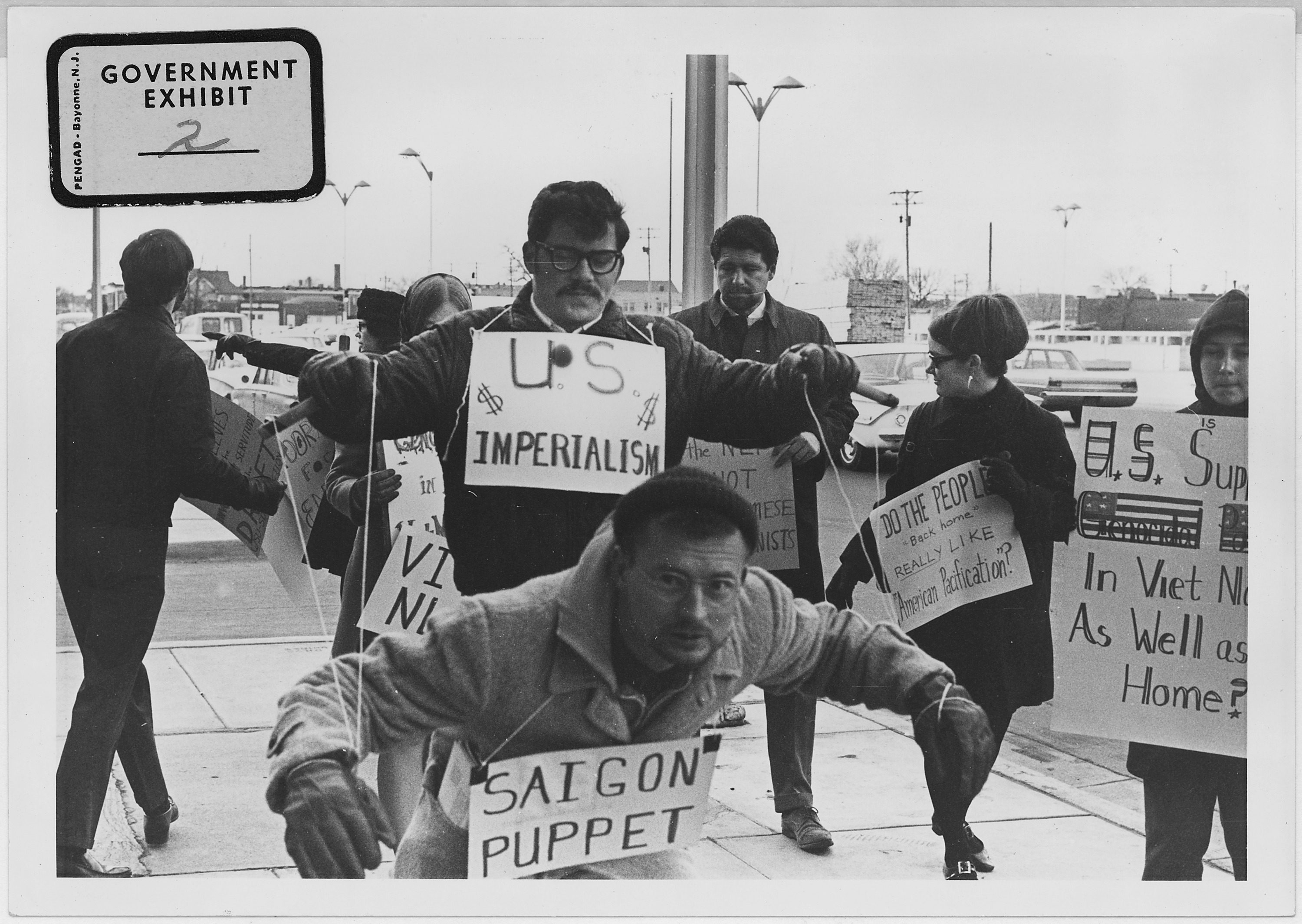
vietnam_war_protesters-_1967-_wichita_kans_-_nara_-_283625

Students in Kansas protest in 1967 against the Vietnam War (via Wikimedia Commons).

The report broadly details the general trends of how the “restless youth,” particularly university students, engaged in a range of anti-establishment activism such as university occupations, street marches, and sit-ins. The CIA report analyzes what issues caught the attention of students, whether they organized ad hoc or within existing organizations, how many students were attending universities, how they connected with other social groups, how they transnationally exchanged ideas, and what ideas inspired them to action. Overall, the report argues that many of the students turned to activism because of their frustration with the socioeconomic and political status quo and that they demanded more from their universities, communities, and governments.

The CIA report also notes that many students, mostly American and European, were inspired to protest by “Marxist social criticism” and the writings of C. Wright Mills, Frantz Fanon, and especially the American critical theorist and sociologist Herbert Marcuse. This Marxist social criticism, also known as Marxist or socialist humanism, stresses the importance of Karl Marx’s early writings and the need for a critical praxis directed against capitalism as well as against traditional Soviet or statist Marxism. Herbert Marcuse was a proponent of socialist humanism and significantly collaborated with the most well-known Marxist humanist philosophical movement of the time – Yugoslavia’s Praxis School.
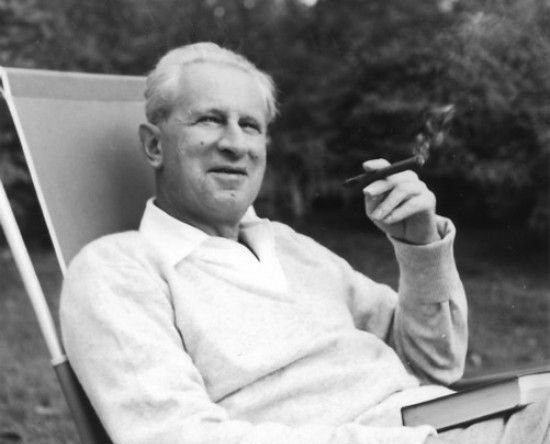
herbert_marcuse_in_newton_massachusetts_1955

Herbert Marcuse in 1955 (via Wikimedia Commons).

The members of Yugoslavia’s Praxis School were prominent professors in the Faculties of Philosophy at both the Zagreb and Belgrade universities who supported Yugoslavia’s protesting university students in 1968. The CIA report has an entire chapter dedicated to the student movement in Yugoslavia, yet, this eleven-page section oddly makes no mention of the Praxis School and the support its members gave to Yugoslavia’s protesting university students. The report clearly makes the connection between Herbert Marcuse, Marxist humanism, and student protests, but it fails to make the broader connection to the socialist humanist Praxis School of Yugoslavia and its affiliates who joined university students in protest in the summer of 1968.

How could the CIA have missed this? Although the authors considered student activism to be a growing threat and a “worldwide phenomenon” fueled in part by this particular philosophical discourse of socialist humanism, they didn’t seem to be interested in the leading socialist humanist movement of the time, despite its influence on students in Yugoslavia and beyond. The Yugoslav government, on the other hand, didn’t miss this connection and became extremely interested in the Praxis School. Although the movement wasn’t pro-capitalist or anti-socialist, the Yugoslav leadership still viewed it as a threat due to its criticism of the ruling party – the League of Communists of Yugoslavia – for not fulfilling its promises to create a more just socialist society. Similar views toward student protests were taken by the authorities in nearby countries: in Czechoslovakia during the Prague Spring and in Poland. The Czechoslovak government also monitored its growing student movement and produced its own report which noted the students’ criticism of Czechoslovak socialism.
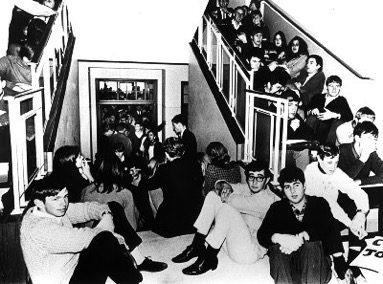
picture1

The student occupation of the University of Belgrade (via The Modern Historian).

Following the student occupation at Belgrade University in June 1968, the Yugoslav authorities quietly cracked down on dissenting students and professors. The main target was the leading cohort of the Praxis School, professors in the Faculty of Philosophy at Belgrade University. Slowly, but surely, eight professors from Belgrade – Mihailo Markovic, Ljubomir Tadic, Miladin Zivotic, Zagorka Golubovic, Dragoljub Micunovic, Nebojsa Popov, Triva Indjic, and Svetozar Stojanovic – were removed from their professorships at the university. The Yugoslav authorities claimed that the professors were the “ideological inspiration” and “practical organizers” of the student demonstrations and university occupation and as such needed to be stopped at all costs. They had become too influential and were improperly educating students with ideas that the Yugoslav socialist system of “self-management” was flawed. Aside from being sacked from their university positions the professors also lost financial support for their research and funding for their publication, the Praxis journal, was essentially cut. Although the Belgrade professors didn’t organize the protests, their Marxist humanism consciously or unconsciously provided the intellectual platform for students to criticize the Yugoslav system. The CIA was never able to put these pieces of the puzzle together and failed to capture this source of student discontent both at home and abroad.

bugburnt

CIA Report, “Restless Youth,” Intelligence File, National Security File, Box 3, LBJ Library.
Additional Sources:
Mihailo Marković and R. S. Cohen, Yugoslavia: The Rise and Fall of Socialist Humanism: A History of the Praxis Group. (2005)Paulina Bren, “1968 East and West: Visions of Political Change and Student Protest from across the Iron Curtain,” in Transnational moments of change: Europe 1945, 1968, 1989, P. Kenney and G. Horn, eds. (2004)

bugburnt
You may also like:

Andrew Weiss reviews a book about student protests in 1968 Mexico: Plaza of Sacrifices: Gender, Power, and Terror in 1968 Mexico by Elaine Carey (2005) .
Nancy Bui discusses the 50th Anniversary of the Vietnam War from a Vietnamese American Perspective.
Mark Lawrence looks at an earlier CIA Study: “Consequences to the US of Communist Domination of Mainland Southeast Asia,” from October 13, 1950.
bugburnt

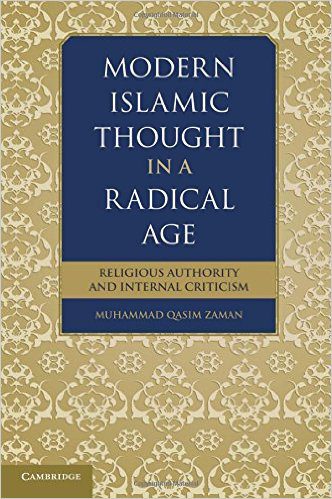
Modern Islamic Thought in a Radical Age, by Muhammad Qasim Zaman (2012)

by David Rahimi

coverStarting with the encounter with European colonialism and modernity in the eighteenth century, Muslims increasingly began to worry that Islam was beset by existential crises as Muslim countries slowly fell under colonial domination. Some thought Islam had stagnated and made Muslims weak; others said true Islam already had the answers to modernity. Consequently, many prominent Muslim intellectuals from the Middle East and South East Asia, like Rashid Rida, Shah Wali Allah, Muhammad Iqbal, ‘Ubayd Allah Sindhi, and Jamal al-Din al-Afghani, insisted over the course of the next two centuries that Islam must in some way rediscover, renew, or reform itself to address the challenges of a changing world. This, of course, raised a host of questions. What needed to be reformed? How should reform be enacted? Who or what had the authority to decide such matters? Were these crises even real?

800px-miqbal4

Muhammad Iqbal was knighted in 1922, by King George V (via Wikimedia Commons)

Muhammad Qasim Zaman takes these concerns as his starting point to examine Muslim contestations of religious authority and “evolving conceptions of [Sunni] Islam” from the nineteenth century to the present day.” At its core, this is a story of inconclusive debates, ambiguity, and cyclical tension as old wounds reopen and close, as lay and traditional religious scholars (the ‘ulama) contest how Islam should be understood and lived. By tracing the contextualized debates of the modern ‘ulama in a comparative, transnational framework, Zaman shows the multifaceted dimensions of internal debate and how this fosters ongoing fragmentation of religious authority in Islam, despite efforts to the contrary. Disposing with an overall chronology or single narrative, Zaman divides his book into the following key thematic issues: religious consensus, ijtihad (i.e. independent analogical reasoning), the common good, religious education, the place of women in law and society, socioeconomic justice, and violence. The problems surrounding these issues have continuously resurfaced within Muslim intellectual and religious circles since the nineteenth century. What links these hot-button, yet seemingly disparate, topics together are the fundamental issues of religious authority, that “aspiration, effort, and ability to shape people’s belief and practice on recognizably ‘religious’ grounds,” and internal criticism among Muslims. Each chapter topic, then, serves as a vehicle through which to explore the interplay between authority and criticism, and what the consequences and implications are for Islamic thinkers and Muslims more broadly.

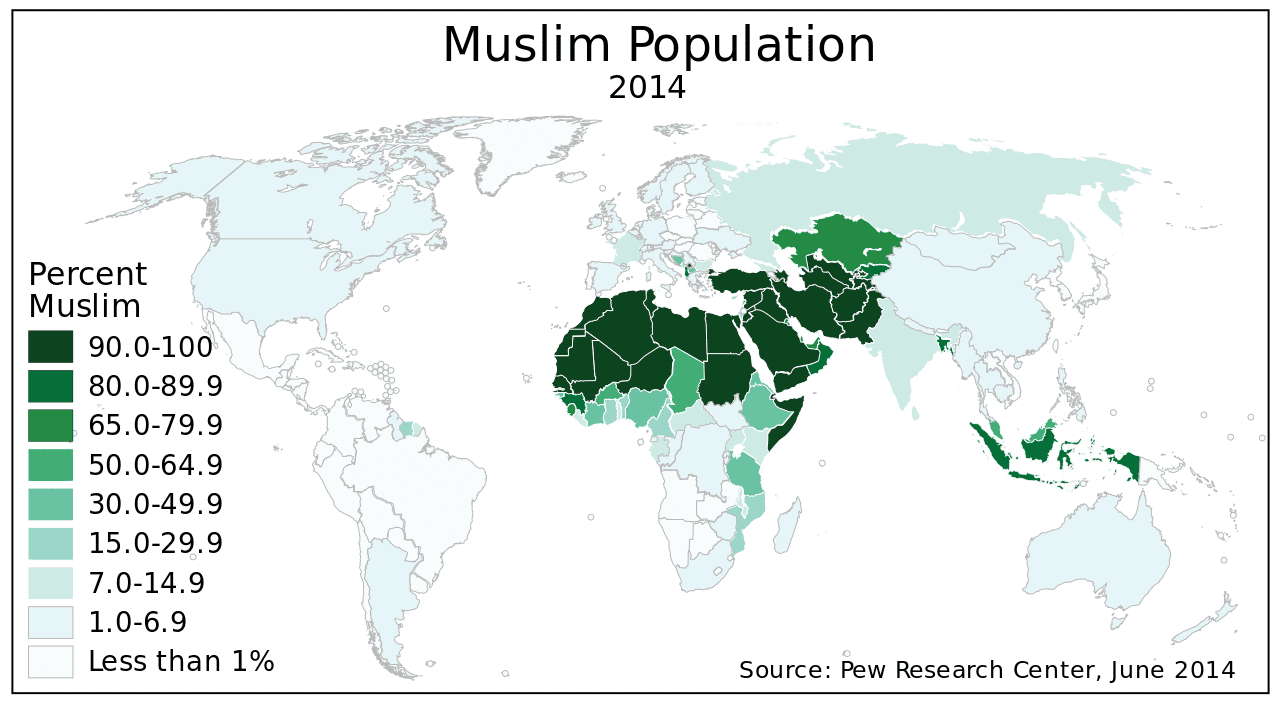
muslim_percent_population_v2-svg

Countries with Muslim-majority populations (via Wikimedia Commons).

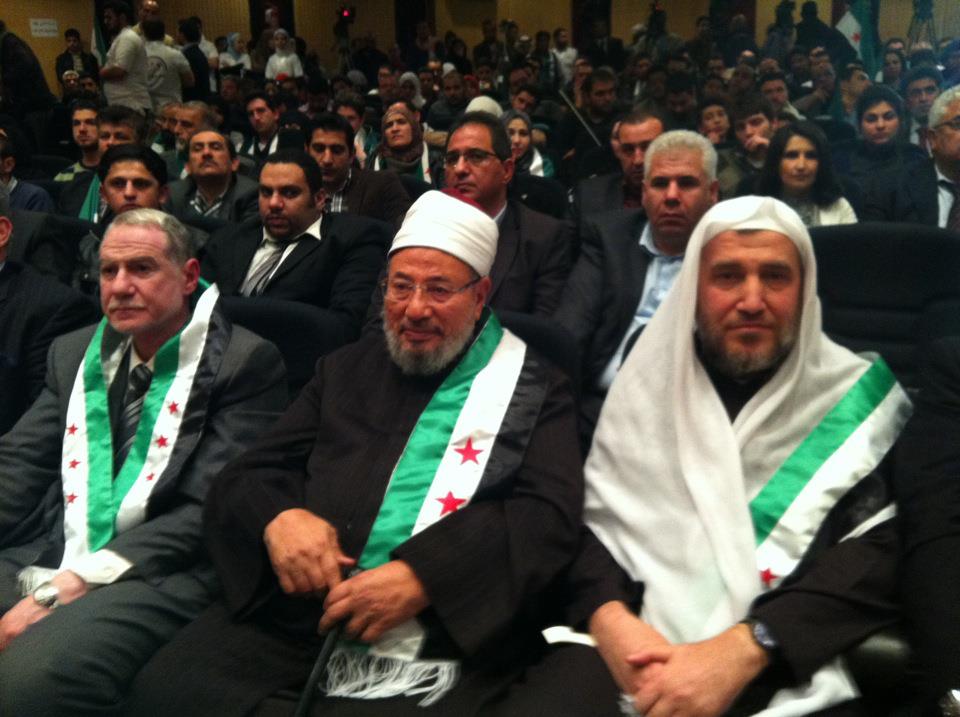
The real world consequences of this battle over religious authority through internal criticism come across strongly in the chapter on violence. For example, the moderate Yusuf al-Qaradawi, the head of the European Council for Fatwa and Research (ECFR), wrote in his 2008 magnum opus Jurisprudence of Jihad that jihad was only permissible in cases of defense. Zaman shows, however, that this opinion does not align with the majority of classical Islamic jurisprudence, to which Qaradawi claims to faithfully adhere. Furthermore, another prominent moderate, Taqi ‘Uthmani of the Pakistani branch of the Deobandi school, had previously rejected purely defensive jihad in the 1970s and 1980s. In 2009, ‘Uthmani reaffirmed this theory of offensive jihad, adding that it only applied, however, to “formal” Islamic states and not to individuals. This disagreement about jihad conveys Zaman’s central point that is replicated across the other chapters as well. The ‘ulama are active in articulating their views, but who or what holds ultimate authority to resolve these religious problems remains unclear, since even the theory of authoritative scholarly consensus is hotly contested. Ultimately, Zaman argues that greater attention must be given to religious authority as a relational concept, formed by the specificities of the context in which this authority is performed. Abstract authority not only comes into tension with authority as it is practiced in real life, but historical circumstances and individual beliefs shape how Muslims respond to or recognize religious authority. The ECFR, founded in 1997, exemplifies this tension, since on the one hand, it seeks to create a new authoritative consensus around a particular set of ‘ulama, yet on the other hand, it claims not to compete with the authority of the many non-affiliated ‘ulama. The unsettled nature of these debates, Zaman insists, results in an “authority deficit” and persistent fragmentation within Muslim intellectual and religious circles.

qaradawi_wih_free_syria_flag

Yusuf al-Qaradawi (center) in 2013 (via Wikimedia Commons).

Modern Islamic Thought in a Radical Age is a work of tremendous insight and compelling vignettes. The weakest portions are its introduction and conclusion, which both tend to be verbose and slightly disorganized. It is also unclear at moments whether the author intends to offer a strong overarching argument or to merely “open a new window onto the Muslim religious and public sphere” – one that forefronts debates among the ‘ulama. Thankfully, these are minor problems. While not meant for readers looking for an introduction to Islam, those hoping for a meticulously researched study of the internal religious dynamics of Sunni Islamic thought will find their expectations well met.

Muhammad Qasim Zaman, Modern Islamic Thought in a Radical Age: Religious Authority and Internal Criticism (New York: Cambridge University Press, 2012).
bugburnt

You may also like:
Listen to 15 Minute History Episode 58: Islam’s First Civil War 
See our suggestions for Great Books on Islam in American Politics & History
Lior Sternfeld recommends Making Islam Democratic: Social Movements and the Post-Islamist Turn by Asef Bayat (2007)
bugburnt

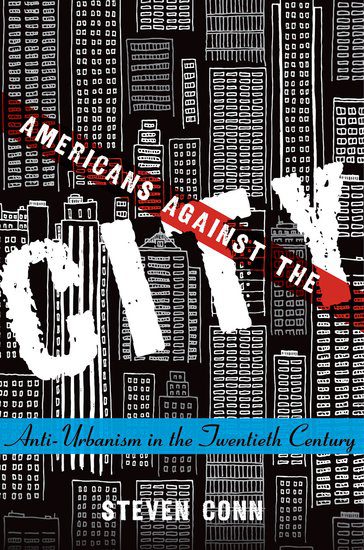
Americans Against the City, By Stephen Conn (2014)

By Emily Whalen

“Have you ever lived in the suburbs?” New York City Mayor Ed Koch asked in a 1982 interview for Playboy magazine. The interviewer had asked the famously witty Koch if he would ever consider a gubernatorial campaign for the state—if Koch won the race, it would mean a move away from the Big Apple and to the governor’s mansion in semi-rural Albany. “It’s sterile,” Koch continued, “It’s nothing. It’s wasting your life, and people do not wish to waste their lives once they’ve seen New York!”

conn-cover

Koch’s bluntness likely closed the door to a potential governorship, despite his popularity among urban constituents. During Koch’s long tenure as mayor (1978-1989) most Americans harbored distinctly anti-urban attitudes, preferring the serenity and monotony of suburban life over the clamor and chaos of the “greatest city in the world.” In fact, as Stephen Conn argues in Americans Against the City, the story of American anti-urbanism—a generalized distaste for the dirt, diversity, and disarray of the city—stretches across the nation’s history. According to Conn, since the end of the Civil War, the American political and physical landscapes have been deeply interrelated. Where and how we live shapes our political attitudes and expectations. Focusing on the material, social, and cultural elements of living habits inside and outside the city, Conn argues that the anti-urban strain in American culture—manifest in the growth of suburbs and decentralized cities—relates directly to a mistrust of centralized government. Progressives in the 1920s saw the dense cities of the Northeast as workshops where the problems of governance could be perfected. Yet by the end of the Second World War, that optimism had faded. Cold Warriors and their successors on both ends of the political spectrum tried to reclaim their independence from big government by rejecting urban life. Conn links the decline of “urbanity” (a sense of collective responsibility and tolerance) in modern politics to this national decentralization—the “hustle and bustle” of a true city provides “lessons in civility and diversity” that once enriched our political process. As Americans fled to suburbs, urbanity—and civility—plummeted.

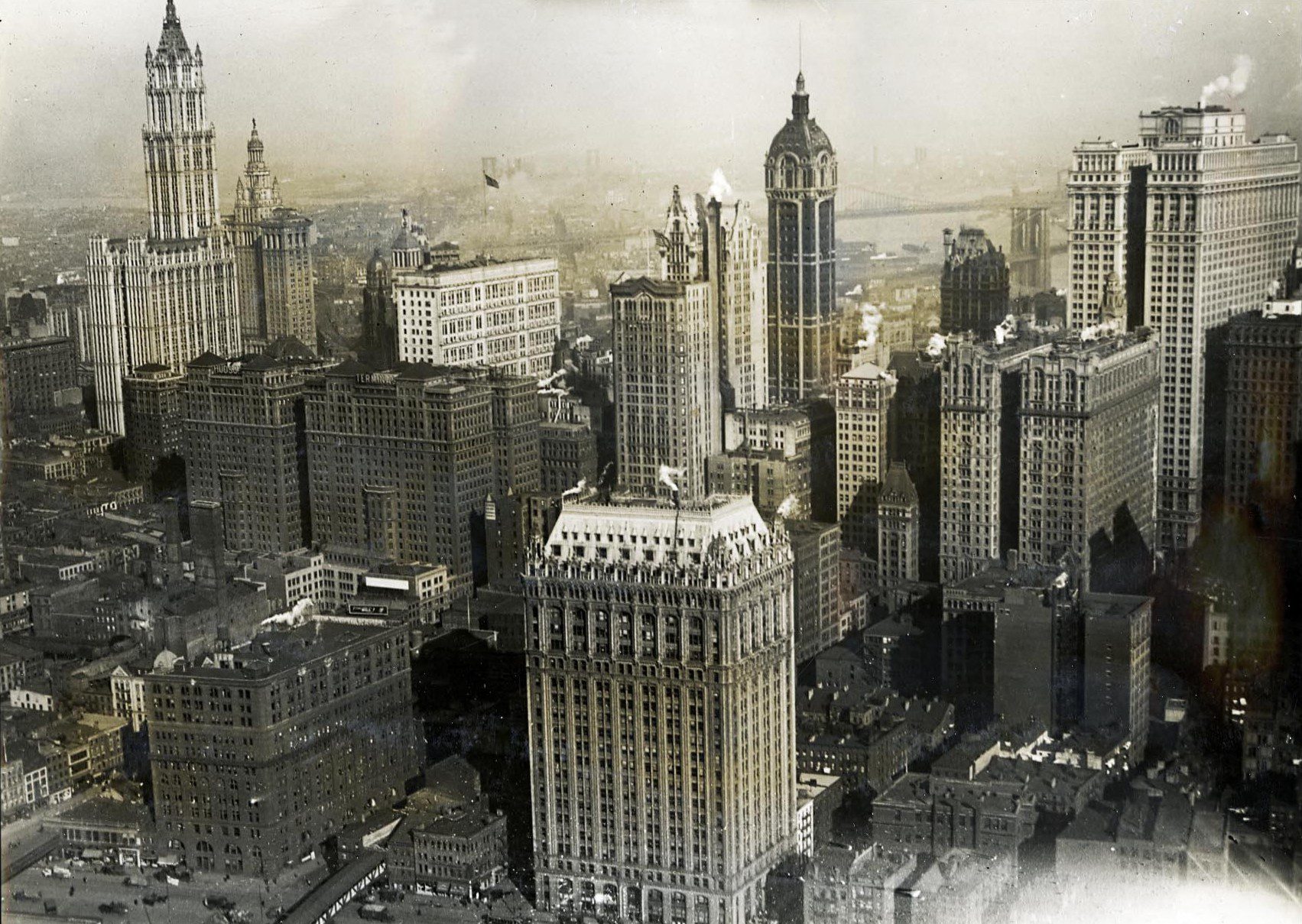
new_york_city_aerial_view_1919
New York City in 1919 epitomized the benefits and problems of urban life (via Wikimedia Commons).

Beginning with Frederick Jackson Turner (whose 1893 essay “The Significance of the Frontier in American History,” Conn describes as “a Mid-Westerner’s revenge on…an overbearing East Coast.”), Americans have been skeptical of cities. Conn examines how a sense of exceptionalism convinced many Southerners and Westerners in the late 19th century that urban centers like New York City and Chicago posed a threat to American values, like ruggedness, self-sufficiency, and independence. Furthermore,  city-dwellers at the turn of the century faced real problems, such as unsanitary living conditions, corrupt political machines, and overcrowding. Yet the solutions that urban-skeptical reformers offered didn’t address these issues; instead, most of these projects aimed to push people out of cities. The problems of the city, according to people like Benton MacKaye, arose from the density and variation of urban life and would not follow Americans into nature. MacKay designed the Appalachian Trail, the 2,200-mile hiking trail extending from Maine to Georgia, in 1921 in the hopes that city-dwellers would follow it out of the urbanized Northeast and, after finding a more wholesome existence, never return.

appalachian_trail_heading_to_double_springs_gap_from_clingmans_dome
The Appalachian Trail (via Wikimedia Commons).

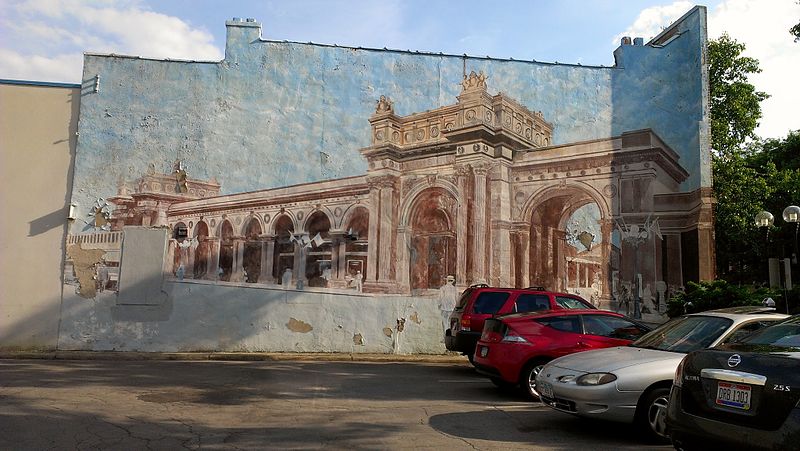
As suburbs proliferated across the nation, Conn argues, they sustained “decentralized cities,” where whites and other privileged groups left urban centers at the end of the work day and returned to homogenous housing developments. “Most suburbs,” Conn explains, rather than developing a unique culture, “functioned to reject the city while simultaneously taking advantage of it.” Decentralized cities like Albuquerque, NM relied on federal government spending for growth, largely for maintaining and constructing roads, despite the anti-government attitudes of their citizens. Other decentralized cities in the Midwest, like Columbus, OH, embarked on “urban renewal” schemes in which the living history of the city fell victim to commercial development. In 1979, city leaders demolished Columbus’s historic train station to make way for a convention center and parking lot. “Beyond expressing their contempt for trains,” Conn argues, “those who ordered the building torn down expressed their contempt for Columbus’s past.” Dismissing the benefits of city dwelling, and the importance of a city’s history, anti-urban sentiments poisoned most urban renewal schemes of the late 19th century.

800px-union_station_mural_by_gregory_ackers_columbus_ohio_1987
This 1987 mural by Gregory Ackers depicts Columbus’ historic Union Station. In 2014, new construction on the lot blocked the mural from public view (via Wikimedia Commons).

Conn looks at many cities across the country in his history of anti-urbanism, including a place familiar to Texans: Houston. Houston city leaders refused to accept federal zoning requirements throughout the 20th century, even when it meant passing on attractive funding opportunities that would enrich public governance and culture. During the Cold War, Houston’s elite saw nefarious designs behind the push for federal zoning laws.  “Zoning was part of a transitive property that led straight to Moscow: zoning = planning = government interference = Stalinism,” Conn relates. Affluent, white residents believed that the free market, not public regulation, would solve Houston’s successive housing crises. Yet, because housing areas were largely segregated by color, privileged Houstonites ignored the problems their poor and marginalized neighbors faced, all while undermining public programs designed to improve general welfare. The elites “simply could not acknowledge that the ‘market’ does not function the same way for all Americans.”

Houston also serves as an example of how modern “gated communities” attempt–and fail–to cultivate the vibrant urbanity lacking in decentralized cities. Communities, Conn demonstrates, are just as much about exclusion as inclusion, and the gated oases of suburbia represent  “exactly the opposite of city life.” The gated communities suggest “a society where social ties have frayed, where we simply do not trust each other and do not even want to make the attempt.” That exclusion—in Houston, as in Greenwich, CT—often follows racial and socioeconomic lines.

aerial_indian_creek_near_dallas_6039814731
Sprawling suburbs, like Indian Creek outside of Dallas, characterize many cities of the American Southwest (via Wikimedia Commons).

Americans Against the City pays close attention to both liberal and conservative anti-urbanism throughout the 19th and 20th centuries. Conn describes the “hippie” communes and environmental movements of the 1970s as “essentially different versions of white flight” from urban issues. Yet toward the end of the book, Martin Anderson (one of President Reagan’s most important economic advisors) and the New Right bear the brunt of Conn’s criticism. These men largely promoted policies based on the idea that the market is more democratic than public government, while simultaneously benefitting from federal access and funding. Fighting against public spending on services and entitlements, Anderson helped entrench the now-prevalent idea that the government has no “role to play in promoting the general welfare, except as it enhances private wealth.”

Americans Against The City stands as a well-researched and provocative history of the ideas and politics rooted in our physical environment.  Conn’s easy writing style and fascinating evidence make the book a pleasure to read. His conclusions resonate with the contemporary moment and offer a new explanation for the fraying political consensus. Suburbs, Conn explains, disconnect us from our geography–disassociating our work lives from our personal lives, our futures from our histories. As a result, although Americans are more mobile than ever, we feel detached from our political geography. This disruption lies at the heart of a creeping polarization in our political discourse, canceling out opportunities for compromise and eroding a sense of collective responsibility. The values of democratic government, Conn reminds us, arose from urban milieux. It remains to be seen whether they will survive in the suburbs.


Read more by Emily Whalen on Not Even Past:
Historical Perspectives on Michael Bay’s 13 Hours: The Secret Soldiers of Benghazi (2016)
Killing a King, by Dan Ephron (2015)
Digital Teaching: Talking in Class? Yes, Please!

US Survey Course: Vietnam War

During the summer of 2016, we will be bringing together our previously published articles, book reviews, and podcasts on key themes and periods in the history of the USA. Each grouping is designed to correspond to the core areas of the US History Survey Courses taken by undergraduate students at the University of Texas at Austin.

bugburnt

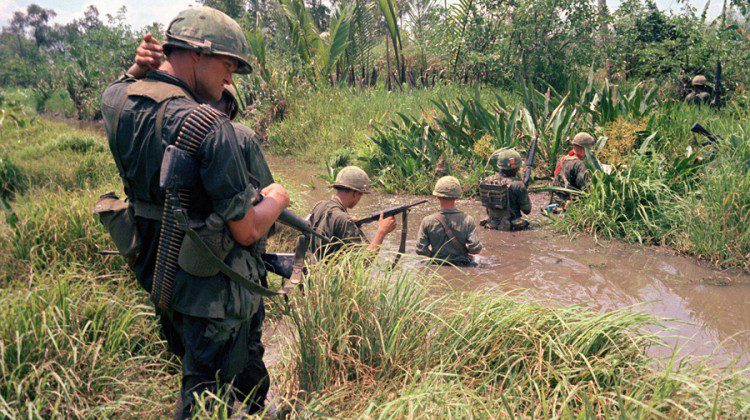
Vietnam War main image

On November 12, 2015, Not Even Past and the the Institute for Historical Studies at UT Austin sponsored a roundtable to discuss the Lessons and Legacies of the War in Vietnam. During that month, Not Even Past published a series of articles to mark the fiftieth anniversary of the end of the Vietnam War.

We start with Mark A. Lawrence’s feature article: The War in Vietnam Revisited.

Next, Nancy Bui, the founder and President of the Vietnamese American Heritage Foundation considers the Vietnam War from a Vietnamese American Perspective.

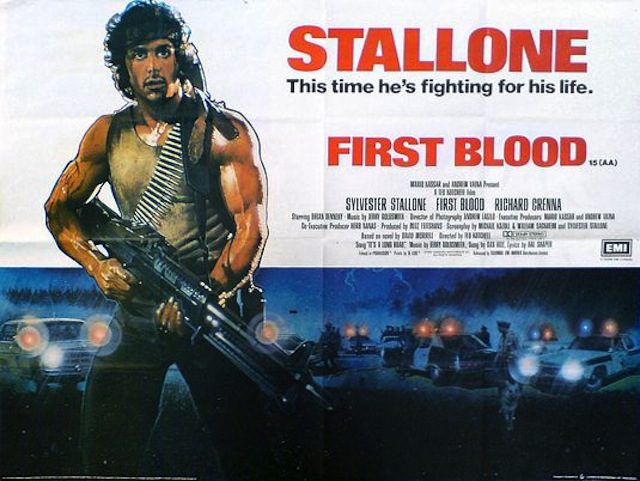
And Janet Davis shares a short meditation on cultural memory and the Vietnam War in two popular films: First Blood and Jaws

First-Blood-film-poster.-Via-Wikipedia1

bugburnt

Over the years, Not Even Past has published a number of articles on the War in Vietnam by Mark Atwood Lawrence. This rich body of material covers wide range of topics and case studies giving our readers a chance to consider the War from a number of different angles:

LBJ and Vietnam: A Conversation

The Prisoner of Events in Vietnam

Changing Course in Vietnam — or Not

CIA Study: “Consequences to the US of Communist Domination of Mainland Southeast Asia,” October 13, 1950

The Lessons of History? Debating the Vietnam and Iraq Wars

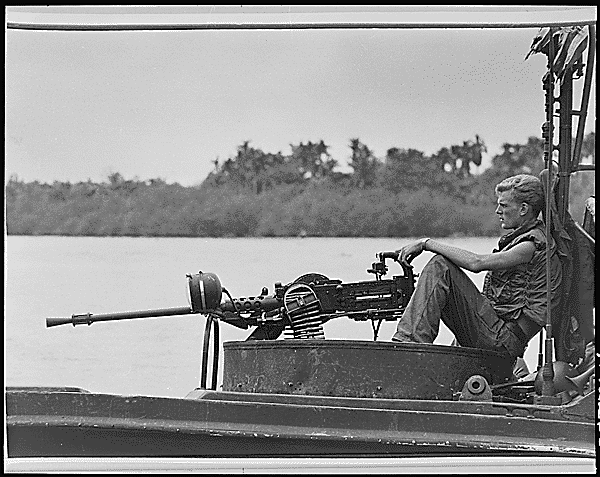
US_river_patrol_boat_in_Vietnam_0

bugburnt

Others have considered the War in Vietnam in relation to broader topics:

Peniel Joseph explains how Muhammad Ali helped make black power into a global brand

Deirdre Smith shares some research on Vietnam between the United States and Yugoslavia.

And, Michael J. Kramer discusses on representing LBJ and power through the medium of dance in The Seldoms Bring LBJ and the 1960s Into the Present in Their Investigation of How Power Goes.

Recommended Reading:

vietnam-books

Mark A. Lawrence shares a list of Must Read Books on the Vietnam War

Jack Loveridge recommends Fear and Loathing on the Campaign Trail ’72, by Hunter S. Thompson (1972)

Clay Katsky suggests Kissinger’s Shadow, by Greg Grandin (Metropolitan Books, 2015)

And finally, Mark A. Lawrence shares a list of books on International History and the Global United States including his edited collection The Vietnam War: An International History in Documents (Oxford University Press, 2014).

15 Minute History:

America and the Beginnings of the Cold War

Potsdam_conference_1945-8-150x150

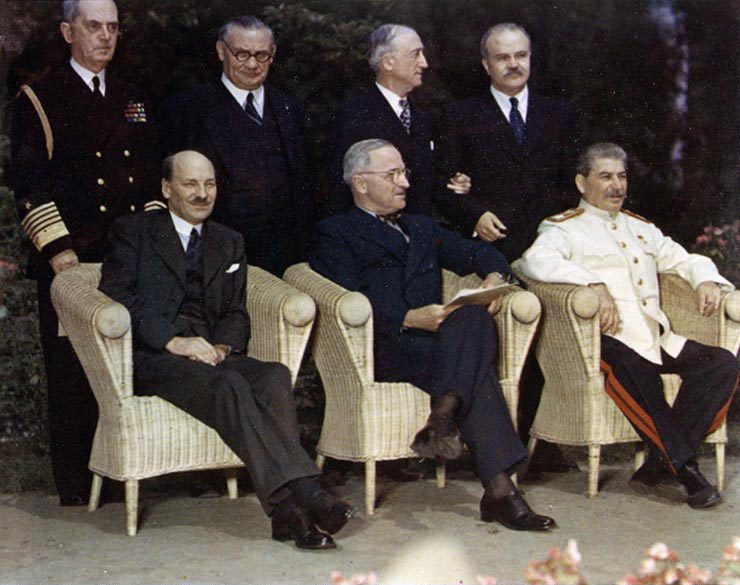
The Cold War dominated international politics for four and a half decades from 1945-1989, and was defined by a rivalry between the United States and the Soviet Union that threatened—literally—to destroy the world. How did two nations that had been allies during World War II turn on each other so completely? And how did the United States, which had been only a marginal player in world politics before the war, come to view itself as a superpower?

In this episode, historian Jeremi Suri discusses the beginnings of the Cold War (1945-1989) its origins in the “unfinished business” of World War II, the role of the development of atomic weapons and espionage, and the ways that it changed the United States in just five short years between 1945 and 1950.

The US and Decolonization after World War II

William_Orpen_–_The_Signing_of_Peace_in_the_Hall_of_Mirrors_Versailles_1919_Ausschnitt-150x150

Following World War II, a large part of the world was in the hands of European powers, established as colonies in the previous centuries. As one of the nations that came out on top of the geo-political situation, the United States was looked to with hope by aspiring nationalist movements, but also seen as a potential source by European allies in the war as a potential supporter of the move to restore the tarnished empires to their former glory. What’s a newly emerged world power to do?

Guest R. Joseph Parrott takes a look at the indecisive position the United States took on decolonization after helping liberate Europe from the threat of enslavement to fascism.

bugburnt

US Survey Course: Cold War

During the summer of 2016, we will be bringing together our previously published articles, book reviews, and podcasts on key themes and periods in the history of the USA. Each grouping is designed to correspond to the core areas of the US History Survey Courses taken by undergraduate students at the University of Texas at Austin.

bugburnt

Feratures copy

We start with two posts by Mark Atwood Lawrence on messages sent by George F. Kennan, a senior U.S. diplomat based in Moscow, and Nikolai Vasilovich Novikov, the Soviet ambassador in Washington, outlining their views on the intention of each nation in 1946. These sources and much more come from one of our featured books, America in the World: A History in Documents from the War with Spain to the War on Terror.

As the US and Soviet Union gathered information on each other, spies and bugs became key, as Brian Selman shows in his article on the bug problem at the US embassy in Moscow: Call Pest Control.

During World War II the United States shipped an enormous amount of aid to the Soviet Union through the Lend-Lease program, a program the Russians minimized and the West exaggerated during the Cold War. This is discussed on NEP by Charters Wynn. And here is a video to accompany the piece.

Cali Slair examines documents pertaining to the global attempts to eradicate Smallpox, and highlights the stockpiling of the virus by the US and Soviet Union during Cold War.

In the US, there were fears that hybrid corn would sow the seeds of Communism in the United States, as Josephine Hill reveals in her discussion of the cartoonist Daniel Robert Fitzpatrick.

Charlotte Canning traces the diplomatic role played by US theatre during the first half of the twentieth century.

Mary C. Neuburger discusses the history of US tobacco company’s importing cigarettes into the Eastern Bloc during the Cold War and her book Balkan Smoke: Tobacco and the Making of Modern Bulgaria.

“Before 1948, the Cold War was largely confined to Europe and the Middle East, areas that both U.S. and Soviet leaders considered vital to their nations’ core foreign policy objectives after the Second World War. By 1950, however, the Cold War had spread to Asia.” Mark Atwood Lawrence explains in his article CIA Study: “Consequences to the US of Communist Domination of Mainland Southeast Asia,” October 13, 1950

R. Joseph Parrott takes us to Cold War Mozambique and connections between Eduardo Mondlane, the first president of the Mozambique Liberation Front (Frente de Libertação de Moçambique or FRELIMO) and the US.

And, he looks back at America’s Pro-Apartheid Cold War Past.

Finally, Andrew Straw shares the story of his mother’s trip to Moscow in preparation for the 1980s Olympics.

bugburnt

From the LBJ Archives:

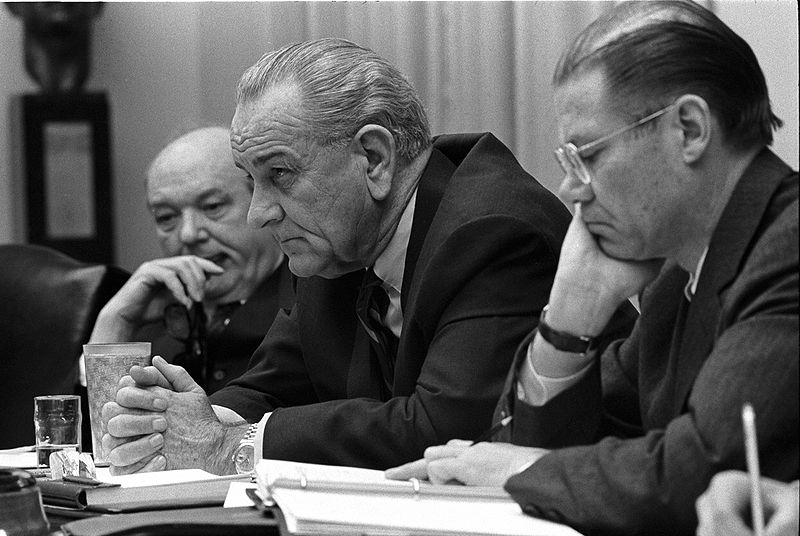
800px-Dean_Rusk_Lyndon_B._Johnson_and_Robert_McNamara_in_Cabinet_Room_meeting_February_1968

Jonathan C. Brown discusses a rare phone call between Lyndon Baines Johnson and Panamanian President Roberto F. Chiari.

Elizabeth Fullerton discovers documents pertaining to the mysterious destruction of a US aircraft in Turkey in 1965 held in the Papers of Lyndon Baines Johnson.

And, Deirdre Smith examines documents that give a first-hand impression of the nature and texture of relations between the United States and Yugoslavia as it proceeded through the 1960s.

bugburnt

On 15 Minute History:

America and the Beginnings of the Cold War

Potsdam_conference_1945-8

The Cold War dominated international politics for four and a half decades from 1945-1989, and was defined by a rivalry between the United States and the Soviet Union that threatened—literally—to destroy the world. How did two nations that had been allies during World War II turn on each other so completely? And how did the United States, which had been only a marginal player in world politics before the war, come to view itself as a superpower?

In this episode, historian Jeremi Suri discusses the beginnings of the Cold War (1945-1989) its origins in the “unfinished business” of World War II, the role of the development of atomic weapons and espionage, and the ways that it changed the United States in just five short years between 1945 and 1950.
Operation Intercept

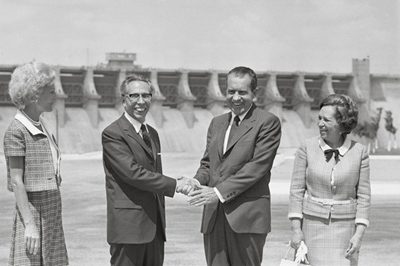
Original Caption: President Richard Nixon and Mexico's President Gustavo Diaz Ordaz shake hands at a ceremony on the Mexico side of the Rio Grande River 9/8 near Del Rio after they dedicated the Amistad Dam, in background.

At 2:30 pm on Saturday September 21 1969, US president Richard Nixon announced ‘the largest peacetime search and seizure operation in history.’ Intended to stem the flow of marijuana into the United States from Mexico, the three-week operation resulted in a near shut down of all traffic across the border and was later referred to by Mexico’s foreign minister as the lowest point in his career.

Guest James Martin from UT’s Department of History describes the motivations for President Nixon’s historic unilateral reaction and how it affected both Americans as well as our ally across the southern border.

Energy Crisis of the 1970s

FLAG_POLICY_DURING_THE_1973_oil_crisis

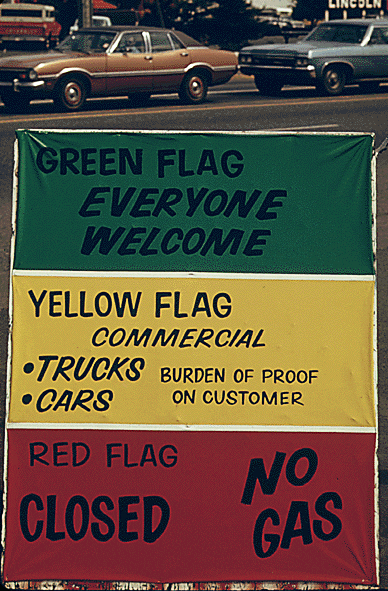
Most Americans probably associate the 1973 oil crisis with long lines at their neighborhood gas stations, but those lines were caused by a complex patchwork of international relationships and negotiations that stretched around the globe.

Guest Chris Dietrich explains the origins of the energy crisis and the ways it shifted international relations in its wake.


bugburnt

Recommended Reading and Films:

At home:

Lav copy

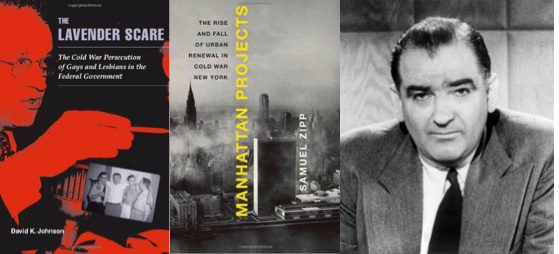
R. Joseph Parrott recommends The Lavender Scare: The Cold War Persecution of Gays and Lesbians in the Federal Government, by David K. Johnson (University of Chicago Press, 2006).

Kyle Shelton reviews, Manhattan Projects: The Rise and Fall of Urban Renewal in Cold War New York, by Samuel Zipp (Oxford University Press, 2010).

And, Dolph Briscoe IV recommends Clint Eastwood’s J. Edgar (2011)

Cold War Politics on the International Stage:

diplomatic copy

Yana Skorobogatov reviews The Atomic Bomb and the Origins of the Cold War, by Campbell Craig and Sergey Radchenko (Yale University Press, 2008)

David A. Conrad suggests Racing the Enemy: Stalin, Truman, and the Surrender of Japan, by Tsuyoshi Hasegawa (Belknap Press, 2006)

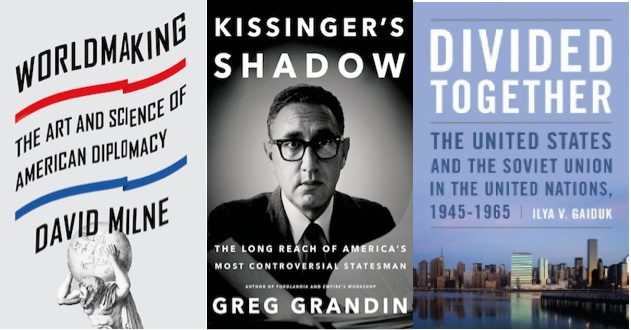
Michelle Reeves recommends Divided Together: The United States and the Soviet Union in the United Nations, 1945-1965, by Ilya Gaiduk (Stanford University Press, 2013) and For the Soul of Mankind: The United States, the Soviet Union, and the Cold War by Melvyn P. Leffler (Hill and Wang, 2008).

Clay Katsky recommends Kissinger’s Shadow, by Greg Grandin (Metropolitan Books, 2015)

If you are interested in US diplomacy during the Cold War see Mark Battjes‘s review of Worldmaking: The Art and Science of American Diplomacy, by David Milne (Macmillan, 2015).

For a gripping history of the Cold War’s final years Jonathan Hunt recommends The Dead Hand: The Untold Story of the Cold War Arms Race and Its Dangerous Legacy, by David E. Hoffman (Anchor, 2009).

R. Joseph Parrott reviews The Rebellion of Ronald Reagan: A History of the End of the Cold War, by James Mann (Penguin, 2010)

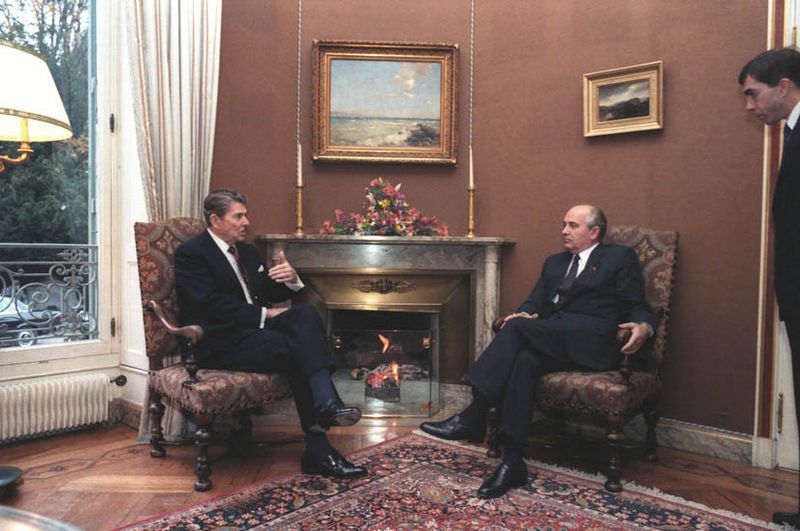
800px-Gorbachev_and_Reagan_1985-4

President Reagan meeting with Soviet General Secretary Gorbachev for the first time during the Geneva Summit in Switzerland, 1985 (Image courtesy of Wikimedia Commons)

Cold War around the World:

Cold War World copy

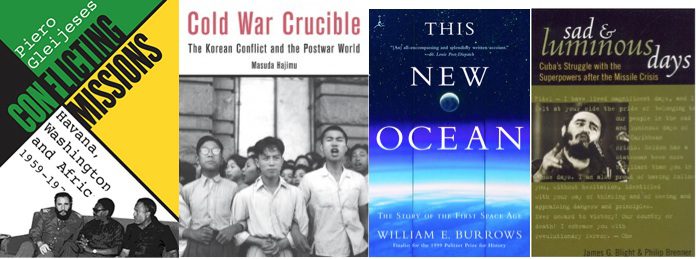
Kazushi Minami suggests Cold War Crucible: The Korean Conflict and the Postwar World, by Hajimu Masuda (Harvard University Press, 2015)

Michelle Reeves discusses Hal Brands’ argument about US influence in Cold War Latin America (Cambridge University Press, 2010).

Aragorn Storm Miller recommends Sad and Luminous Days: Cuba’s Struggle with the Superpowers after the Missile Crisis, by James G. Blight & Philip Brenner (Rowman and Littlefield, 2002).

Yana Skorobogatov on Conflicting Missions: Havana, Washington, and Africa, 1959-1976, by Piero Gleijeses (University of North Carolina Press, 2002)

Toyin Falola shares some Great Books on Africa and the U.S, including Thomas Borstelmann, Apartheid’s Reluctant Uncle: The United States and Southern Africa in the Early Cold War (Oxford University Press, 1993).

And finally, John Lisle takes us even further afield, into space, in his review of This New Ocean: The Story of the First Space Age, by William Burrows (Random House, 1998).

bugburnt

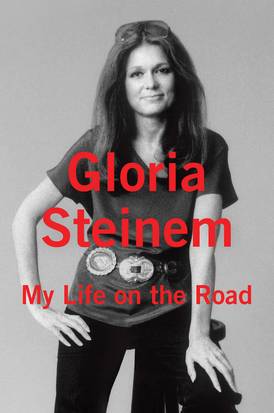
My Life on the Road, by Gloria Steinem (2015)

By Megan Seaholm

Gloria Steinem’s eighth book is part feminist memoir, part autobiography of personal growth and change, part invocation to the adventure of living in the present, and part story book. Her style is relaxed and conversational but never random or sloppy. She presents four purposes of the book in the Introduction, but I found two recurring themes: the joy of serendipitous discovery while traveling to new places and the value of listening, the power of groups talking and listening, that she learned from the talking circles while in India.

steinem

The life on-the-road theme begins as she recalls that until she was ten years old her family spent most of each year travelling around the country as her father bought and sold antiques. Though she longed for a “real home” when she was a child, she is grateful for her father’s “faith in a friendly universe” and credits him with her tolerance for a life of relative insecurity. She writes with sadness about her lonely mother who worked as a journalist before she married. This migrant life ended when her parents divorced and she lived in Toledo with her clinically depressed mother. She went to Smith College on a scholarship—Government major, Phi Beta Kappa—and, then, spent two years in India on a fellowship. She studied at the University of Delhi and spent several months with a Gandhi-inspired group who walked from village to village after terrifying caste riots in east India. The walking group invited villagers to meet with them, and with each other, to share their grievances and to provide reassurance after the riots. She credits this experience with teaching her the value of listening and the amazing things that happen when people share with each other in groups.

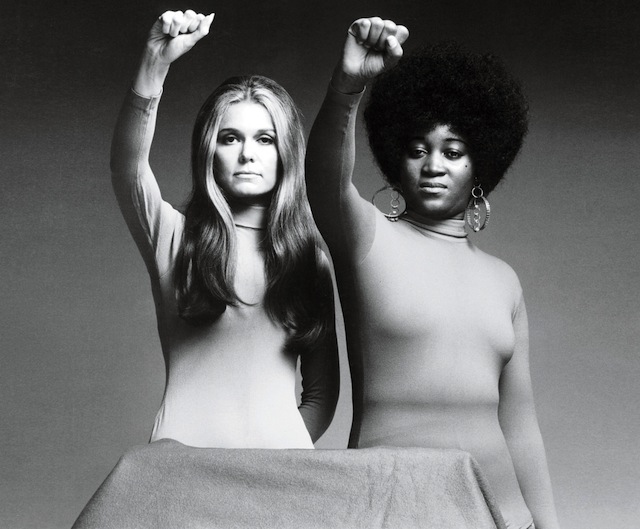
Gloria Steinem and Dorothy Pitman Hughes, circa 1970. Photograph by Dan Wynn.
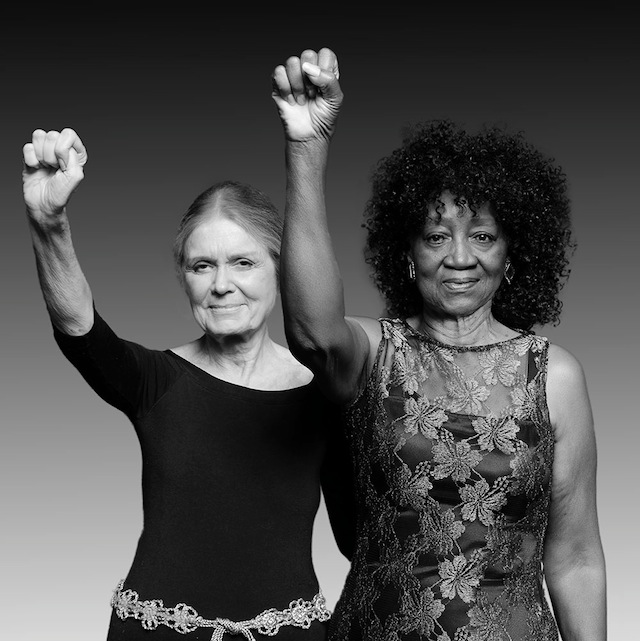
Gloria Steinem and Dorothy Pitman Hughes, circa 1972. Photograph by Dan Wynn.

She returned to the U.S. to work as a free-lance journalist and an avid participant in political campaigns, the first being the 1952 Adlai Stevenson campaign for president. She became aware of the women’s rights-women’s liberation movement in the 1960s. In 1971, after New York Magazine published her article “After Black Power, Women’s Liberation,” she began to receive invitations to speak about feminism. Terrified of public speaking, she enlisted the help of her friend Dorothy Pitman. As a bi-racial team, they spoke at community centers, in union halls, and school gyms. As Steinem gained skill and confidence, this duo was soon traveling to college campuses, to meetings of the National Welfare Rights Organization, to speak with United Farm Workers chapters, lesbian groups, and antiwar activists. Steinem saw her job as helping the audiences become “one big talking circle” — there was always discussion after she and Pitman made their presentations. Later, she would work and travel with the inimitable Florynce (Flo) Kennedy.

Most of the stories that Steinem shares are stories from the road as she became “a public speaker and a gatherer of groups” and one of the best-known feminists in the U.S. She refers to these campus speaking engagements as the “largest slice of my traveling pie.” One of her best stories is about the often-tense 1977 National Women’s Conference in Houston. This account features Bella Abzug, co-founder of Women Strike for Peace in 1961, three-term Congresswoman from New York, and tireless activist. Abzug, Congresswomen Shirley Chisholm and Patsy Mink asked Steinem to help them organize the National Women’s Political Caucus, which they did in 1971 with a diverse group of notable women. There are other stories from the feminist trenches, but this book is only part feminist memoir. There is a curious and very fun chapter titled “Surrealism in Everyday Life,” and there is a chapter about her time in “Indian Country” by which she means her relationships with Native Americans, including Wilma Mankiller, deputy chief of the Cherokee Nation. Speaking of “Indian Country,” I was troubled when she confidently asserted the popular, but erroneous, notion that that the U.S. Constitution was modeled on the Iroquois Confederacy.

Steinem shares these stories in the most-unassuming way as if you were a long-time friends visiting over a cup of coffee after having not seen each other for a while. She talks (writes) about covering Eugene McCarthy after Robert Kennedy’s assassination in 1968 and about the Clinton-Obama contest in 2008. My favorite chapter, “Why I Don’t Drive,” is an account of conversations she has had with taxi drivers. Oh, the stories!

Gloria Steinem and Dorothy Pitman Hughes in 2014.

But, of the lessons that she has learned and that she shares, my favorite is this: “One of the simplest paths to deep change is for the less powerful to speak as much as they listen, and for the more powerful to listen as much as they speak.”

International History and the Global United States: More to Read

by Mark A. Lawrence

Lawrencebooks

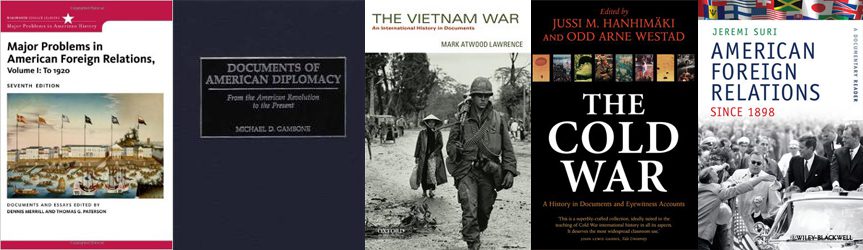
Dennis Merrill and Thomas G. Paterson, editors, Major Problems in American Foreign Relations (Houghton Mifflin, 5th edition, 2002). This pathbreaking collection, widely assigned in undergraduate classes, blends primary-source documents with excerpts from scholarly works that take contrasting positions on key interpretive questions. In this way, the book gives students a sense of scholarly debates along with a small amount of original material to use in assessing them.

Jussi Hanhimäki and Odd Arne Westad, editors, The Cold War: A History in Documents and Eyewitness Accounts (Oxford University Press, 2003). As the title suggests, this collection has a relatively narrow chronological focus – just the Cold War years from the 1940s to 1989. But it is admirably broad in other respects, collecting material from numerous countries and blending high-level policy documents with reminiscences by ordinary people.

Michael D. Gambone, editor, Documents of American Diplomacy (Greenwood Press, 2002). This collection contains an impressive 167 documents reaching from the Declaration of Independence to the Clinton presidency. All of the classics of American decision-making are here, making it an excellent choice for anyone trying to track down documents of indisputable significance.

Mark Atwood Lawrence, editor, The Vietnam War: An International History in Documents (Oxford University Press, 2014). Compiled by UT-Austin’s Mark Lawrence, this book collects documents from just a single episode in the history of U.S. foreign relations – the Vietnam War. But it brings together material from the United States with documents from Vietnam, China, and elsewhere.

Jeremi Suri, editor, Foreign Relations of the United States Since 1898 (Wiley-Blackwell, 2010). Compiled by UT-Austin’s Jeremi Suri, this book collects approximately 50 documents, nearly all of them American. It’s one of the best brief collections for classroom purposes.

bugburnt

The Global United States

By Mark A. Lawrence

For many students, the most exciting thing about history is not the scholarly monographs that we spend years researching and writing and they are often expected to read. Rather, many students are most intensely drawn to the study of the past by reading and analyzing primary sources – the original documents that constitute the raw material of history.

Primary documents can sweep us into the past, giving us direct access to the words, cadences, biases, insights, and passions of remote historical actors. History comes alive, and voices whisper across chasms of time, space, and perception. In the best case, such material can enable students to make their own judgments about the past and to weigh the claims of scholars.

To promote the study of primary source material in my field, the history of U.S. foreign relations, I teamed up with two colleagues over the last few years to compile a volume of documents that we hope will inspire students to delve further into the subject.

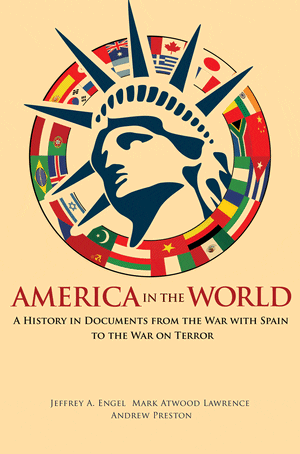
The book, America in the World: A History in Documents from the War with Spain to the War on Terror, encompasses about 125 years of history. It charts the rise of the United States from a peripheral, comparatively weak power in the late nineteenth century to the pinnacle of its military, diplomatic, and cultural influence in the early twenty-first. How and why did this momentous transformation occur? Who resisted and why? What were the attitudes of foreign nations as the United States became a great power of the first order and then surpassed them all?

Via 228 documents, the book helps answer these questions by inviting readers to consider the opinions and pronouncements of some of the people who took part in American policymaking and witnessed the American rise to power. Other historians have published collections of primary-source material on American foreign relations before. But our collection is new and different in at least three respects.

800px-The_Administration's_Promises_Have_Been_Kept
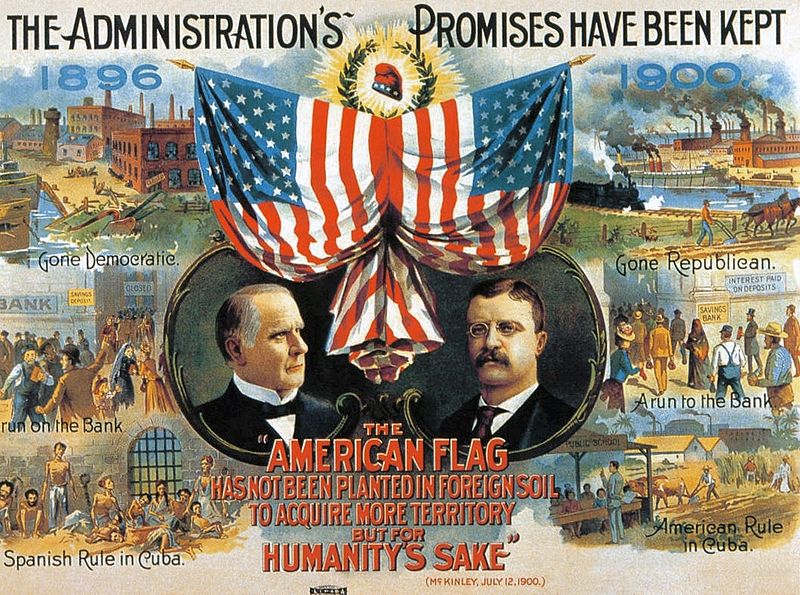
1900 campaign poster celebrating American imperial expansion

First, the book covers a relatively long period of time. Whereas most document collections focus on particular segments of this period, especially the Cold War, our book reveals and explores continuities across the larger flow of time, including the recent post-Cold War years. In fact, the collection features two chapters on the period since 1989, enabling readers to consider contemporary dilemmas faced by the Bush and Obama administrations in light of historical experience.

Second, the collection reflects key recent trends in the study of U.S. foreign relations. In recent decades, diplomatic historians have increasingly called into question the tendency among an older generation to write histories of U.S. policymaking on the basis of U.S. sources alone. Scholars should strive for a truly international kind of history that sets U.S. behavior within an international context and, by making use of foreign archives, views the United States through the eyes of foreign governments and peoples. Diplomatic historians in recent years have also called into question the field’s traditional focus on elite policymakers. Increasingly, scholars have recognized the need to take account of popular opinion and the influences of powerful people outside of government.

ellington6b
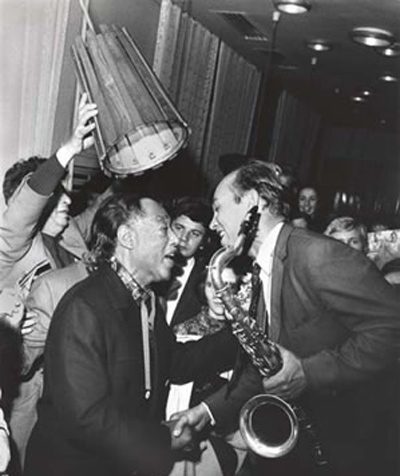
Duke Ellington in the Soviet Union, 1971. Ellington and his orchestra encountered a vibrant – if still partially underground – jazz scene and played with Russian musicians in both official and unofficial capacities. The band leader’s Soviet tour followed the announcement of the upcoming and historic trip to the USSR by President Richard Nixon, a pianist and avid jazz fan.

Our book takes account of both of these critiques of diplomatic history. To be sure, we include many documents reflecting the views of elite American policymakers – presidential declarations, policy memoranda, diplomatic dispatches, are still important sources. But we intermingle this kind of material, which has been the sole focus of nearly all the existing document readers in U.S. foreign relations, with two other kinds of documents: some reflecting foreign perceptions of the United States and others reflecting the opinions of Americans outside policymaking circles – clergymen, cartoonists, musicians, novelists, polemicists, and others.

Third, the book features relatively tight thematic coherence. There is, of course, an infinite number of documents that could reasonably have gone into our book. We handled the problem of over-abundance partly by building each chapter around a single interpretive question that guided our selections. Our chapters are not, that is, mere compilations of important documents related to a general topic or time period – the usual approach in document books. Rather, the chapters contain documents reflecting various perspectives on an interpretive problem that scholars have identified as crucial to understanding U.S. foreign relations. For example, the chapter on the great Cold War crisis of the early 1960s asks why the East-West conflict became so dangerous at that particular time. The chapter on the 1990s, asks how the United States reoriented its foreign policy following the collapse of the enemy that had given shape and purpose to American diplomacy for decades.

Coca-Cola_Morocco
Coca Cola in Morocco

Following this approach, we place conflicting points of view in dialogue with one another to show the development of particular sets of ideas over time. While this approach means that we pass over some important questions, it does, we hope, enhance the book’s appeal by giving the chapters a clear logic and flow.

Whether we have achieved our goals is for readers to decide. But one thing that I and my co-editors – Jeffrey A. Engel of Southern Methodist University and Andrew Preston of Cambridge University – can say for sure is that the book was no small undertaking. Although all three of us pursued other projects at the same time, locating, selecting, editing, and writing introductory material for 223 documents took far longer than we had anticipated – nearly a decade, in fact.

But we’re pleased with the end result, and we hope that innumerable students – and perhaps other readers interested in America’s foreign relations – will use it in the years ahead to find inspiration for the study of history.

Jeffrey A. Engel, Mark A. Lawrence, and Andrew Preston, eds., America in the World: A History in Documents from the War with Spain to the War on Terror

Mark Lawrence’s suggestions for Further Reading can be found here.


You may also enjoy:

Introduction to America in the World

Mark Lawrence on Not Even Past: “The Lessons of History,” “The Prisoner of Events in Vietnam,” “CIA Study [on the consequences of war in Vietnam]”

Jonathan C. Brown, “A Rare Phone Call from one President to Another“


Campaign poster: Wikimedia

Duke Ellington Collection, Archives Center, National Museum of American History, Smithsonian Institution

Coca cola in Morocco via Creative Commons, ciukes/Flickr

bugburnt

Student Showcase – The Day the Gridiron Turned Pink

Seth Franco and Dylan Gill
Cedar Bayou Junior School
Junior Division
Group Exhibit

Read Seth and Dylan’s Process Paper

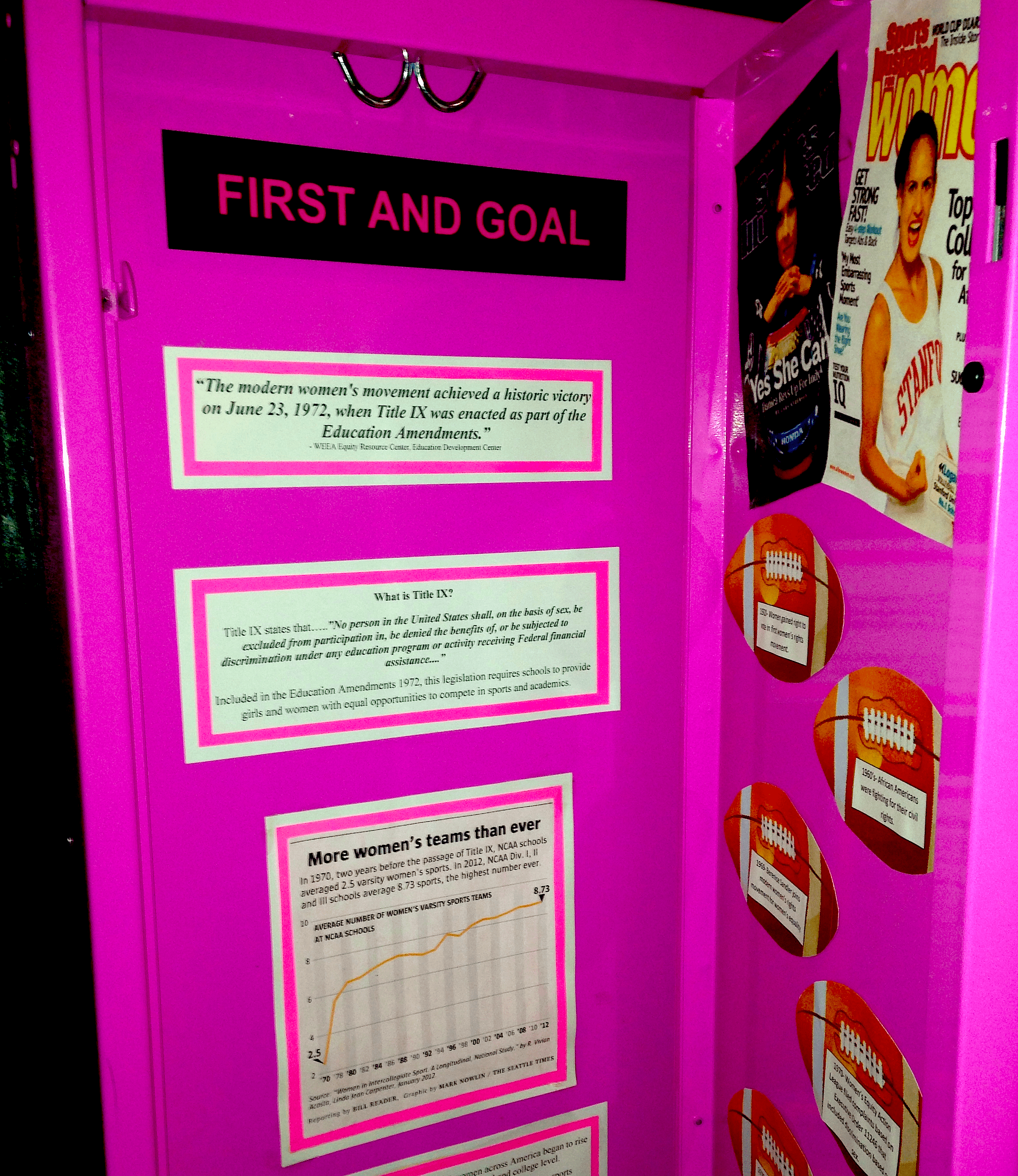
In 2014, female athletics are common in America’s high schools and colleges. But this was not always the case. Prior to the 1972 passage of the Title IX Education Amendment, all male teams received most, if not all, of the resources available for athletics. But in the following decades, female participation in high school and college athletics skyrocketed. In their Texas History Day exhibit, Seth Franco and Dylan Gill explored the history behind this monumental piece of legislation and considered how it changed America–and even their own school:

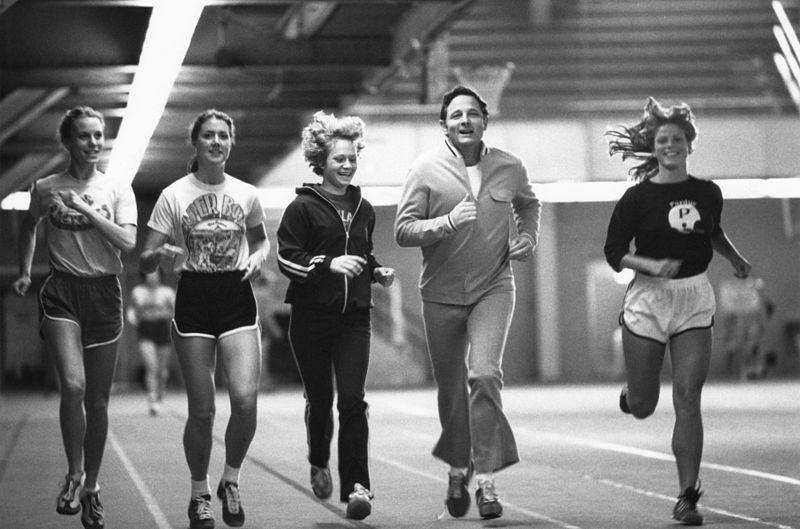
Indiana Senator Birch Bayh exercises with Title IX athletes at Purdue University, ca. 1970s (Birch Bayh Senate Office - Senatorial Papers of Birch Bayh, Indiana University)
Indiana Senator Birch Bayh exercises with Title IX athletes at Purdue University, ca. 1970s (Birch Bayh Senate Office – Senatorial Papers of Birch Bayh, Indiana University)

This year’s National History Day theme, Rights and Responsibilities, offered many great topics to consider, but we ended up selecting Title IX, which is the law that opened the door to equal access for girls and women across our nation. We chose this topic because we wanted a topic that would be unexpected for two boys. Also, we had a couple of girls that were on our football team this year so we were both wondering how girls were able to participate in a sport that is dominated by males. Before the History Fair this year, we didn’t even know that Title IX existed and even though it seems normal that girls play lots of different sports today, it has not always been that way.

Section from Seth and Dylan’s exhibit shows pink board with photos of women athletes
Section from Seth and Dylan’s exhibit

Our project related to the theme of Rights and Responsibilities because Title IX established the right of gender equity in education, jobs, and sports. Although we are focusing our project on sports because we feel that sports scholarships have offered women the opportunities to further themselves in the education and business world more than ever before, Title IX has made it possible for the door to be opened into many different areas that were previously closed. This historically significant legislation has changed the lives of girls and women across our nation.


A look back on recent Texas History Day projects:

One enslaved man’s attempt to revolt against American slavery

An early pioneer for free press in America

And a look at the brutal world of migrant work during the Great Depression

Student Showcase – The Impact of the Great Depression Towards Rights and Responsibilities of Migrant Workers

Korbin San Miguel
St. Matthew Catholic School
Junior Division
Individual Documentary

Read Korbin’s Process Paper

The Great Depression was a period of high unemployment and extreme poverty. But even those who managed to find work often found themselves underpaid and exploited. Korbin San Miguel created a Texas History Day documentary on migratory farm laborers during the Great Depression and the oppressive work conditions they often faced. In his process paper, Korbin discussed the inspirations behind this project, including a classic piece of fiction:

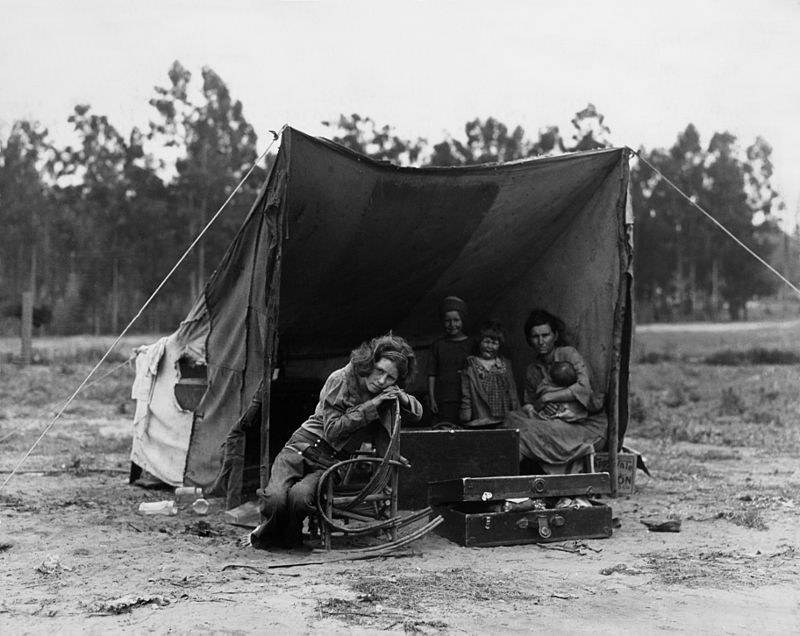
One of Dorothea Lange's iconic photographs of Florence Owens Thompson, a migrant worker, and her family during the Great Depression (Library of Congress)
One of Dorothea Lange’s iconic photographs of Florence Owens Thompson, a migrant worker, and her family during the Great Depression (Library of Congress)

In trying to determine a suitable topic for my research, I consider looking though my grandfather’s oil history books to get ideas. While looking through a stack of books, I found The Grapes of Wrath, a novel of historical fiction that takes place during the Great Depression. After reading the book’s depiction of migrant farmworkers and the harsh exploitation they faced, I knew that I could tie in “rights and responsibilities” with this profound yet compelling subject. I was sure that this was an interesting topic to pursue for my History Fair project.

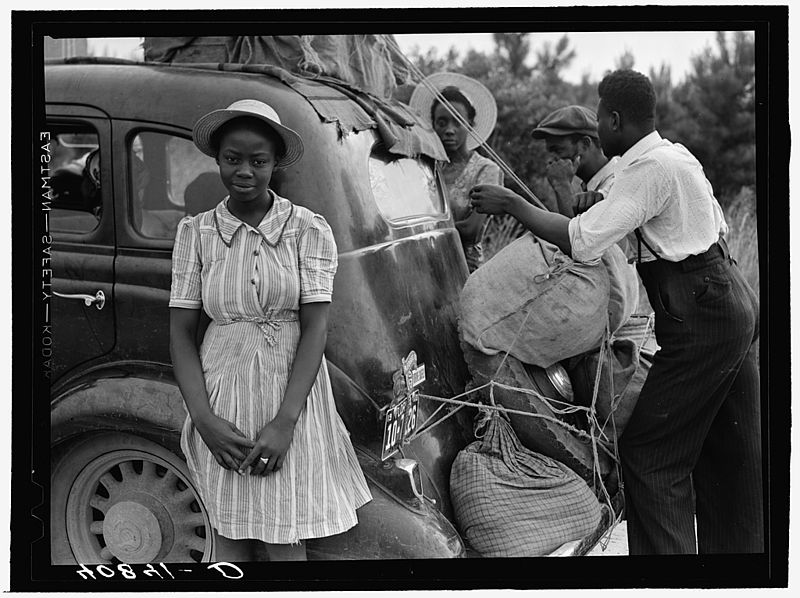
Group of Florida migrants near Shawboro, North Carolina on their way to Cranbury, New Jersey, to pick potatoes (Library of Congress)

My documentary connects to the theme because it significantly portrays the history of the plight of migrant workers. It expresses the history of the persistent exploitation of migrant farmer workers and their families. With no rights or laws to protect them from mistreatment, they were forced to accept demanding labor which brought hardship and agony. They were entitled to basic human rights but farm owners exploited the migrant workers and took no responsibility for their basic rights and humanity.


More Texas History projects on NEP:

The story behind one of New Orleans’s most iconic neighborhoods

The life of Douglas MacArthur, right down to his corn cob pipe

A project that captures the Orwellian reign of Joseph Stalin

« Previous Page
Next Page »

Recent Posts

  • The Radical Spanish Empire Roundtable – Introduction
  • All Eyes on the Petition: Reflections on The Radical Spanish Empire
  • Forgery, Invention, and the History of Skepticism in The Radical Spanish Empire
  • Iberian Subaltern Political Philosophies and The Radical Spanish Empire
  • Lawfare and the Legal Construction of Race in The Radical Spanish Empire
NOT EVEN PAST is produced by

The Department of History

The University of Texas at Austin

We are supported by the College of Liberal Arts
And our Readers

Donate
Contact

All content © 2010-present NOT EVEN PAST and the authors, unless otherwise noted

Sign up to receive our MONTHLY NEWSLETTER

  • New
  • Features
  • Reviews
  • Texas
  • Teaching
  • Digital
  • Watch & Listen
  • Authors
  • About