• New
  • Features
  • Reviews
  • Texas
  • Teaching
  • Digital
  • Watch & Listen
  • Authors
  • About

The past is never dead. It's not even past

Not Even Past

The National Museum of Anthropology in San Salvador

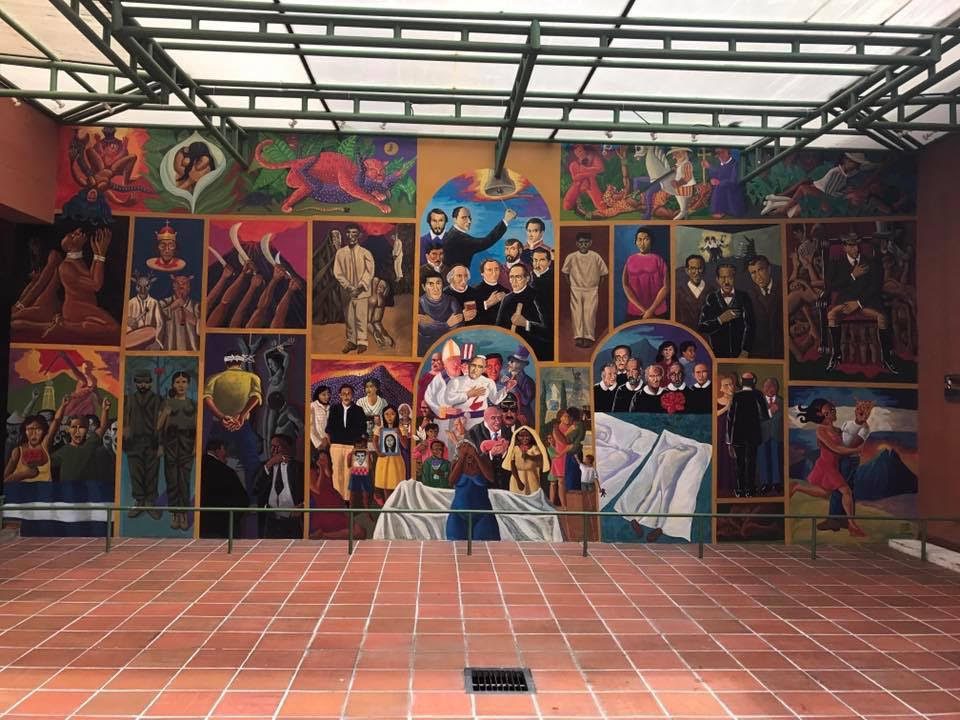
Picture of a mural at the Museo Nacional de Antropología (National Museum of Anthropology), San Salvador
Museo Nacional de Antropología (National Museum of Anthropology), San Salvador (via Brittany Erwin)

By Brittany Erwin

With its multiple universities, extensive commercial sector, and fast-growing population, the city of San Salvador has become an important axis of cultural production for the Salvadoran nation. As the country’s capital city, it houses many notable institutions, including the National Archive, The Museum of Art, and the National Theater, in addition to several historic churches. Included in these important institutions is MUNA, the Museo Nacional de Antropología.

Founded in 1883, MUNA was a product of cooperation between Salvadoran president Rafael Zaldívar and David J. Guzmán, a politician and scholar. Today the full name of the museum is the David J. Guzman National Museum of Anthropology in honor of his contributions to natural and archaeological knowledge in the country.

Located in the heart of downtown San Salvador, this museum offers the nation’s most comprehensive exhibition of Salvadoran history. With five exhibit halls, space for temporary displays and artists’ showcases, MUNA serves as a pillar of El Salvador’s effort towards cultural preservation.

The current temporary exhibit explores the legacy of the last significant eruption of the San Salvador Volcano a hundred years ago, in 1917. Seismic activity and its effects on all aspects of daily life is an important reoccurring theme in the historical narrative that this museum presents.

As visitors enter, they encounter a large, striking mural on the interior courtyard wall. Its vibrant colors and graphic scenery illustrate the significant historical impression that this small country has made. Painted by Antonio Barilla and completed in 2011, the work illustrates the story of the nation. Over centuries, struggles for power among different social, cultural, and ethnic groups have manifested in cycles of conquest, internal conflict, and war. In this sense, Barilla’s mural represents the history of this country as a story about people who have turned a legacy of suffering into one of perseverance and triumph. In that same sense, the mural also provides a thematic map to enhance the museum visitor’s examination of the artifacts that make up that history.

The quantity of exhibits in this museum is impressive, ranging from early-Mayan ceramics to modern-day markers of Catholic culture. Three of its more prominent specialties are the agricultural foundations of El Salvador’s early civilizations, the ongoing role of ritual worship in community life, and the consequences of living in a highly volcanic region.

For the student, this institution offers a wide range of historical, biological, and anthropological information about the interesting dynamics between the past, present, and future in this Central American country. In addition to the artifact displays, MUNA is home to a specialized library. Its collections comprise a variety of primary and secondary works pertaining to the political, economic, social, and cultural history of the nation. These resources are available to local and international researchers.

For the tourist, the historian, or the curious visitor, MUNA allows for a Salvadoran excursion to the past, starting from the earliest days of inhabitance and ending in the contemporary reality of twenty-first century life.

For more information about this museum and its collections, visit: http://www.cultura.gob.sv/museo-nacional-de-antropologia-dr-david-j-guzman/

Also by Brittany Erwin on Not Even Past:

The Museo Regional de Oriente in San Miguel, El Salvador

You may also like:

Too much Inclusion? Museo Casa de la Memoria, Medellín, Colombia, by Jimena Perry
History Museums: Museo Nacionál de Antropología, Mexico, by Robert Wilks
History Museums: the Good, the Bad, and the Beautiful by Joan Neuberger


The views and opinions expressed in this article or video are those of the individual author(s) or presenter(s) and do not necessarily reflect the policy or views of the editors at Not Even Past, the UT Department of History, the University of Texas at Austin, or the UT System Board of Regents. Not Even Past is an online public history magazine rather than a peer-reviewed academic journal. While we make efforts to ensure that factual information in articles was obtained from reliable sources, Not Even Past is not responsible for any errors or omissions.
Studying the Vietnam War: How the Scholarship Has Changed

by Mark Atwood Lawrence

Originally published as “Studying the Vietnam War: How the Scholarship Has Changed” in the Fall 2017 issue of Humanities magazine, a publication of the National Endowment for the Humanities.”

Editors Note: The Ken Burns and Lynn Novick documentary The Vietnam War premiered on PBS last Sunday, September 17. Mark A. Lawrence, Associate Professor of History at the University of Texas at Austin and preeminent historian of the Vietnam War, reflects on what we are learning from historians’ renewed interest in the subject, especially with new scholarship based on Vietnamese sources.

These are boom times for historians of the Vietnam War. One reason is resurgent public interest in a topic that had lost some of its salience in American life during the 1990s. At that time, the end of the Cold War and surging confidence about U.S. power seemed to diminish the relevance of long ago controversies and the need to draw lessons from America’s lost war. But then came the wars in Afghanistan and Iraq: grueling conflicts that, in key respects, resembled the war in Southeast Asia three decades earlier. Critics complained that George W. Bush had mired the nation in “another Vietnam,” and military strategists focused anew on the earlier war for clues about fighting insurgents in distant, inhospitable places. For their part, historians seized the opportunity to reinterpret Vietnam for a younger generation and especially to compare and contrast the Vietnam conflict with America’s new embroilments.

More recently, intense public interest in the war has been sustained by fiftieth anniversaries of the war’s most harrowing years for the United States. Publishers have used these occasions to release high-profile histories, including Mark Bowden’s widely reviewed Hue 1968, a sprawling account of the largest battle between U.S. and Communist forces during the 1968 Tet Offensive. The media are taking part as well. During 2017 and early 2018, the New York Times is publishing an online series of approximately 130 op-eds focused on the events of 1967. The biggest moment of all is due in late September: the premiere of the much anticipated 18-hour documentary on the war from Ken Burns and Lynn Novick, an event certain to inspire new waves of commentary about Vietnam and to rekindle debate in living rooms across the nation.

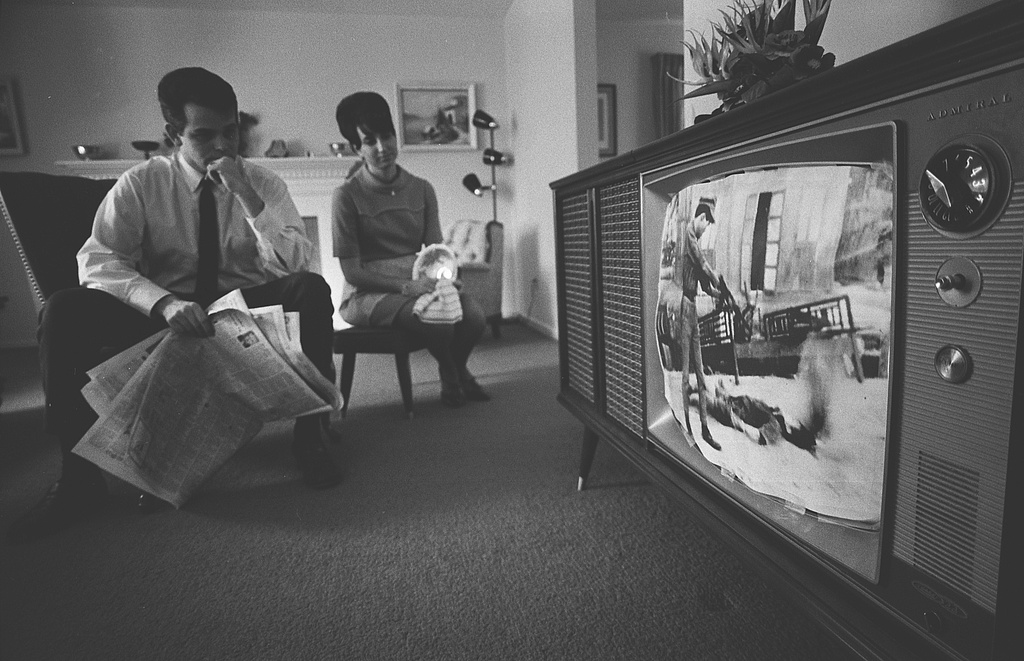
Footage of Vietnam being broadcast in an American living room, February 1968 (via Wikipedia). The first episode of the highly anticipated The Vietnam War by Ken Burns and Lynn Novick premiered on Sunday, September 17, once again bringing a divisive and contested history into American living rooms.

But there is another, less noticed reason for renewed attention to the Vietnam War: Spectacular new source material has transformed the possibilities for writing about the subject. Some of this new documentation has emerged from U.S. archives as a result of declassification in the last decade or so. Records from the Nixon and Ford presidencies (1969–1977), especially, are making it possible for historians to write with more confidence and in greater detail about the final stages of U.S. involvement in Vietnam, long a relatively neglected era of the war.

Indeed, the last phase of U.S. military operations has recently spawned an especially contentious debate on one of the most fundamental controversies about Vietnam: Could the United States and its South Vietnamese allies have won the war if the American public had not turned against it? Provocative new works by Lewis Sorley and Gregory Daddis lead the way in arguing for and against, respectively, the notion that the U.S. military could have secured overall victory, if not for crumbling political support within the United States.

Meanwhile, writing about every phase of American decision-making has been enhanced by the release of audio recordings that U.S. presidents from Franklin D. Roosevelt to Richard Nixon made of important meetings, telephone conversations, or both. Because these often convey the mood and emotions of senior policymakers, they are invaluable in helping historians gain a richer understanding of the motives that underlay decision-making about the war. It is now possible, for example, to hear Lyndon Johnson’s anguish about escalating the U.S. role in 1964 and 1965. LBJ’s doubts, along with his obvious awareness of the problems that would beset U.S. forces if he escalated the war in Vietnam, have led many historians to scrap the once dominant idea that leaders in Washington, ignorant of Vietnamese politics and blinded by Cold War assumptions about the dangers of communism, walked step-by-step into a “quagmire” that no one had anticipated. The old question—How could Americans have been so ignorant?—has been replaced by a new one: Why did U.S. leaders commit the nation to war despite abundant doubts and accurate knowledge of the obstacles they would confront?

President Lyndon B. Johnson at a National Security meeting on Vietnam, July 1965 (via Wikimedia Commons)

The most impressive new source material, however, has emerged from countries other than the United States. As recently as 30 years ago, historians were limited to U.S. and West European sources, making it impossible to write with authority about Vietnam itself or decision-making by North Vietnam’s allies, China, the Soviet Union, and Eastern European nations. Everything changed with the end of the Cold War. East European nations went furthest in opening their archives to researchers. For its part, the Russian government opened some Soviet-era records, most notably the records of the Communist party. China and Vietnam, where the end of the Cold War did not produce dramatic political change, lagged behind, yet even those governments gradually permitted access to some records from the Cold War years. Most strikingly, the Vietnamese government opened troves of material amassed by the defunct regime in Saigon that ruled below the seventeenth parallel during the heyday of U.S. involvement.

The result has been a large and growing body of new work by ambitious and linguistically skilled scholars eager to explore fresh dimensions of the war. Historians Mark Philip Bradley, Robert K. Brigham, William J. Duiker, Christopher Goscha, David S. Marr, and Sophie Quinn-Judge led the way in examining Vietnam’s experience, drawing on newly available Vietnamese sources to produce pathbreaking studies around the turn of the century. A younger generation of scholars, most of whom wrote dissertations rooted in extensive research in Vietnam, has built on those accomplishments and even, for the first time, begun delving into decision-making by the Communist government in Hanoi. Meanwhile, historians of Soviet and Chinese foreign policy, most notably Ilya Gaiduk, Chen Jian, and Qiang Zhai, have used new documentation to examine the complex relationships between the Vietnamese Communists and their superpower patrons.

Unquestionably, archival openings in Russia and China, just as in Vietnam, remain partial and selective, leaving studies rooted in newly accessible material—stunning as it may be—highly susceptible to debate and revision as more documentation becomes available. Yet, measured against the near impossibility of doing this kind of work just three decades ago, historians have made remarkable progress toward rethinking the Vietnam War as an episode not just in U.S. history but also in Vietnamese and world history. Historians, in short, increasingly appreciate the war for what it was at the time: a multisided conflict involving numerous Vietnamese and international actors and driven by extraordinarily complicated and shifting motives.

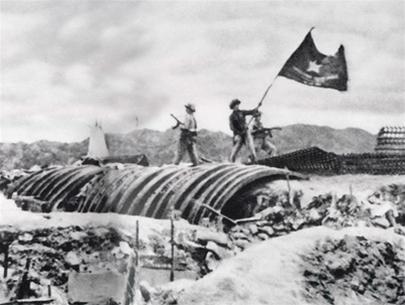
What precisely has this new research in non-U.S. sources revealed thus far? Three examples point to the variety and significance of the new discoveries. First, studies of Chinese foreign policy have revealed details of North Vietnam’s dependence on its mighty neighbor to the north in the years before the Cultural Revolution, which greatly diminished China’s ambitions abroad. Despite historical tensions between Vietnam and China, newly available sources show definitively that Chinese military helped train and advise Vietnamese Communist forces from as early as 1950 and played an especially pivotal role in the 1954 Battle of Dien Bien Phu, the Vietnamese victory that ended French colonialism and dealt a major blow to the West in the Cold War.

The Battle of Dien Bien Phu, 1954 (via Wikimedia Commons)

More strikingly, new documents clarify the vast amounts of equipment and even manpower that China provided to North Vietnam during the later fighting that involved U.S. combat forces. According to historian Qiang Zhai, China sent everything from military gear and weapons to table tennis balls, playing cards, sewing needles, and vegetable seed under a series of agreements with North Vietnam. At the same time, Qiang Zhai asserts, a total of 320,000 Chinese soldiers served in North Vietnam between June 1965 and March 1968, peaking at 170,000 during 1967. To be sure, Chinese forces were not assigned combat roles. But Zhai observes that they enabled North Vietnam to send more of its own forces to southern battlefields by performing valuable functions such as repairing bridges and rail lines, building and relocating factories, and manning antiaircraft guns. Such tasks could, of course, be hazardous, not least because of U.S. bombing of some parts of North Vietnam. According to Zhai’s sources, 1,100 Chinese soldiers died in North Vietnam and another 4,200 were wounded.

Second, new sources from Vietnam are exposing the complexity of decision-making among Communist leaders in Hanoi. For many years, historians assumed that North Vietnamese leaders marched in lockstep and permitted no dissent. This view was sustained in part by the belief that the regime in Hanoi was totalitarian to its core and utterly subservient to its most powerful leaders, above all Ho Chi Minh. Recent discoveries have, however, called all of this into question. For one thing, historians Lien-Hang Nguyen and Pierre Asselin have revealed that Ho Chi Minh—long assumed to have been the preeminent North Vietnamese leader all the way to his death in 1969—in fact, lost a great deal of influence around 1960.

The pivotal figure thereafter was Le Duan, a Southern-born revolutionary who remained relatively obscure to Western historians until recent years. Thanks to recent publications, though, it’s clear that Le Duan, a firebrand eager to throw enormous blood and resources into the effort to reunify his country under Communist leadership, dominated decision-making in Hanoi during the peak years of American involvement. Understanding the importance of Le Duan and the hawks who surrounded him helps enormously to appreciate the escalatory pressures that operated on the Vietnamese side, even as Lyndon Johnson and his aides stepped up the American commitment in the mid 1960s. We can now see that leaders on both sides rejected diplomacy and banked on military victory, a tragic convergence of hawkishness that fueled escalation.

The dominance of the hawks in Hanoi does not mean, though, that there were no contrary voices once they were in the driver’s seat. Scholars working with Vietnamese sources have discovered evidence of substantial factionalism within the Hanoi regime throughout the late 1950s and 1960s. Broadly speaking, some high-ranking North Vietnamese leaders, including Ho Chi Minh, prioritized consolidation of Communist rule above the seventeenth parallel and were wary of major expenditures of lives and treasure to bring about reunification. Others, including Le Duan, strongly favored reunification—even at the cost of a major war likely to draw in the United States—over all other North Vietnamese priorities. New studies of the war show that North Vietnamese policy flowed from the interplay of these two points of view. During the late 1950s, the moderate faction held sway, and the result was a period of relative peace in Vietnam. With the triumph of the hawks, however, Hanoi embraced a new war and transformed North Vietnam into a full-fledged police state in order to keep the skeptics at bay.

Third, the new scholarship has shed valuable new light on the nature of the South Vietnamese state that endured from its beginning in 1954 to its collapse in 1975. Was South Vietnam merely a puppet of the United States, an artificial creation doomed to fall apart whenever Washington withdrew its economic and military assistance? Or was it a viable nation with a legitimate government that, absent the onslaught by northern Communists, could have endured as a stable, pro-Western entity into the indefinite future? For many years, the debate was more a matter of polemics than historical inquiry. Opponents of the war argued that the United States hitched itself to a hopeless Potemkin experiment led by venal, authoritarian leaders, while supporters saw South Vietnam as a beleaguered young nation that, for all its faults, was doing its best to resist Communist aggression.

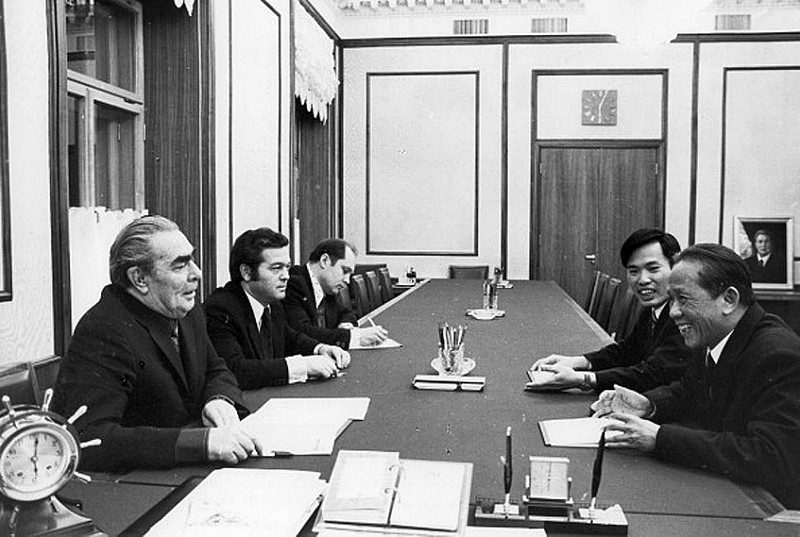
Leonid Brezhnev during talks with Le Duan, October 1975 (via Flickr)

Unsurprisingly, much of the new scholarship rooted in Vietnamese sources has argued for a gray area between these two extremes. Historians such as Edward Miller and Jessica Chapman focus especially on the late 1950s and early 1960s, suggesting that the South Vietnamese government headed by Ngo Dinh Diem possessed a degree of legitimacy and popular support unrecognized by Diem’s critics at the time or since. To be sure, they also point out the government’s inability to expand its base further among the South Vietnamese population. But they show that the South Vietnamese state possessed a remarkable amount of agency that its leaders might have exercised differently. All in all, these historians have helped restore the Vietnamese to the center of their own history.

What do all these revelations mean for how we should understand the Vietnam War in its totality? Clearly, the new work in non-American sources holds implications for primordial questions about the U.S. role in Vietnam. Was the U.S. commitment to Vietnam justified by any genuine security interests in the region? Why did the United States fail to achieve its objectives despite monumental effort? Might different decisions by American leaders have led to a different outcome? Knowing more about the international and Vietnamese contexts makes it far more possible than ever before to form authoritative opinions about questions that cannot logically be answered fully on the basis of U.S. sources alone. But the new work also underscores the possibility of addressing questions that transcend the American experience and viewing the Vietnam War within the context of, for example, decolonization, the international Communist movement, and the Sino-Soviet split. The good news is that, given the range of new and still-to-be-released source material and robust interest in the war four decades after it ended, historians are sure to move forward energetically on both tracks. The boom times may stick around for a while.

Also by Mark A. Lawrence on Not Even Past:

Must Read Books on the Vietnam War
The Prisoner of Events in Vietnam
Changing Course in Vietnam – or not
LBJ and Vietnam: A Conversation

You may also like:

Aden Knaap reviews Kill Anything that Moves: The Real American War in Vietnam
Janet Davis on cultural memory and the Vietnam War
Clay Katsky reviews Kissinger’s Shadow

Mapping & Microbes: The New Archive (No. 22)

by Christopher Rose

Can the microbe speak?

It’s 5:30 pm, and I’ve been staring at my computer screen for over eight hours. There’s a crick in my neck, my breathing is shallow, my blood pressure has elevated, and the entire Giza governorate has just disappeared off of the map the instant that I finished tracing its borders—for the third time. I take a deep breath, utter a few choice unpleasant words under my breath, make sure to save my work, and turn off the computer. Today, the dragon has won.

I am two weeks into what I had originally, and naively, thought would be a one-week project to map the outbreak of epidemic and epizootic diseases in Egypt during the First World War, which comprises a subsection of my dissertation project. It’s not a great time to be working on Egypt, as it’s become nearly impossible to get research clearance from the Egyptian government. Funding has also become a near impossibility: my optimism at being named a finalist for a Fulbright in early 2016 was short lived; the program was suspended due to security concerns before awards were announced.

While online resources are scarce, I did find that the Egyptian government’s official gazetteer has an online index of its entire run since the 1870s. Over the course of several days, I discovered that the gazetteer was a virtual treasure trove of exactly the sort of data I’ve been looking for: reports of disease outbreaks in detailed locations up and down the Nile Valley. Over a week, I compiled a spreadsheet of almost 800 records for the period between late 1914 and mid-1919.

The question, of course, was what to do with this data. I was certain the diseases would tell me something, if I could just figure out how to get them to speak.

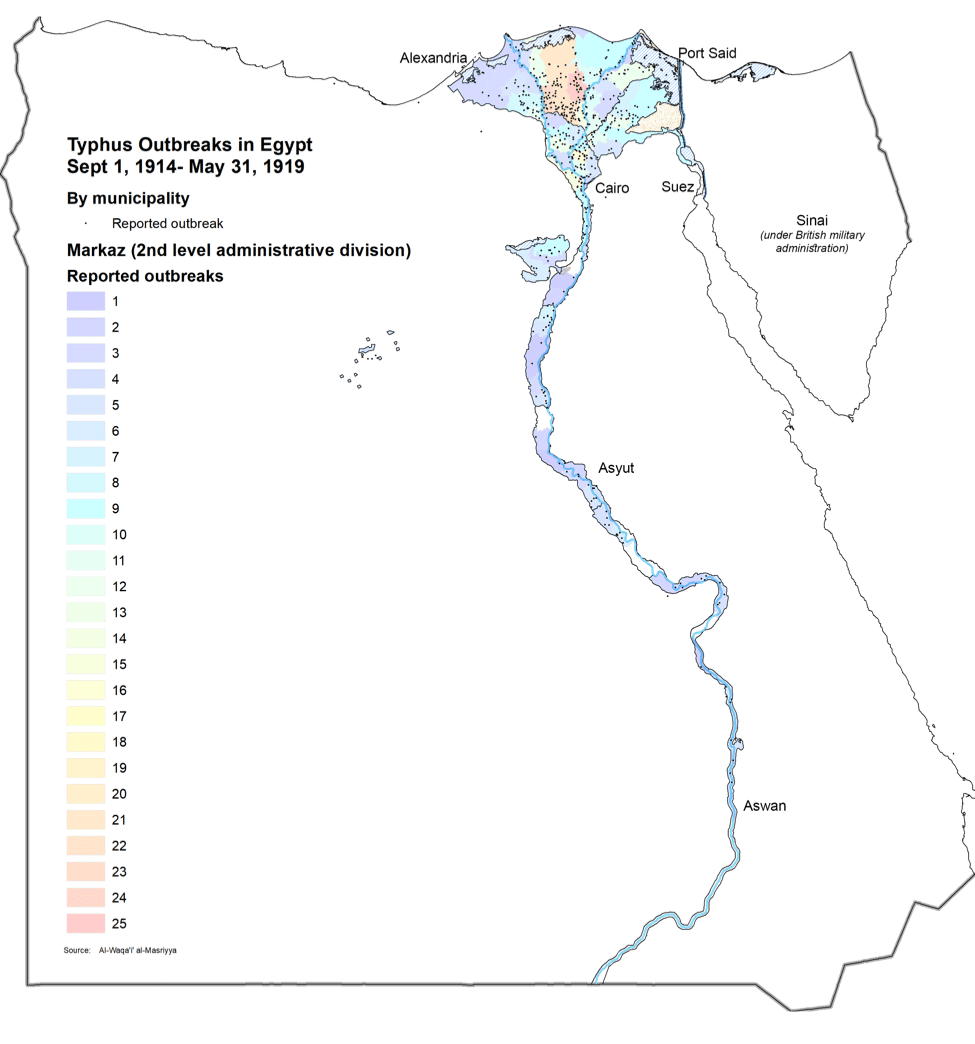
Map showing typhus outbreaks in Egypt, September 1, 1914 – May 31, 1919 (created by Chris Rose)

It was Julia Gossard, a UT alumna now teaching at Utah State University, who pointed me in the direction of the Programming Historian, a website dedicated to helping historians use digital tools to process data through modeling, mapping, and other methods. I didn’t have time to learn a programming language, but mapping was an idea I liked. The site has several columns about creating maps, using open source mapping software. While I’m a big fan of open source, especially when it replaces costly technical software, I was a bit uneasy about the lack of support for the platform – in short, I foresaw the ability to get myself into trouble, but not out of it.

A little digging around led me to the unexpected find that UT has an institutional subscription to ARCGIS, which is the (otherwise very expensive) industry standard mapping platform. Using UT’s institutional subscription to Lynda.com, I started training myself to use ARCGIS.

Had I known what I was getting myself into, I probably wouldn’t have dived right in.

Mapping the data required me to tag each record with the latitude and longitude of the reported location. This led me to one of the key stumbling blocks for all scholars of the Middle East who’ve dabbled in the digital humanities—so much data is out there on the web, but much of it is transliterated from the original language. There is no universally recognized Arabic-to-Latin transliteration method, and the potential inconsistencies are well on display in the web’s largest open-source geographic database, Geonames.org. While some of its Egyptian entries contained the original names in Arabic script, most did not, leaving me to guess—frequently incorrectly—how they might have been rendered. Since Geonames is open-source, I added the names both in Arabic and one of the more commonly recognized transliteration systems to Geonames’s database as I went, which will hopefully make someone else’s life a little easier.

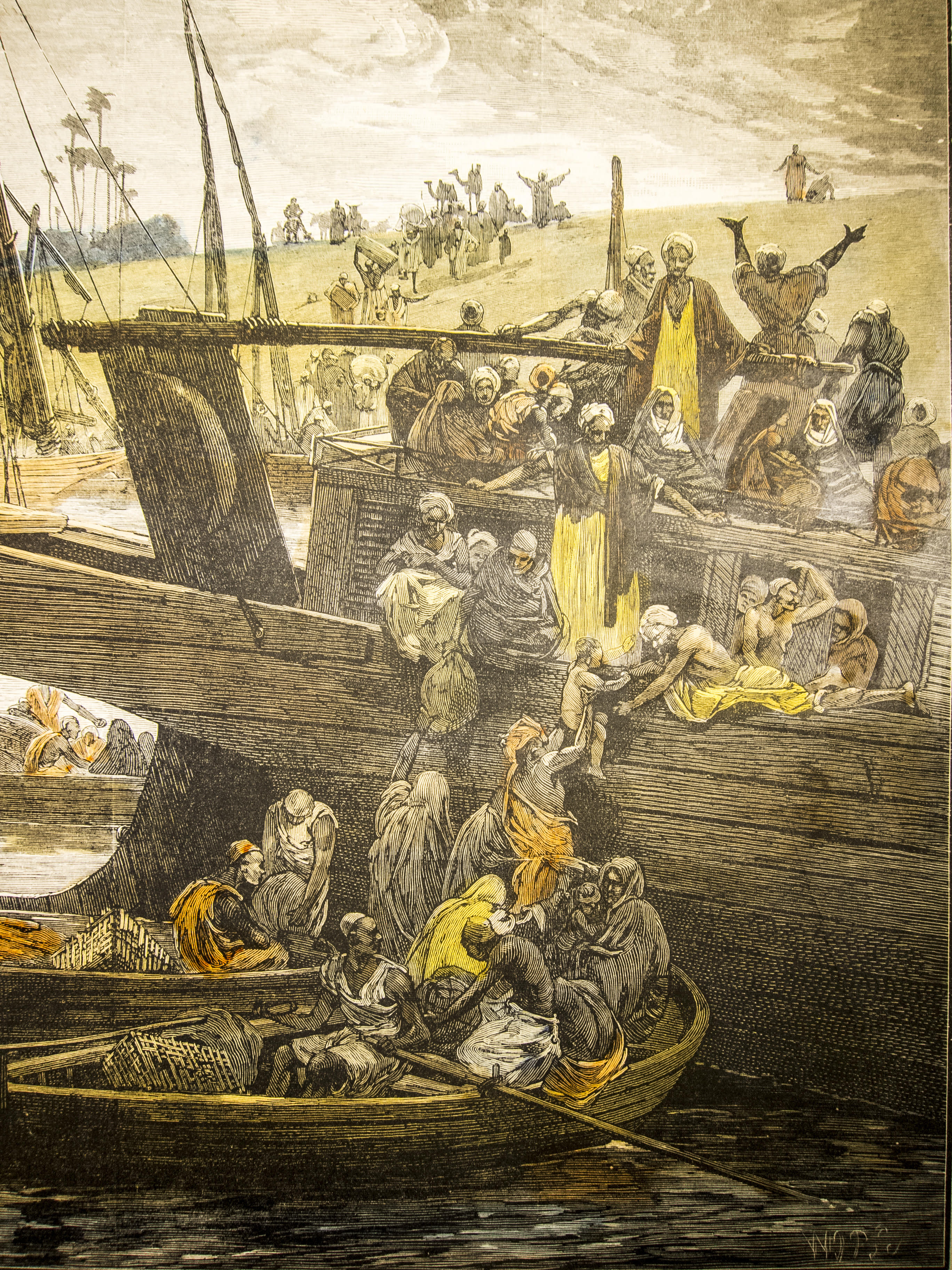
People fleeing a cholera outbreak at the port of Boulaq (near Cairo) in 1883 (via Wellcome Collection)

Finally, it was time to start mapping, and herein lay another challenge. ARCGIS has an expansive built in library of open source data, which included, as I had hoped, administrative maps of Egypt. I very quickly realized, however, that the administrative borders of the early 21c did not correlate directly to those of the early 20c. At least one governorate has since been split into three and there were a lot of unfamiliar names on the maps. I discovered that the UT Libraries has a copy of the 1917 Egyptian census, which has a big fold out map of the country. I scanned it, brought it home and compared it to the current maps … and realized that it was probably going to be easier to draw the 1917 map in ARCGIS rather than try to adapt the contemporary maps.

The process took nearly two weeks, employing long forgotten Photoshop skills (yay for bezel curves!), tracing a century old map and rendering it onto a satellite image of contemporary Egypt. The resultant map is, as they say, “good enough.” It’s probably got a distortion of around 2 miles, but it’ll never appear in print at that level of detail. Maybe when my monograph becomes a best-seller, I’ll hire someone to re-draw it.

I learned that ARCGIS has some quirks. It has a tendency to freeze up every 60-90 seconds. I quickly learned to save my work every time I did anything, a lesson that came in handy when, for some reason, the entire Giza governorate vanished inexplicably … three times … after I drew it. (The following morning, I discovered that the governorate hadn’t vanished, it was just invisible. I still don’t actually know why).

Finally, the big day came. After the blood, sweat, tears, swearing, and yelling at the cat, the map was finished. I overlay my disease data, and sat back to look at the results.

Children playing in a poor neighborhood of Alexandria under quarantine during an outbreak of typhus, sometime around WWI (via Wellcome Collection)

Have the microbes told me a story? They have. As I set forth on the next phase of my project, I have clusters of locations and specific dates to look for. But the maps have also given me more questions—Is there a correlation between a two-year outbreak of cattle plague and the rampant inflation in the cost of food during the war? Does the death of 139,000 Egyptians due to influenza at war’s end have anything to do with the eruption of a populist uprising just six weeks later? And why is this most deadly epidemic absent from the press and the pages of the official gazetteer?

I also realized the importance of presenting my data in this visual form. No one is going to go through all 800 records on my spreadsheet, but the map provides a clear snapshot of my subject and the questions it raises, and it makes a visual case for the argument I’m laying out in my dissertation. In this form, it will make my modest contribution to this field of study more convincing and accessible.

The New Archive series highlights various uses of digital tools in humanities research. More from the series:

Charlie S. Binkow explores Honest Abe’s Archive
Joseph Parrott highlights the digitalized political posters collected by archivist and artist Lincoln Cushing
Maria José Afanador-Llach discusses her experience at a Digitilization Workshop in Venice
Daniel J. Cohen and Roy Rosenzweig, Digital History: A Guide to Gathering, Preserving, and Presenting the Past on the Web

You may also like:

Hanan Hammad on gender in a small town in Egypt
Martin Thomas and Richard Toye discuss the Dreyfus Affair and the Fashoda Crisis of 1898
Cali Slair on the eradication of smallpox

Rodolfo Valentín González Pérez: An unusual disappearance

Rodolfo Valentín González Pérez: An unusual disappearance

They weren’t all the same.  We know of at least one soldier who had a conscience.  There were several, actually.  Most were weighty figures, captains and colonels who refused to follow orders.  Some of them quit or went into exile.  Others died.  But I’m talking about conscripts, the powerless boys who were in military service when the decision was made to interrupt the institutional process of the Chilean state on September 11, 1973.  When the elected socialist government of Salvador Allende was overthrown by the US-backed Chilean military. When those boys were commanded to arrest, torture, and kill their own brothers and sisters.

Rodolfo González was one such conscript.  He was proud that he had been chosen for the Air Force.  He was just eighteen.  After the coup, he was commissioned to serve at the DINA, Dirección de Inteligencia Nacional.  That was General Pinochet’s secret police.

Rodolfo wasn’t an agent, but he did participate.  He had guard duty.  He delivered messages.  He got coffee for the boss when the boss got tired of torturing someone.

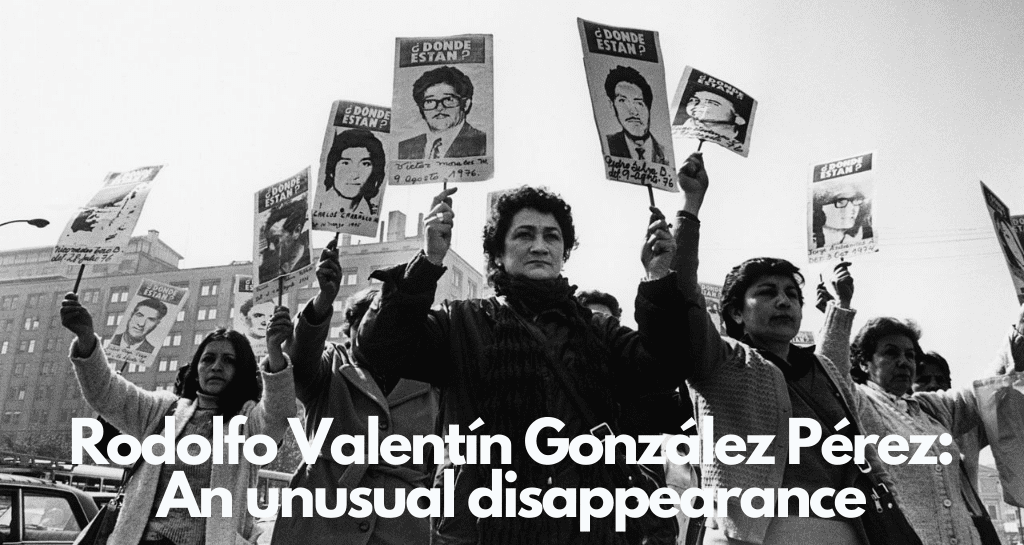
He lived with his aunt, María González.  I knew her.  She was a member of the Association of the Relatives of the Detained-Disappeared (Agrupación de Familiares de Detenidos-Desaparecidos) until the day she died.  She marched alongside Doris, Inelia, and the mothers of so many others who had disappeared, carrying her placard with the picture of Rodolfo.  María González was an anomaly.  Rodolfo was unusual company for the other prisoners at Villa Grimaldi, too.

Demonstration by members of the Association of the Relatives of the Detained-Disappeared
Demonstration by members of the Association of the Relatives of the Detained-Disappeared (Photographer: Kena Lorenzini, via Wikimedia Commons)

María González said that, when her nephew started out at the DINA, he stopped wearing a uniform.  They gave him a dark suit and black shoes.  They picked him up in a car every day, a black Chevrolet Impala with tinted windows.  Once, Rodolfo showed his military ID to his aunt.  It identified him as a member of the DINA.  That was a violation of protocol.  The first one.

During the dictatorship, showing military ID was understood as a threat.  It was a way to cut in line and get preferential treatment.  But the DINA was different.  You weren’t supposed to show that one anywhere, except at the door.  They had several doors, actually, all of them, secret.

Rodolfo Valentín didn’t do well at the DINA.  His own humanity betrayed him.  Some days, he was sent to guard prisoners with bullet wounds, internal injuries, and broken bones at the Military Hospital.  He would use his privileged access to tell to the prisoners what their respective situations were.  Later, he contacted some family members, letting them know where their loved ones were and in what condition.

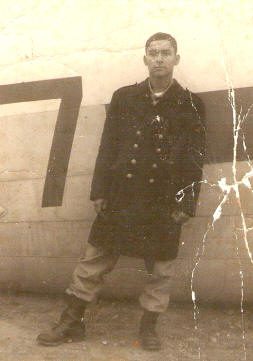
Rodolfo Valentín González Pérez
Rodolfo Valentín González Pérez (via Memoria Viva)

Maybe he wasn’t so clever.  Maybe Rodolfo really thought that was how it was done.  That was, after all, the Chilean way.  But not in the DINA.  One would think he had been thoroughly briefed.  My suspicion is that our Rodolfo Valentín was very clever.  If so, he was in open rebellion.

I don’t know if he really thought he had a chance of not getting caught.  Maybe, like many others, he believed the military government would be over soon.  Or, maybe, he was just very brave.  Rodolfo was already a witness to the wildness of the DINA.  If he wasn’t on board, then he was dangerous.  The day would come when he would speak out.

He had an older brother who was a leftist militant.  He had been given temporary asylum at the Argentine embassy.

Rodolfo was the third of ten.  He had lived with his aunt since he was small.  His father had died in ’64, leaving his mother more mouths than she could feed.  His aunt had raised him to lighten the load.  But someone had taught him very young that there are things one would never do to another human being.  Perhaps that was his father.

He fell in step with the DINA at the beginning.  Afraid, perhaps, or just following orders, as they say.  And, maybe, he missed his father.  That would leave any boy vulnerable to the military style.  And maybe he was the favorite recruit of someone important.  Military hierarchy works that way, believe it or not.  And it just might be true that Rodolfo was momentarily tempted by the unlimited power of the DINA.  It was naked, corrupt, clandestine, total power.

One thing we know for certain.  His parents loved the cinema.  That’s how he got the name Rodolfo Valentín.  Perhaps, they were romantics, fans of Gardel, the tango singer.  The cosmopolitan night life of Santiago in the ‘50’s ended, for them, abruptly.  A heart attack, or an accident; I’m not sure.  Rodolfo was ten when he went to live with his aunt.

The DINA caught him, of course.  Communicating with the incomunicados.  The next day, he was one of them.  They took him from aunt’s home on the night of July 23, 1974.  He could have met Inelia’s boy, Héctor, first as a DINA man, with infinite power over him, and, a few days later, as a comrade in the anonymous darkness at Villa Grimaldi. 

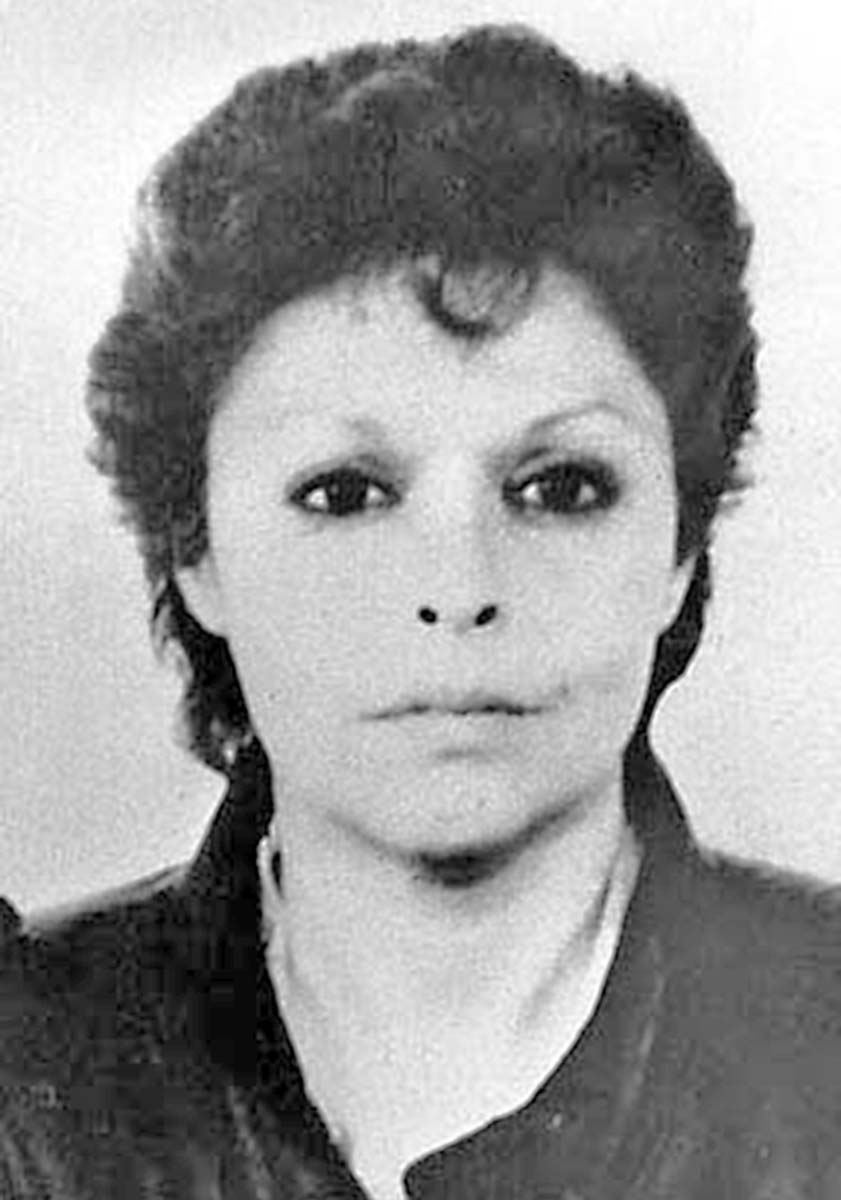
Luz Arce
Luz Arce (via Memoria Viva)

During the Popular Unity years, Luz Arce had belonged to the Socialist Party.  She was taken in June 1974.  Rodolfo was her guard at the Military Hospital.  He became too friendly.  He even asked for her advice about how to get his brother out of the country.

Then, Luz Arce defected to the enemy.  First, she became an informant and, later, a full-blown DINA agent.  Stockholm Syndrome, that’s what they called it.  When someone who is abducted begins to collaborate with their abductors.  It’s what happened to Patty Hearst.

In 1990, when military rule was over, Luz Arce recanted.  She told everything she knew to the Rettig Commission.  She said she saw Rodolfo at Villa Grimaldi.  He had his leg in a cast.  Out of desperation, he had thrown himself from the tower.  Maybe he thought he could escape, but no one ever escaped from the DINA.

They might have thrown him from the tower.  The DINA agents were especially cruel with Rodolfo.  For them, he was a traitor.  Because of his brother, they figured he was a leftist infiltrator.

That wasn’t true.  The other prisoners even said he was different.  He had no political background.  Leftist parties had training.  Militants knew the drill.  They knew what to expect when they were tortured.  Rodolfo, they said, was “like a virgin.”  An inexperienced, innocent boy.

Luz Arce said that the last time she saw Rodolfo alive, he was stripped naked and hanging from a beam at Villa Grimaldi.  We don’t know if he was hanging by his hands, by his feet, or in some unimaginably painful stress position, barely breathing and wishing he could stop.

In 1977, two Air Force officials showed up at his aunt’s apartment in Santiago to confiscate Rodolfo’s military insignia.  It seems they made a special effort to make sure that he never reappeared.  Or maybe they did it just to be cruel.  Why they waited so long was a mystery.

If all children had someone to teach them right from wrong; someone who would say that sometimes the authorities are evil; that power and goodness are not the same thing; then there would be no DINA, no CIA black ops, no My Lai massacres.  There would be no cruelty, no abduction and no torture.  I am surprised that there were so few like Rodolfo.  Sometimes, in this world, there seem to be more cowards than heroes, more darkness than light.  It doesn’t have to be that way.

There were nearly 2,000 who disappeared in Chile between 1974 and 1976.  Most of them were convinced of an ideology.  They had chosen to sacrifice their lives for the dream of a better world.  But Rodolfo’s option was more primitive.  He decided that he could not become a torturer, even if it meant he would be tortured.  He chose solidarity, and it cost him everything he had.


For more on Chile’s disappeared ones, see www.memoriaviva.com.

Nathan Stone is a new graduate student in Latin American History.  He lived in Chile for many years, starting in 1979.

You may also like:

Monica Jimenez reviews Remembering Pinochet’s Chile
Jimena Perry on memory and violence in Colombia
Elizabeth O’Brien reviews Partners in Conflict: The Politics of Gender, Sexuality, and Labor in the Chilean Agrarian Reform, 1950-1970

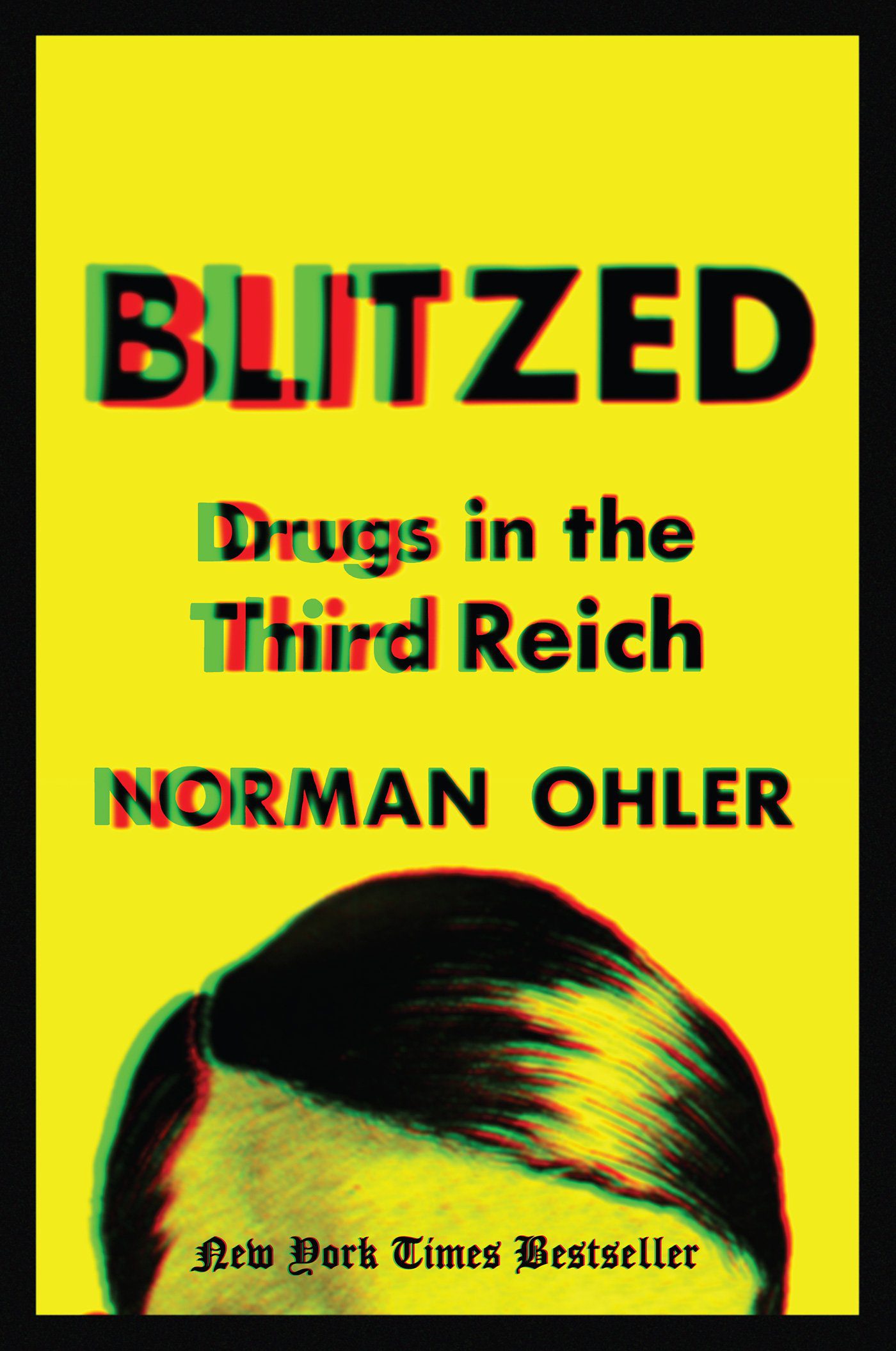
Blitzed: Drugs in the Third Reich by Norman Ohler (2016)

By Natalie Cincotta

A German novelist and screenwriter, Norman Ohler first happened upon the topic of drug use in the Third Reich through a Berlin-based DJ, who told him that drugs were widespread at the time. Intending to write a novel on the subject, Ohler went into the archives in search of historical detail for his book. What he found in military records and the personal papers of Hitler’s physician was so astounding that Ohler left the world of fiction to write a work of history.

The result is the highly readable, bitingly ironic Blitzed, that, although not without problems, lends a fresh perspective on Hitler and the Second World War. In sum, Ohler aims to show that drug use was rife in Nazi Germany. From its rise through to its collapse, German citizens were high, German soldiers were high, and Hitler was high.

In the 1920s, many Germans turned to artificial stimulants to cope with the trauma of WWI, Ohler argues, and eventually Nazi promises of collective ecstasy and euphoria became like a drug itself. In 1937, in a pharmaceutical factory not far from Berlin, the pharmacist Dr. Fritz Hauschild found a drug to match the social intoxication of the time: Pervitin.

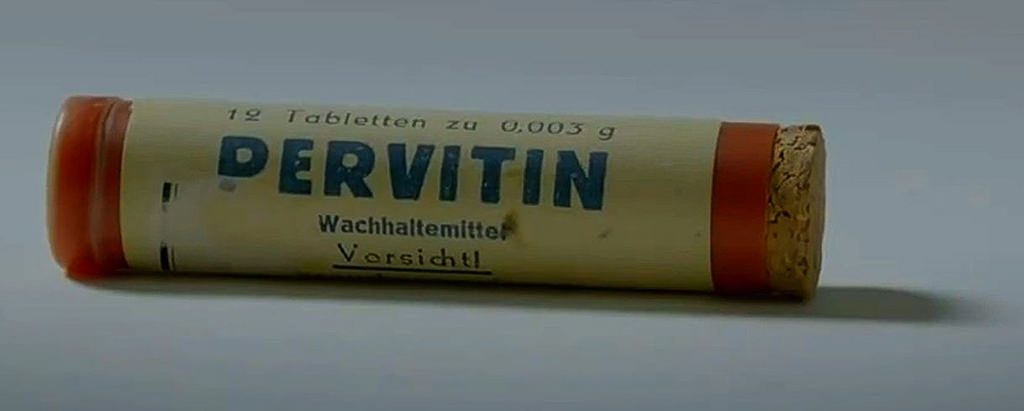
The first German methylamphetamine, Pervitin was a performance-enhancing drug that gave the consumer an “artificial kick” of heightened energy, alertness, euphoria, and intensified senses, often lasting more than 12 hours. Pervitin was marketed to Germans as a panacea cure for anything from depression to “frigidity” in women. By 1939, the drug was also distributed among German army battalions as they swept through Poland and France without sleep and without halt.

The “people’s drug:” Pervitin (Karl-Ludwig Poggemann via Flickr)

Ohler even goes so far as to say that the use of Pervitin was crucial to Germany victory in France in 1940. The German surprise-strategy to drive tanks through the Ardennes – later coined the “sickle cut” by Winston Churchill – was a near-impossible operation, argues Ohler, that only stood a chance if the Germans could drive day and night without stopping. Learning from the use of Pervitin during the Polish campaign, army officials realized that overcoming fatigue was just as crucial as tactic and equipment. The Wehrmacht ordered 35 million tablets for the campaign.

Critics have pointed out that Ohler tends to make sweeping generalizations. Does the evidence he presented, in fact, allow Ohler to say that many or most German citizens and soldiers were taking methylamphetamines? In a scathing review, historian Richard J. Evans wrote that Ohler severely overstates the role of drugs in both civil society and the military effort. “To claim that all Germans, or even a majority of them, could only function on drugs in the Third Reich,” writes Evans, “is wildly implausible.” While it may be difficult to pinpoint how many ordinary Germans took Pervitin, Ohler makes a convincing case for its methodical use and central role in the 1940 campaign.

Hitler and his entourage at the Wolf’s Lair, June 1940. Hitler’s personal physician, Dr. Theodor Morell, stands in the second row, second from the right (via Bundesarchiv)

The second issue that Ohler addresses is that of Hitler’s drug use. Fearing illness and an inability to perform, Hitler sought out performance-enhancing remedies that came in the form of vitamin injections and glucose solutions from Dr. Theodor Morell, his personal physician who saw and treated him more or less daily from 1936 until the end of the war. By 1944, Ohler argues, Hitler was addicted to a mix of cocaine and Eukodal (an opiate), assumed to be marked by an ‘X’ in Morell’s charts. When Eukodal supplies began to run out by February 1945, Hitler began suffering withdrawal symptoms.

Ohler’s assertion that Hitler was a drug addict has roused the ire of some historians, notably Evans, who has dismissed Ohler’s claims as a “crass,” “inaccurate” and morally problematic account that excuses Hitler of his own behavior and crimes. But, that does not seem to be Ohler’s argument here. Blitzed does not propose to reshape our understanding of Hitler’s psyche or ideology, but rather to understand the elements – including drug consumption –  that held Hitler firmly in a world of delusion that ultimately prolonged the Second World War. Historians including Anthony Beevor and Ian Kershaw consider Blitzed a valuable addition to scholarship that is not apologetic, but illuminative.

Perhaps the debate about Blitzed is not only about our understanding of Hitler and National Socialism, but also about who gets to contribute to the already well-trodden scholarship. In his review, Evans expressed concern that Ohler’s background as a novelist gives him a “skewed perspective.” But the perspective of an outsider may be what the discipline needs. Blitzed allows the general reader to learn about a well known period in a new light, while also offering new lines of inquiry for scholars. A meticulously researched and bold work, Blitzed is a must-read for the general reader and scholar alike.

More by Natalie Cincotta on Not Even Past
Veiled Empire: Gender and Power in Soviet Central Asia (Review)

Kevin Baker reviews Omer Bartov’s Hitler’s Army
David Crew discusses the work of German propaganda photographers during the Second World War
Chris Babits on finding Hitler (in all the wrong places)

Too Much Inclusion? Museo Casa de la Memoria, Medellín, Colombia

By Jimena Perry

In 2013, a memory museum opened in Medellín, Department of Antioquia Colombia. Its founding was part of the Victim Assistance Program created by the city’s mayoralty in 2004. Known as one of Colombia’s most violent cities, due mainly to the drug cartel of Medellín led by Pablo Escobar, this urban area suffered severe violence (bombings, targeted killings, kidnappings, bribes, threats, and massacres) from the 1980s to the mid-1990s. The communes of Medellín ‒16 divided into neighborhoods and institutional areas‒ acquired a very bad reputation during this period because most forms of violence happened there. According to official sources, such as the National Registry of Victims, 1,383.988 of 8,421,627 registered victims nationwide, are from the Department of Antioquia.

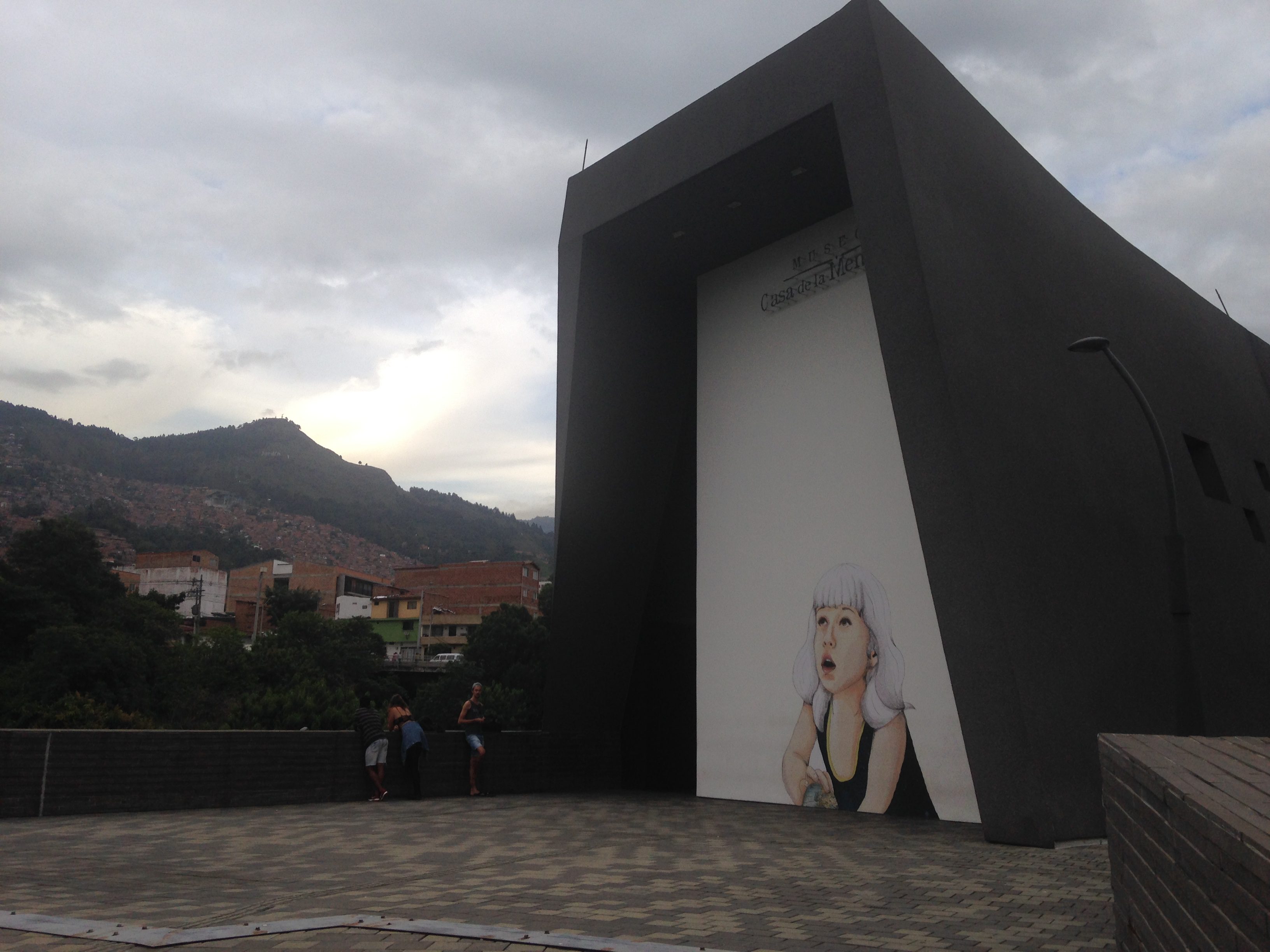
The house-museum (casa museo) is conceived as part of the symbolic reparation of victims the state must pursue, as a space in which they can grieve, come together to tell their stories, and heal. The museum has 378 testimonies that can be heard, viewed, and read. The building in which it is housed has three stories. The first one is a temporary exhibition space, the second is where the permanent display is, and the third is a documentation center. Located downtown, the museum is at the Bicentenario Park and behind a traditional theatre.

Museo Casa de la Memoria, Medellín (Jimena Perry, 2017).

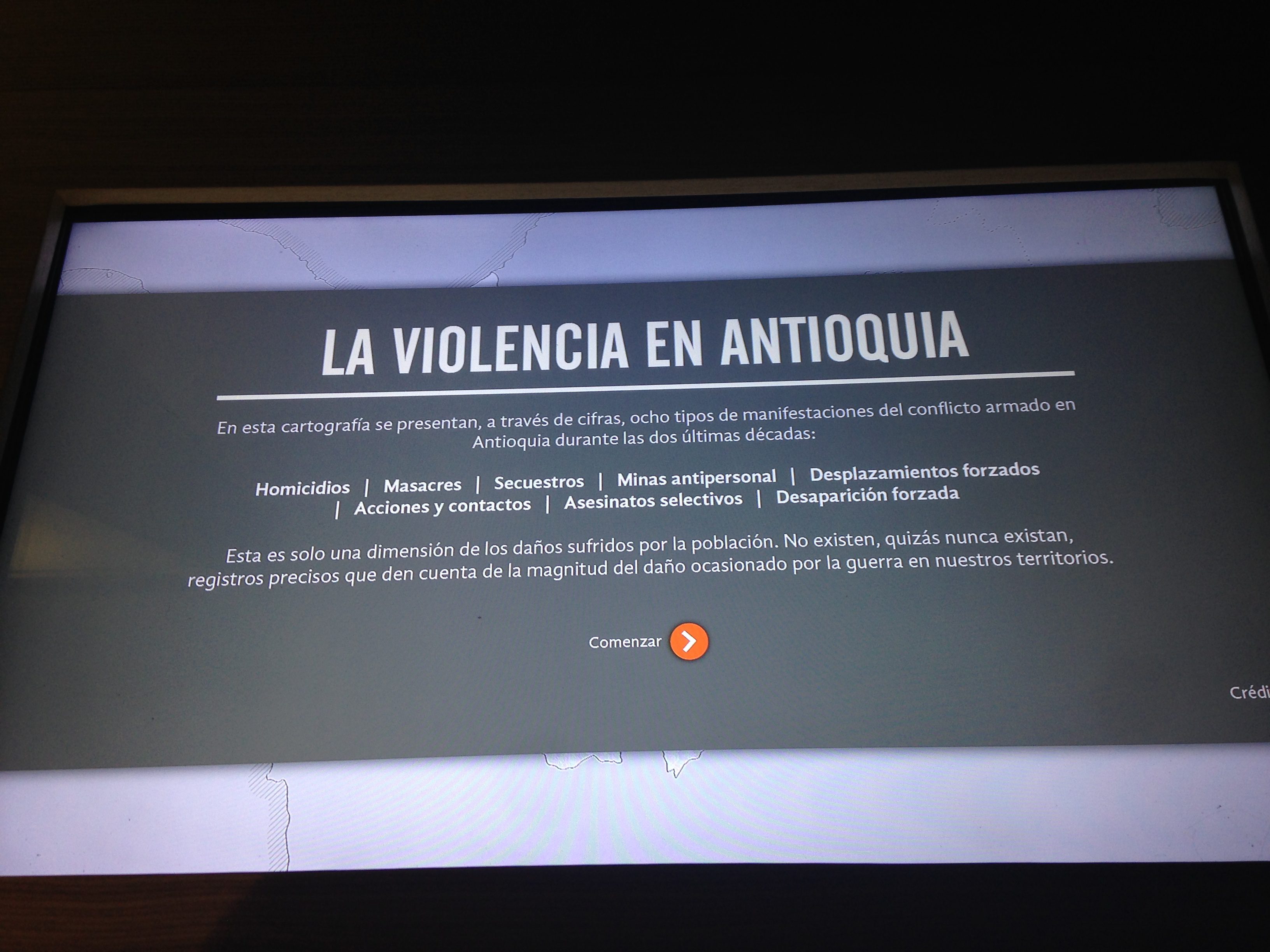
The permanent exhibition of the museum is divided into 16 topics. The first one, named Absences, opens the hall with a mirror wall in which people can read fragments of testimonies related to the sadness of losing loved ones, homes, lands, and domestic animals. The second one, Nostalgic Landscapes, is an audiovisual projected on a wall in which one can observe Antioquia’s rural sceneries affected by the armed conflict. It is meant to convey the pain of forced displacement. The third one, called simply Medellín, is a narrative of the city’s history since 1541. It includes indigenous peoples, afrodescendants, and peasants, trying to be as inclusive as possible. The fourth, Sensitive Territories, is composed by three interactive cartographies which show the numbers of the department´s municipalities, facts of victimization that are remembered collectively, and memory sites in Medellín. These cartographies are intended to highlight how the people from Antioquia resisted the conflict, to denounce atrocities, and to call the viewers’ attention to social mobility.

Interactive Cartographies. People can touch the screens and navigate through information related to violence, victims, and memory (Jimena Perry, 2017).

The fifth space is called Medellín in Movement. It is also a video in which spectators can see the city in action. It shows streets, people, activities, traffic, day, night, and the different ways of inhabiting the urban center. The sixth one, Children’s Words, is a touching panel in which kids define words such as love, violence, fear, dead, displacement, and murder. This is one example: “Murder: To take away the best of a person.” This sentence was written by a nine-year-old boy. The seventh, is an interactive chronology, from 1946 to 2013, in which the history of Colombian violence is told. This piece sticks out due to its grand size and the information it contains. A person can click on its links to find out specific data about certain events, such as the creation of the Fuerzas Armadas Revolucionarias de Colombia, FARC-EP (Armed Revolutionary Forces of Colombia-People’s Army), peace processes, and institutional efforts to end the country’s armed conflict.   

Interactive Chronology (Jimena Perry, 2017).

Space number eight is perhaps one of the most impressive of the displays. It is called Multiple Faces of Violence. This is a sample of approximately 50 pictures taken by four known photographers. The images are displayed in triptychs which the observer can turn and alternate. They are shocking and capture many violent moments that deserve reflection. Besides the pictures there is an interactive screen where the photographers tell their experiences taking the images. The following pictures are the work of Natalia Botero, Jesús Abad Colorado, Albeiro Lopera and Steven Ferry. I chose only a few of them. The images reproduced here were taken by Jimena Perry.

The ninth topic of the permanent exhibition is named Words. Like with the children’s definitions, here children and adults play with the meanings of fear, solidarity, resiliency, memory and difference. The tenth space, Whispers, as shocking or more as the former, is composed by 13 wooden boxes attached to a wall. If someone places his or her ear to a box, a testimony of violence can be heard. The narrative of each box is different and some of them are very hard to listen to.

Wooden Boxes (Jimena Perry, 2017).

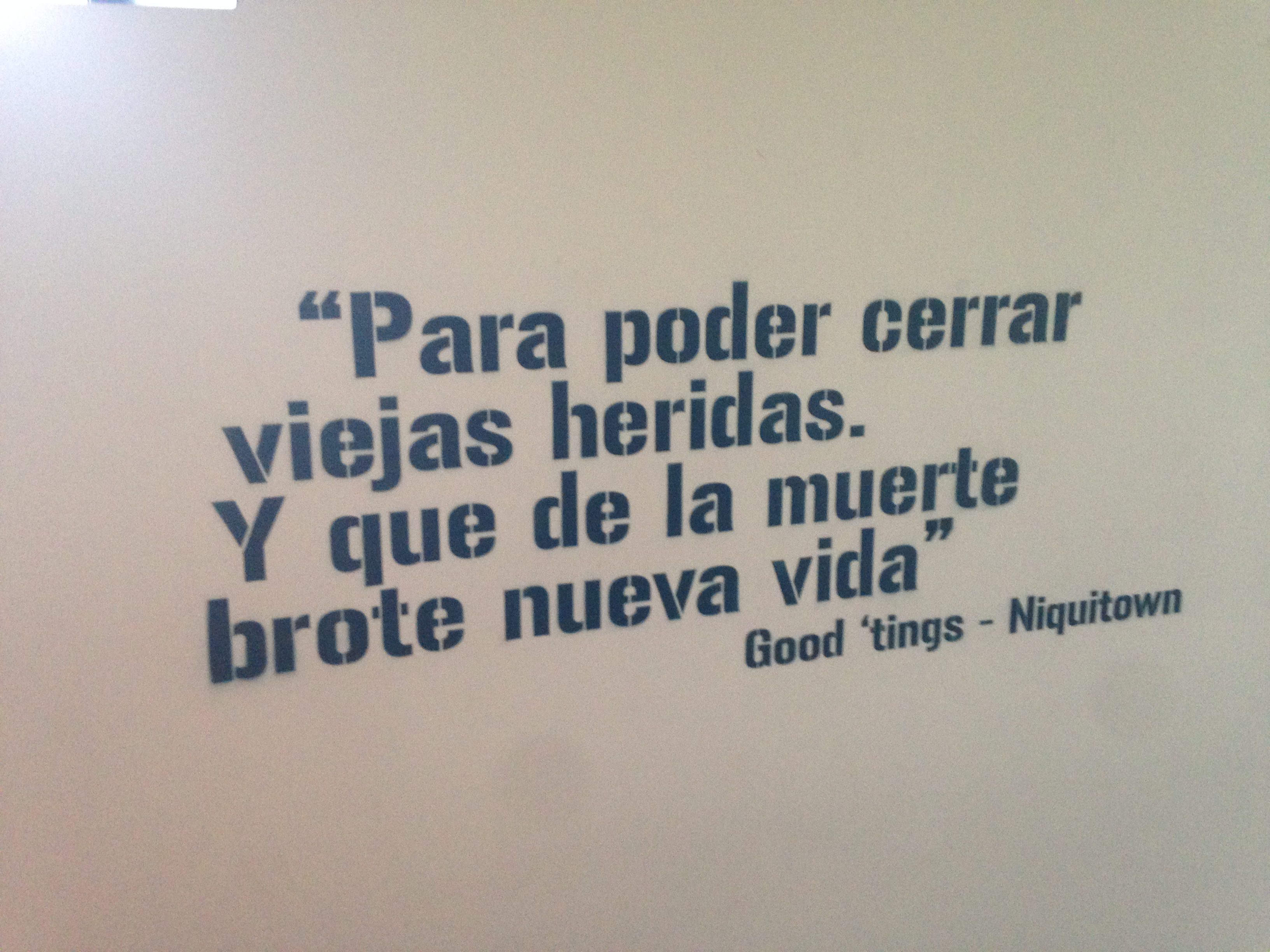
The eleventh space is a composition of 16 cases with artistic pieces in which the armed conflict is represented. They are in the middle of the permanent hall and include topics such as violence against the earth and indigenous communities. The twelfth one, Present Histories, is made of three person-size panels in which recent victims — survivors of violence, politicians, activists of human rights, and priests — give their views and experiences of war. Twenty-four different voices can be heard here. Space thirteen is a recompilation of recent songs with social meaning. Here people can stop to listen to the music, which is mainly hip-hop and rap. The fourteenth one, Art’s Point of View, is also an interactive panel that presents artistic works in which violence is depicted. The fifteenth one, Memory Enclosure, is a wall in which the viewer observes images that come and go over a black screen. The pictures allude to birthdays, baptisms, and everyday life activities and chores to remind the viewer how life was interrupted violently. The last part of the permanent exhibition is a long hall in which there are fragments of speeches of human rights activists, writers, and other people who had fought for peace in Colombia.

“To close old wounds. And that from death new life arises.” (Jimena Perry, 2017)

Medellín’s House-Memory Museum is a place intended to give voice to Medellín’s victims of violence and provide them a site to grieve, reunite, remember, and develop strategies to avoid future violence. The institution’s first director defined this mission clearly enough, however the second and current one is implementing some changes. She said publicly that the museum should not only be for victims and perpetrators but for every citizen. This statement caused uneasiness in the city’s inhabitants because the space is supposed to represent symbolically the people directly affected by violence. So, here big questions come up: How much inclusion is desirable? Which is the audience of the institution?

Another issue worth mentioning is the absence of drug trafficking victims at the museum. Even though Pablo Escobar was born in Rionegro, his business was all run in the capital of Antioquia. Escobar and his organization, the Medellín Cartel, committed 623 attacks that left hundreds of dead civilians and thousands wounded. The Cartel also was responsible for the murder of 550 policemen, 100 bombs in Bogotá and Medellín in malls, official institutions, airplanes, and newspapers. Approximately 15,000 people died due to the actions of the Medellín Cartel between 1989 and 1993. Among the deceased were presidential candidates, journalists and politicians. Kidnappings of politicians and journalists were very common as well. It is surprising that the museum does not mention these victims. This is a part of Colombian history that remains absent from most institutions, drug lords are not part of museum narratives leaving big silences that need to be filled. Perhaps telling this part of history should also be part of the healing process.


Also by Jimena Perry on Not Even Past:

Time to Remember: Violence in Museums and Memory in Colombia, 2000-2014
My Cocaine Museum, by Michael Taussig (2004)

You may also like:

Magical Realism on Drugs: Colombian History in Netflix’s Narcos

Digital Teaching: Mapping Networks Across Avant-Garde Magazines

In “The European Avant-Garde in Print” (REE 325), students explored the unique and vibrant print culture in Central Europe between the two world wars and the social and political context that produced it. I sought to expose students to the networked qualities of magazines that were published in Czech, Hungarian, Serbo-Croatian, Polish, and German. We examined contributor lists, the aesthetic qualities of the “New Typography,” and the way that the magazines cross promoted each other through advertisement.

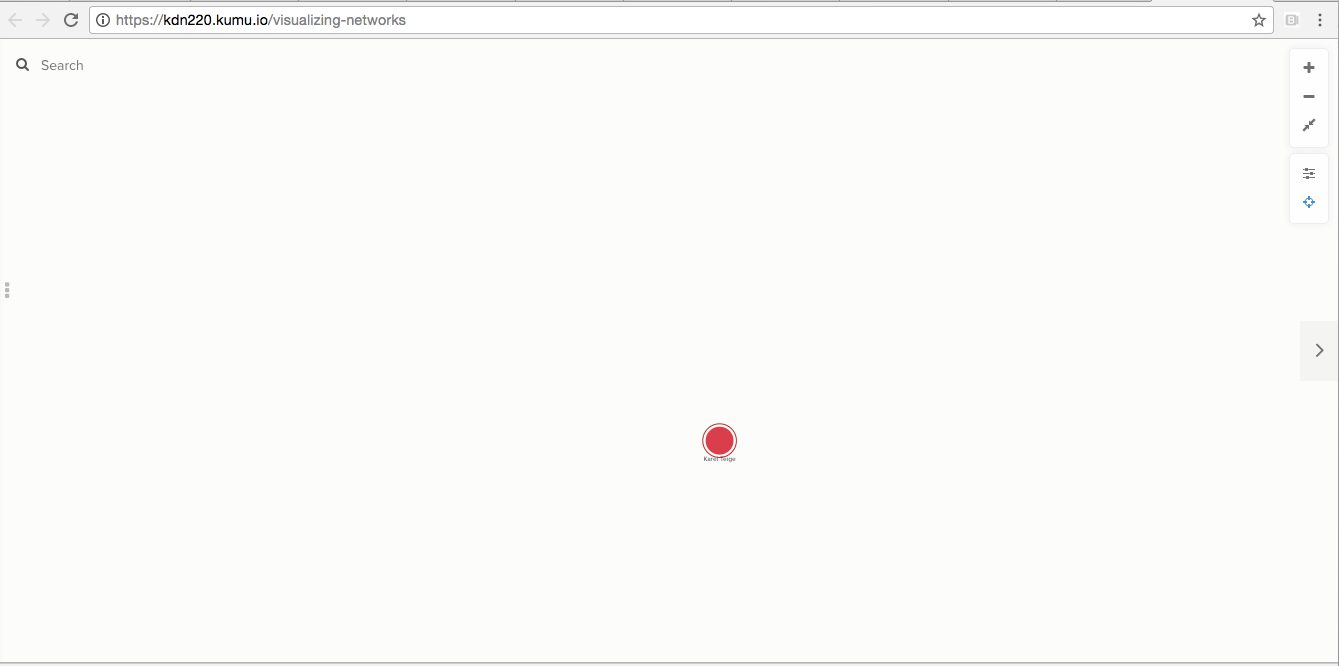
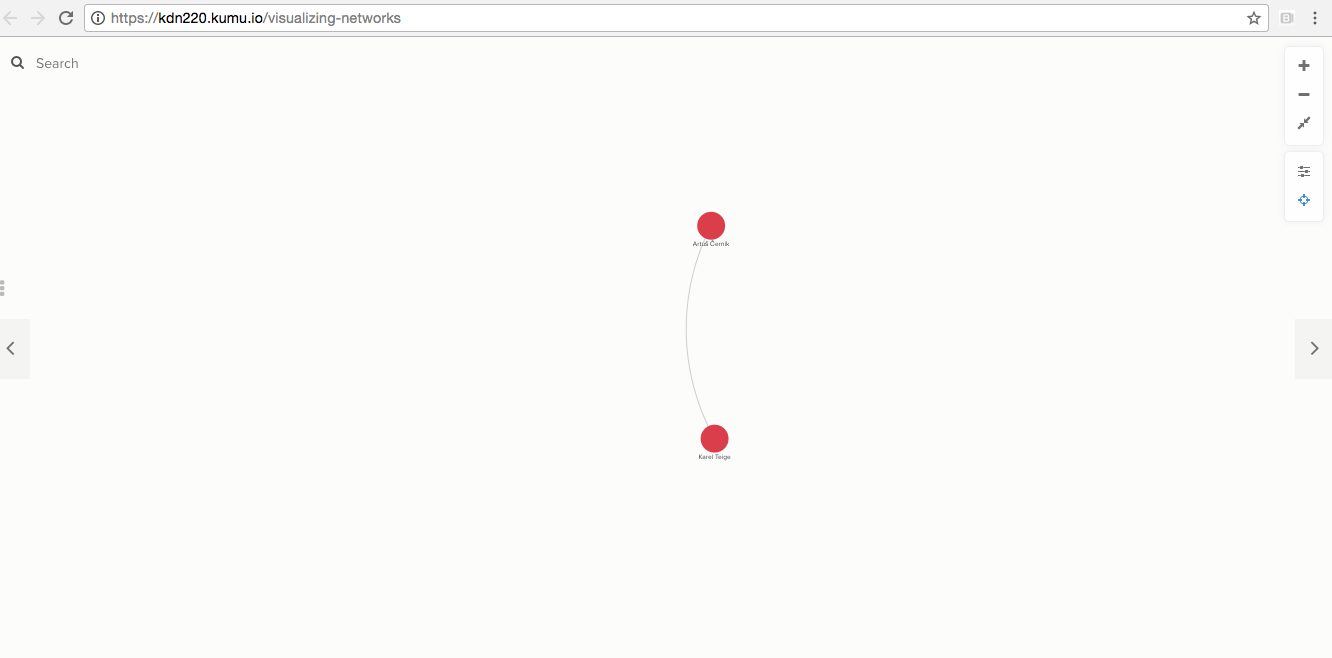
Students discovered the transnational and multilingual interconnectivity of these magazines through the use of various digital mapping and open source publishing resources, such as Kumu and Scalar. Using Kumu’s Social Network Analysis tool, for instance, I could help students visualize how one figure, such as Karel Teige, the leading member of the leftist Czech avant-garde group Devětsil, leveraged his connections with editors elsewhere to make magazines that facilitated relations with major figures of a pan-European avant-garde. To offer just one example, through the Brno-based magazine, Pásmo, the Czech avant-garde actively collaborated with the Russian born and Berlin-based artist El Lissitzky, the German Bauhaus director Walter Gropius, and French-German correspondent Yvan Goll.

(via author)

I used digital mapping in my lectures  to make this fluid exchange more concrete and dynamic for students.  Then, a major component of the class was built around students developing their own digital mapping and visualization group projects. In this way, students had the opportunity to engage critically and interactively with the materials covered in the course.

One group drew on our extensive discussion of Dada periodicals published both in Europe and the United States—which we had the opportunity to view in person at the Harry Ransom Center—to reveal how some prominent artists appeared in Dada publications on both sides of the Atlantic. They also used their map to comment on who did not figure in these publications—namely, women, with the exception of the New York-based 291 contributor Agnes Meyer, whom they featured.

(via author)

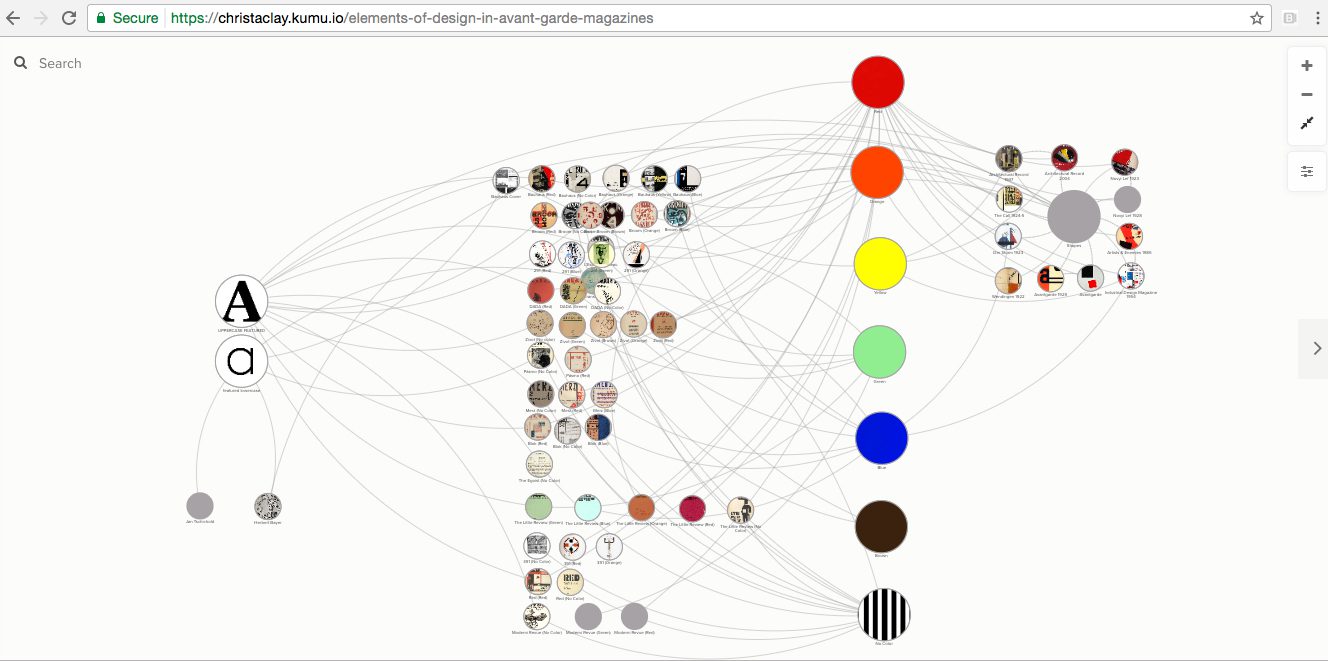
Another group of students chose to document connections across a series of publications not via their contributors or geographic locale, but rather in relation to shared principles of design, such as color, shape, and textual form. This group even built their map to visually reflect in its own design the various components that they chose to highlight.

(via author)

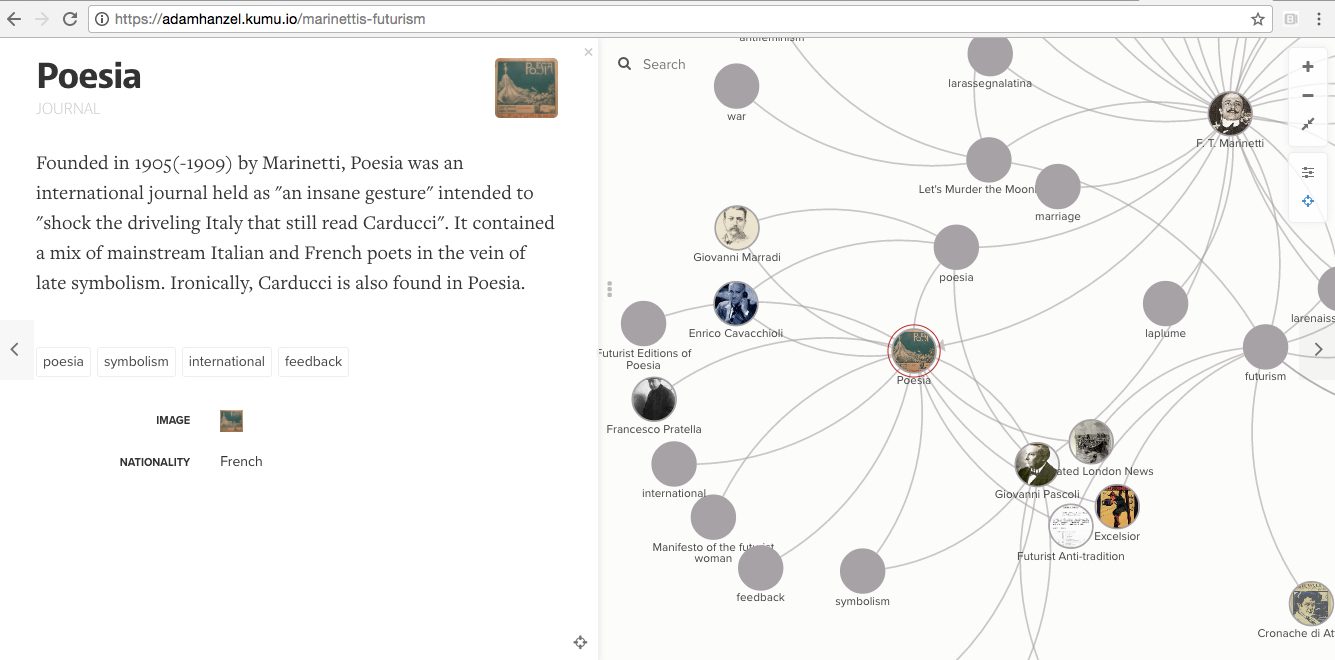
Another project focused on a single magazine—the Italian Poesia—to make manifest the various personal connections between the leading figure of Italian Futurism, F.T. Marinetti, and other artists and authors related to the movement.

(via author)

The digital mapping component of the course was largely made possible with the assistance of UT’s Slavic and Digital Scholarship librarian, Ian Goodale, who made multiple class visits in which students had the opportunity to workshop their digital projects, and who also held weekly office hours in the Slavic Department. Ian also created a Scalar platform that holds all the mapping projects in one place, with the Kumu maps embedded, and includes other analytical content generated by students, allowing for further connections to be drawn across the group projects.

I observe in my own classroom, and in the work of my peers both across UT and at other institutions, the need for universities and colleges to commit to allocating funding for their libraries so that they may train and hire staff who are able to support digital pedagogy. For example, this past semester, Ian Goodale also helped my colleague in the Slavic Department, Vlad Beronja, create another digital project, Yugoslav Punk, with students in his course on Punks & Divas in Southeastern Europe.

Another aim in teaching “The European Avant-Garde in Print,” was to expose students to non-European periodicals, to explore the variety  of responses to inter-war social and political conditions, and also to find actors outside of a European male cohort largely not represented in the Central European set. By giving students the opportunity to create their own mapping projects, I hoped to reveal unexpected connections between these cultural products. There is more work to be done in achieving these goals in a future iteration of this course, and data visualization and digital mapping tools will facilitate students’ active learning towards this end.

You may also like:

Digital Learning: Starting from Scratch, by Joan Neuberger
Media and Politics From the Prague Spring Archive, by Ian Goodale
The Prague Spring Archive Project, by Mary Neuburger and Ian Goodale

_________________________________________________________________________________________

The views and opinions expressed in this article or video are those of the individual author(s) or presenter(s) and do not necessarily reflect the policy or views of the editors at Not Even Past, the UT Department of History, the University of Texas at Austin, or the UT System Board of Regents. Not Even Past is an online public history magazine rather than a peer-reviewed academic journal. While we make efforts to ensure that factual information in articles was obtained from reliable sources, Not Even Past is not responsible for any errors or omissions.
Age of Anger: A History of the Present, by Pankaj Mishra (2017)

By Ben Weiss

In Age of Anger: A History of the Present, acclaimed author and journalist Pankaj Mishra explores what he describes as the tremors of global change. For the past several decades, liberal cosmopolitanism provided a false sense of security after the fall of the Soviet Union. Now, Mishra claims, world schisms have begun to manifest in increasingly overt displays of violence by state and non-state actors alike, leaving dubious possibilities for the coming years. In this accessible work of public history, Mishra traces a long arc of the rise of the Age of Anger from the Enlightenment to what he perceives as the precarious present.

The book was written and published as we watched the explosion of chaos in Syria and Iraq, the collapse of established and relatively balanced political and economic relationships, increases in terrorist activity in places such as Turkey, Kenya, and Nigeria, and increasing violence stemming from racial prejudices in France, Great Britain, and the United States. The rise of rancorous populism cracking its way through the foundations of traditional model democracies in the West, evidenced by the success of Donald Trump, Marine Le Pen, and Brexit, leads Mishra to fear that the globe is on the precipice of world wide disaster.

“After a long, uneasy equipoise since 1945, the old west-dominated world order is giving way to an apparent global disorder.” This new disorderly Age of Anger ranges both from the destabilizing fury of history’s marginalized populations as well as the counterrevolutionary response that has mobilized hatred within mainstream political discourses. Unfortunately, Mishra offers little perspective on how the world may emerge from this predicament. For him, the tumultuous year that was 2016 is only the beginning.

The real value of this fairly pessimistic yet stimulating work is in Mishra’s analysis of how we arrived in the Age of Anger. Scholars in subaltern and imperial histories have argued for decades that the sheer arrogance of narratives of Western liberal progress have concealed the crumbling foundations of modernized globalization. Mishra offers an accessible and nuanced narrative of the emergence of popular rage from the European Enlightenment, through the advent of industrialization and imperialism, and the various alignments of the non-Western world within a Eurocentric global order during the twentieth century. From the upheavals of the Reign of Terror in revolutionary France to the rise of fascism in the twentieth century, he shows that the neatly packaged concept of liberal modernization mostly consists of a process of “carnage and bedlam.” Mishra argues that elites, unable to cope with the reality of modernization, take refuge in precipitating alienation: destruction of civil liberties, states of emergency, anti-Islamic movements, rhetoric purporting the global clash of civilizations, and the like. Though perhaps framed within too much of a polarized dichotomy, Mishra’s analysis reveals a massive schism between political and economic elites and the larger masses who have been directed into “cultural supremacism, populism and rancorous brutality” as a result of being denied the promised advantages of modernity. The consequential tension leaves us on the threshold of a “global civil war.”

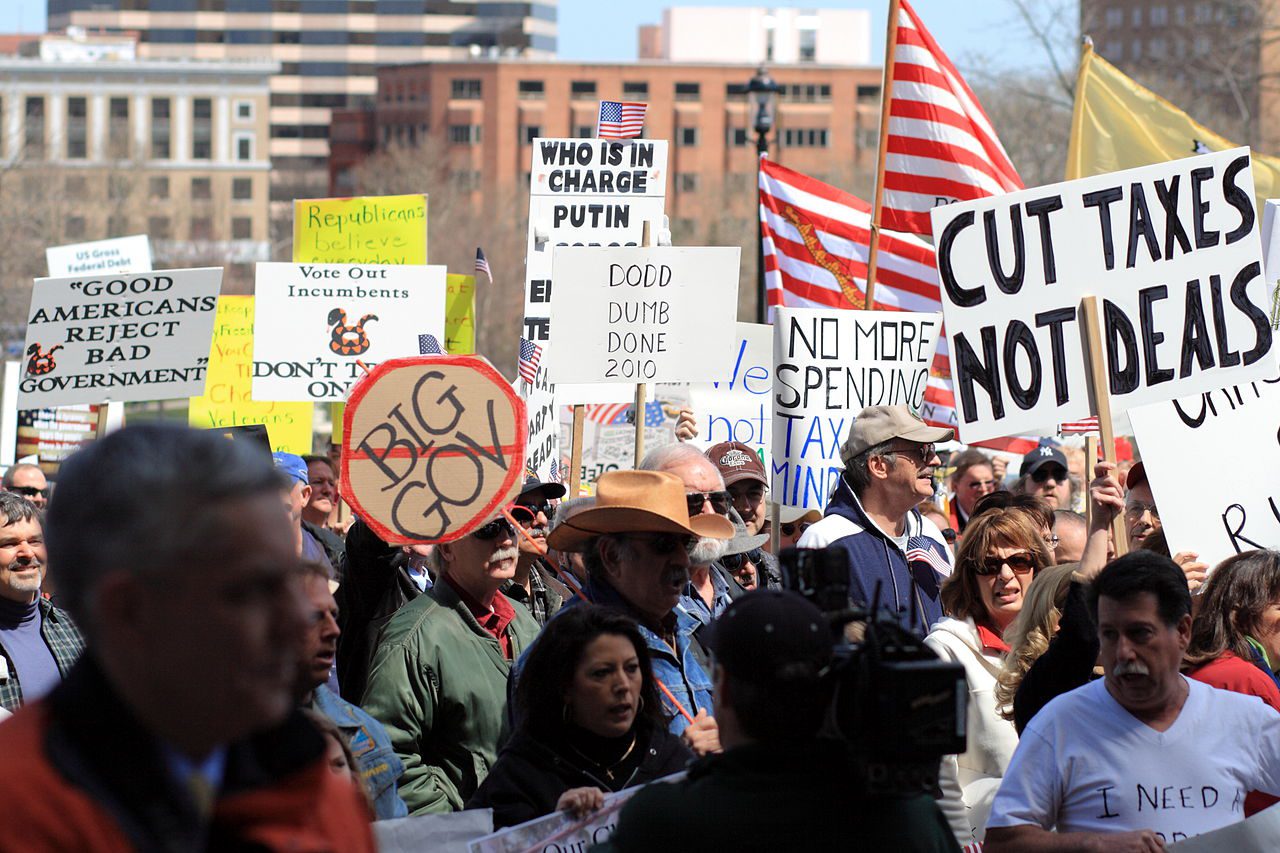
A Tea Party protest in 2009 (via Wikimedia Commons).

Mishra predicts that continuing economic stagnation will exacerbate the bitterness of these existing divisions. Many will react to literal displacement from their societies or social and political displacement as we have seen with the recent and rapid expansion of activities in United States immigration. The subsequent fear and rage will divide those who may resort to radical violence because they have nothing left to lose from those who will empower more radical elites who promise to tear down the existing system. However, for Mishra, this chaos is fully representative of the process of liberal modernization. Once you strip the implications of liberal modernization of its positive rhetoric, what remains is a cacophony of violence. Slavery, imperialism, and warfare have always been the dark underbelly of the liberal project.

While modernization has generated the context for this violence to take on truly global proportions for the first time, Mishra’s detailed history describes the development of these themes through earlier centuries. For example, Voltaire routinely emphasized the exemplary capacity of humanity to exercise free will, however, he actively encouraged Catherine the Great to coerce Poles and Turks into Enlightenment education under threat of violence. All the while, Catherine’s actions allowed him to make a fortune in the commercial investments of new markets that arose as a result of this coerced ideological diffusion. Mishra also alerts readers to the various thinkers such as Rousseau and Nietzsche who prefigured the growth of dissident populations and their inevitable role as destabilizers during the emergence of modernization, drawing interesting parallels to the role of Islam in the twentieth century.

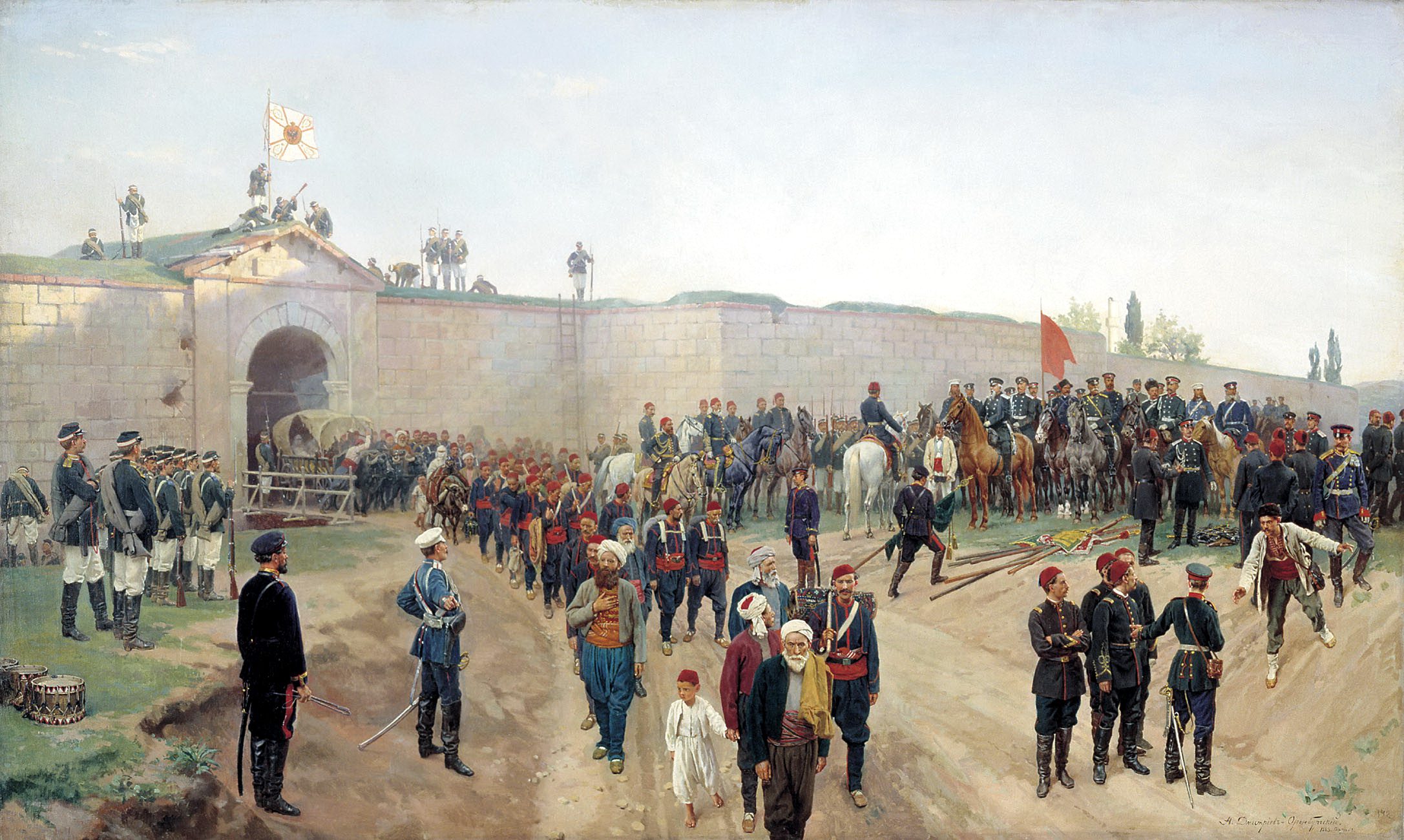
The Ottoman capitulation in 1877 ended the Russo-Turkish War (via Wikimedia Commons).

By demonstrating the connection of ideas in Europe with the rest of the world, Mishra is able to draw heavily from Nietzsche’s concept of ressentiment, which encapsulates the innate hatred and envy fostered by groups who are positioned as inferior. For example, ressentiment could describe the attitude of the colonized under imperial regimes. Mishra claims that Muhammad Iqbal, an Islamic poet and religious reformist, and Lu Xun, an activist in China all pulled from Nietzsche’s ideas, while “Hitler revered Atatürk” and “Lenin and Gramsci were keen on Taylorism.” This mix of Enlightenment thought with global adaptations speaks to the paradoxical fusion of self-contempt instilled by liberal otherization with the rage that facilitates resistance to the same system. Indeed, as Mishra contends, leaders from all over the global south and east met imperialism by synchronizing with Western ideology in order to secure their independence from the West. This aspiration failed locking much of Africa, Asia, Latin America, and various Marxist movements into liberal modernity. “The key to man’s behaviour lies not in any clash of opposed civilizations, but, on the contrary, in irresistible mimetic desire: the logic of fascination, emulation and righteous self-assertion that binds the rivals inseparably. It lies in ressentiment, the tormented mirror games in which the West as well as its ostensible enemies and indeed all inhabitants of the modern world are trapped.”

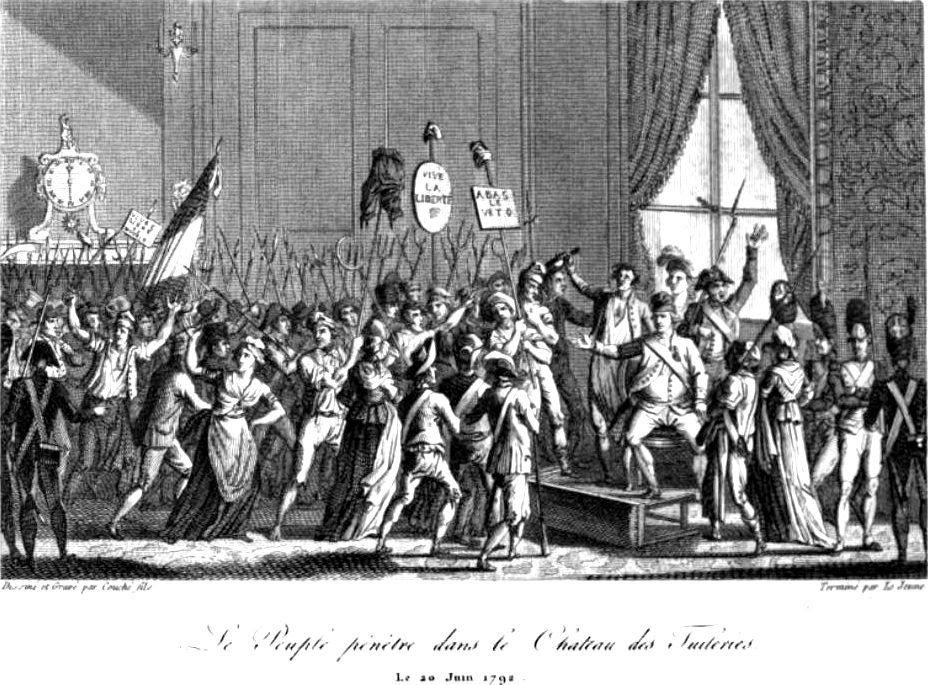
The Paris Commune stormed the Tuileries Palace in 1792 during the French Revolution (via Wikimedia Commons).

The ambitious project of Age of Anger is not without its faults, namely some oversights and generalizations. For one, Mishra does not consider social democracy or Marxism as the alternatives to neoliberal world systems that they perceive themselves to be. In other ways, his attempts to paint a larger history in broad strokes risks overgeneralizing some phenomena and exaggerating historical causality. Due to some of these flaws, proponents of liberalism may find his arguments unconvincing, but for those sympathetic to analysis of the darker sides of modernity, Mishra’s work should prove thought provoking while drawing attention to potential linkages in historical developments across multiple centuries in a way that brings arguments previously sequestered to academia into the public sphere.
Pankaj Mishra, Age of Anger: A History of the Present (New York: Farrar, Straus and Giroux, 2017).


Also by Ben Weiss on Not Even Past:

My Alternative PhD in History.
The British Industrial Revolution in Global Perspective, by Robert C. Allen (2009).
Violence: Six Sideways Perspectives, by Slavoj Žižek (2008).

Why I Ban the Word “Feminism” from My Classes

by Jacqueline Jones

In each of my graduate seminars, at the beginning of the semester, I caution students not to use certain words I consider problematic; these words can actually hinder our understanding of a complex past.  Commonly used—or rather, overused—in everyday conversation as well as academic discourse, the banned words include “power,” “freedom,” and “race.”  I tell my students that these words are imprecise—they had different meanings depending upon the times and places in which they were used– and that today we tend to invoke them too casually and even thoughtlessly.

Oh yes, and there is another word I ask my students to avoid—“feminism.”  Students often greet this particular injunction with surprise and dismay. Does it mean that their instructor believes that women should stay at home and not venture into the paid labor force?  If so, why is she standing in front of a classroom now?  So I have to be sure to make a case about the pitfalls related to the use of the word.  Even the broadest possible definition is problematic, as we shall see.

Protesters at the 2017 Women’s March (via Wikimedia Commons).

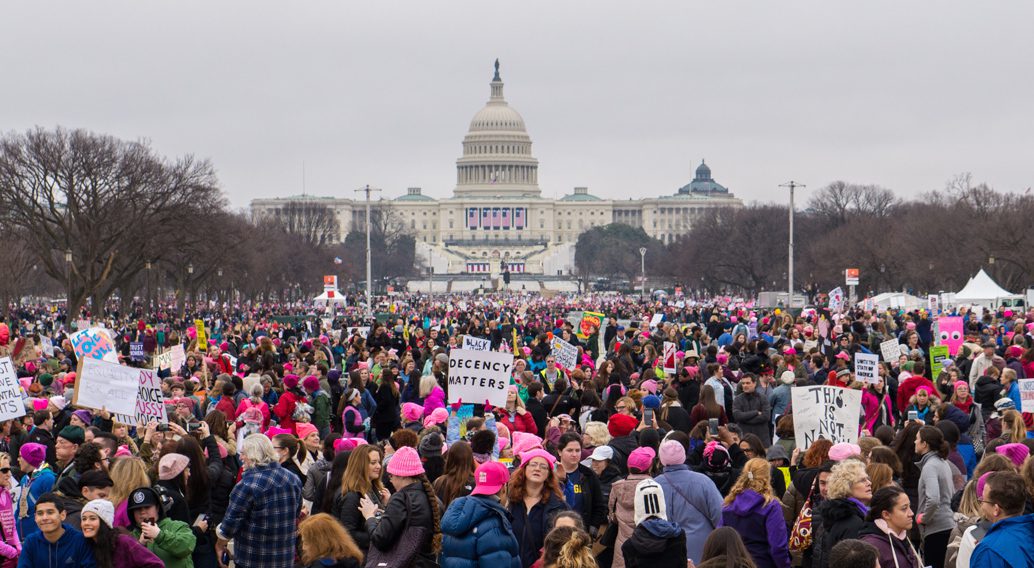
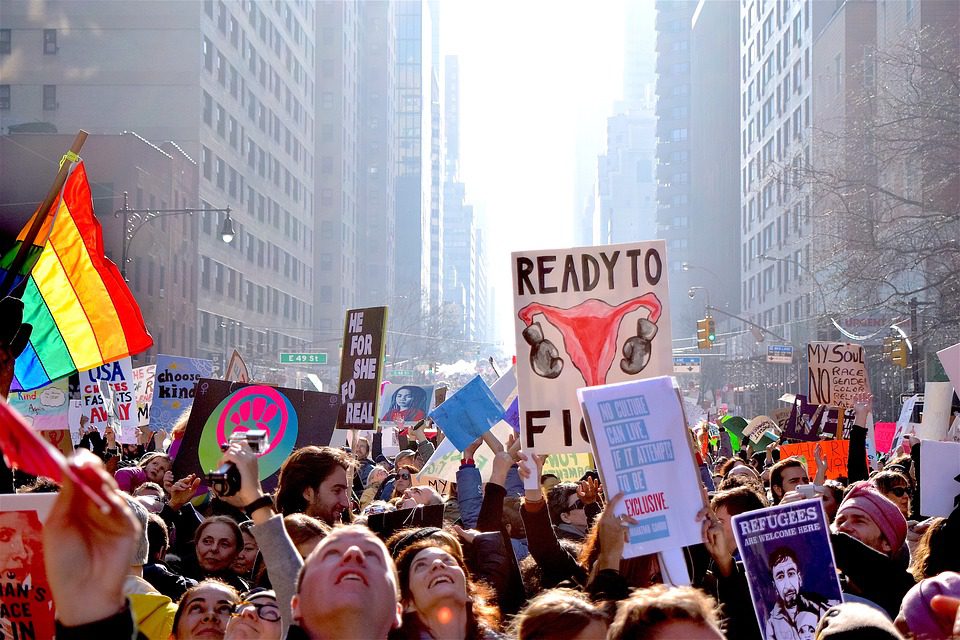
The purpose of the massive march on Washington held on January 21, the day after President Trump’s inauguration, was to protest his election.  It was called the “Women’s March,” and as we all know, sister marches took place all over the country and the world the same day.  A group of women initiated the idea of the protest, and took care of all the logistics; many participants wore pink “pussy hats” to call attention to the President’s demeaning remarks about grabbing women’s genitals captured on the infamous Access Hollywood videotape.  The hand-held signs at the rally covered a whole range of issues, including abortion and reproductive rights, equal pay, sexual harassment, Black Lives Matter, protection for undocumented immigrants, public education, and women’s struggles for fair treatment and equality generally.   Presumably, Trump’s election had prompted an historic level of anger and frustration among women. Many news outlets, participants, and observers suggested that the march represented a remarkable display of re-energized, twenty-first century feminism, with the word itself suggesting a kind of transcendent womanhood bringing together women of various ages, races, classes, and ethnicity.

Protesters at a sister rally in 2017 (via Pixabay).

Well, not exactly.  Although only 6 percent of African American women voted for Trump, 53 percent of white women did.  We can safely assume, then, that many white women not only stayed away from the march, but also objected to it in principle: the pink-pussy-hat contingent did not speak for them.  So we might ask, which groups of women did not march?  Here is a possible, partial list: devout Catholic women who believe that birth control, abortion, and gay marriage are sins against God; former factory workers who were fired from their jobs when their plants were shipped overseas; the wives and daughters and mothers of unemployed coal miners; anti-immigrant activists; women of color who saw the march as dominated by white women; and pro-gun rights supporters. Missing too were probably women who found Mr. Trump’s video sex-talk disgusting but chose not to see this as the defining issue in the 2016 Presidential campaign–just as some liberal women might have disapproved of Bill Clinton’s affair with Monica Lewinsky but did not let that affair diminish their support for him when he was president.  In both these cases, the pro-Trump and pro-Clinton supporters expressed less solidarity with the men’s victims and more support for other elements of the men’s politics.  In other words, these women eschewed any putative “sisterhood” in favor of other political issues.

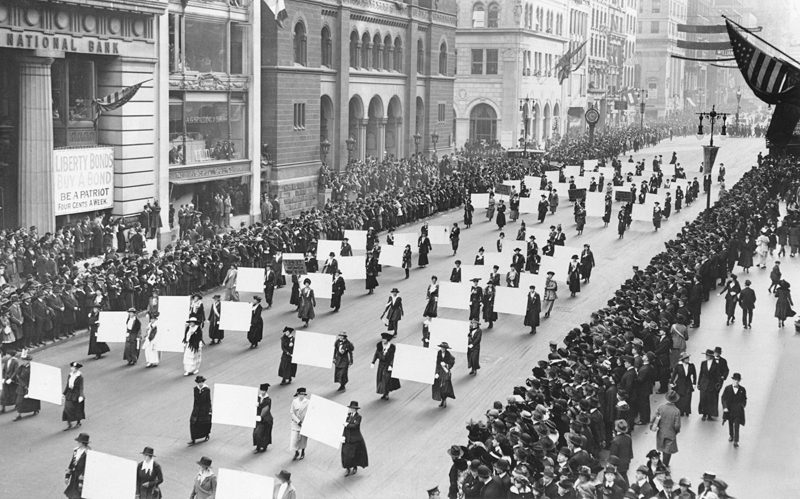
Suffragists parade down Fifth Avenue, 1917 (via Wikimedia Commons).

Another way of looking at this issue is to challenge the view that feminists had as their greatest priority a woman president.  How many self-identified feminists were eager to see Sarah Palin run for president in 2012?  Again, for many women, their overriding concern is not womanhood per se but a wide range of political beliefs and commitments. As we learned soon after U. S. women got the right to vote in 1919, different groups of women have different politics; in the 1920s, the suffragists were astonished to find that women tended to vote the way their husbands did, according to a matrix of ethnic and class factors.

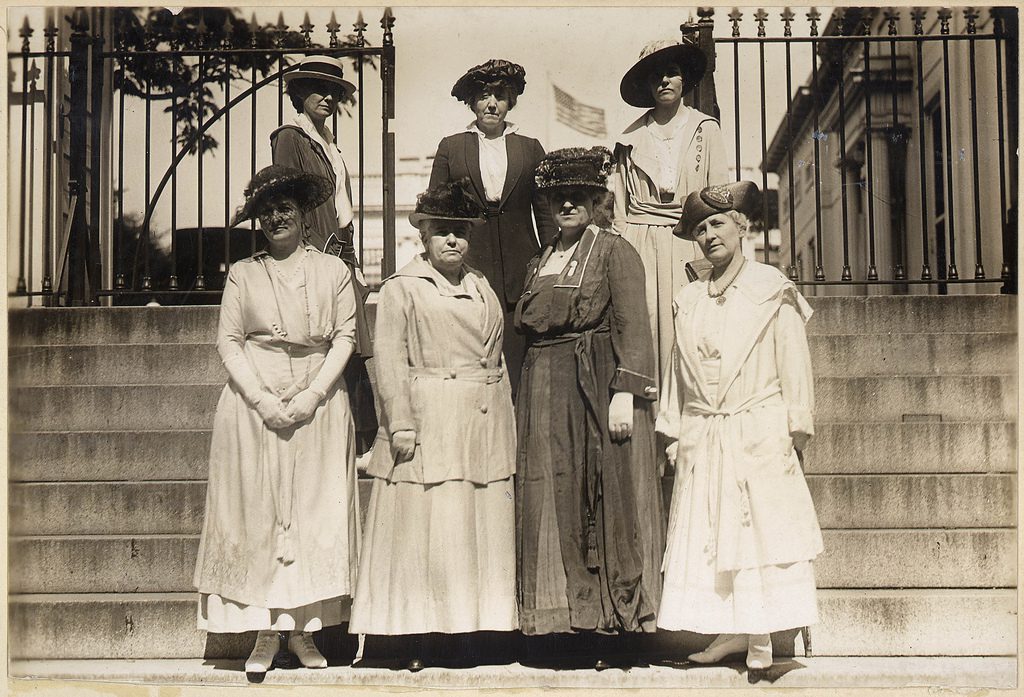
Delegation of officers of the National American Woman Suffrage Association, 1917 (US National Archives via Flickr).

The example of the Women’s March suggests that, for all the talk today of “intersectionality” (the interconnectedness of certain social signifiers such as class, religion, “race,” and gender) “feminism” promotes a very specific political agenda, one that does not necessarily reflect the priorities and lived experience of a substantial portion of the female population. In essence, the word “feminism” is too vague to have much meaning within a society where women have multiple forms of identity, and gender might or might not be the defining one at any particular time.  Even the broadest possible definition—feminists are people who seek to advance the interests or the equal rights of women—has its limitations.
As an historian, I would suggest several reasons why students should avoid the use of the word “feminism”–unless they encounter the word in a primary text; then they should try to figure out what the user meant by it.

  • The word itself did not appear in common usage until the 1920s. Therefore it would be a mistake to apply it to people before that time, or to people since who themselves have not embraced the label; otherwise we risk imposing a term on historical actors who might or might not have used it to describe themselves.
  • Throughout history, various waves of the so-called “women’s” or “feminist” movement were actually riven by intense conflicts among women. Around the turn of the twentieth century, leading white suffragists went out of their way to denigrate their black counterparts and express contempt for immigrant and working class men and women. The early organizers of the National Organization for Women feared that association with lesbians and militant black women would taint their drive for respectability.  Organizers of the 2017 Women’s march debated whether or not anti-abortion women could or should be included in the protest: could one be a feminist and at the same time oppose reproductive rights for women?

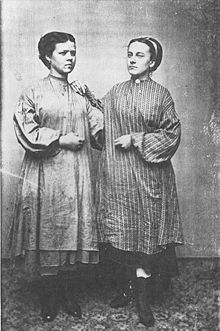
Two Lowell mill workers, ca. 1840 (via Wikimedia Commons).

  • Often in history when we find solidarity among women it is not because these groups of women sought to advocate better working conditions or the right to vote for all women; rather, their reference group consisted of women like themselves. In the 1840s, Lowell textile mill workers walked off the job and went on strike not as “feminists,” but as young white Protestant women from middling households—in other words, as women who had much in common with each other.  Religion, ethnicity, lineage, and “race” have all been significant sources of identity for women; when a particular group of women advocates for itself, it is not necessarily advocating for all other women.
  • Similarly, we are often tempted to label those strong women we find in history as “feminists,” on the assumption that they spoke and acted on behalf of all women. Yet they might have believed they had more in common with their male counterparts than with other groups of women.  Female labor-union organizers probably felt more affinity with their male co-workers than with wealthy women who had no experience with wage work.  In other words, the transcendent sisterhood that feminism presupposes is often a myth, a chimera.
  • The word not only lacks a precise definition, it also carries with it a great deal of baggage. Indeed, some people have a visceral, negative reaction to the sound of it. It is difficult to use a term with such varied and fluid meanings.  And feminism meant something different to women of the 1960s, when they could not open a credit-card account in their own name or aspire to certain “men’s jobs,” when they debated the social division of labor in the paid workplace and in the home, compared to young women today, who at times see feminism through the prism of music lyrics, movies, fashion, and celebrity culture:  Is the talented, fabulously wealthy Taylor Swift a feminist?
  • Finally, a personal note: In the 1960s, I was a college student and caught up in what was then called the “feminist movement” as shaped by Betty Friedan’s book The Feminine Mystique and the newly formed National Organization for Women.  My mother disapproved of my emerging priorities in life; she had gotten married right after World War II, and she believed (rightly, as it turned out) that the movement denigrated her choice to stay home full-time with her children.  I was puzzled and distressed that my mother could not appreciate my choices; but now I am also puzzled and distressed that the movement could not appreciate her choices.  Coming of age during the war, she feared that she would never marry and have a family, and when she finally had that opportunity, she was happy—for the most part—to embrace it, despite the considerable financial sacrifice for the household that her choice entailed.

Women’s March 2017 (Backbone Campaign via Flickr).

Perhaps, with very few exceptions—equal pay for equal work?—there are few issues on which all women everywhere can agree.  My own view is that, we can pursue social justice in ways that advance the interests of large numbers of men as well as women, without having to defend the dubious proposition that “feminism” as constructed today speaks to and for all women.  It doesn’t.  For the historian, that fact means that we have to come up with other, more creative ways of discussing forms of women’s activism and personal self-advancement that took place in the past, and, in altered form, continue today.

Also by Jacqueline Jones on Not Even Past:

The Works of Stephen Hahn.
On the Myth of Race in America.
History in a “Post-Truth” Era.

The Blemished Archive: How Documents Get Saved

By Chris Babits

In a May 2016 podcast for the Journal of American History, Yael A. Sternhell said, “For the great majority of [historians], when we walk into an archive, we have this illusion that this is where historical knowledge lies. Raw primary sources. Untainted. Unblemished. Just waiting for us to pick them up and create [a] narrative that will adhere to the history of the topics we’re looking at.” She believes that this is not how we should look at archives. Sternhell challenges historians to think about how papers got to their respective archives, who arranged them, and whether the arrangement of items in special collections and archives affect the stories that historians construct.

university_of_north_texas_september_2015_11_hurley_administration_building-1

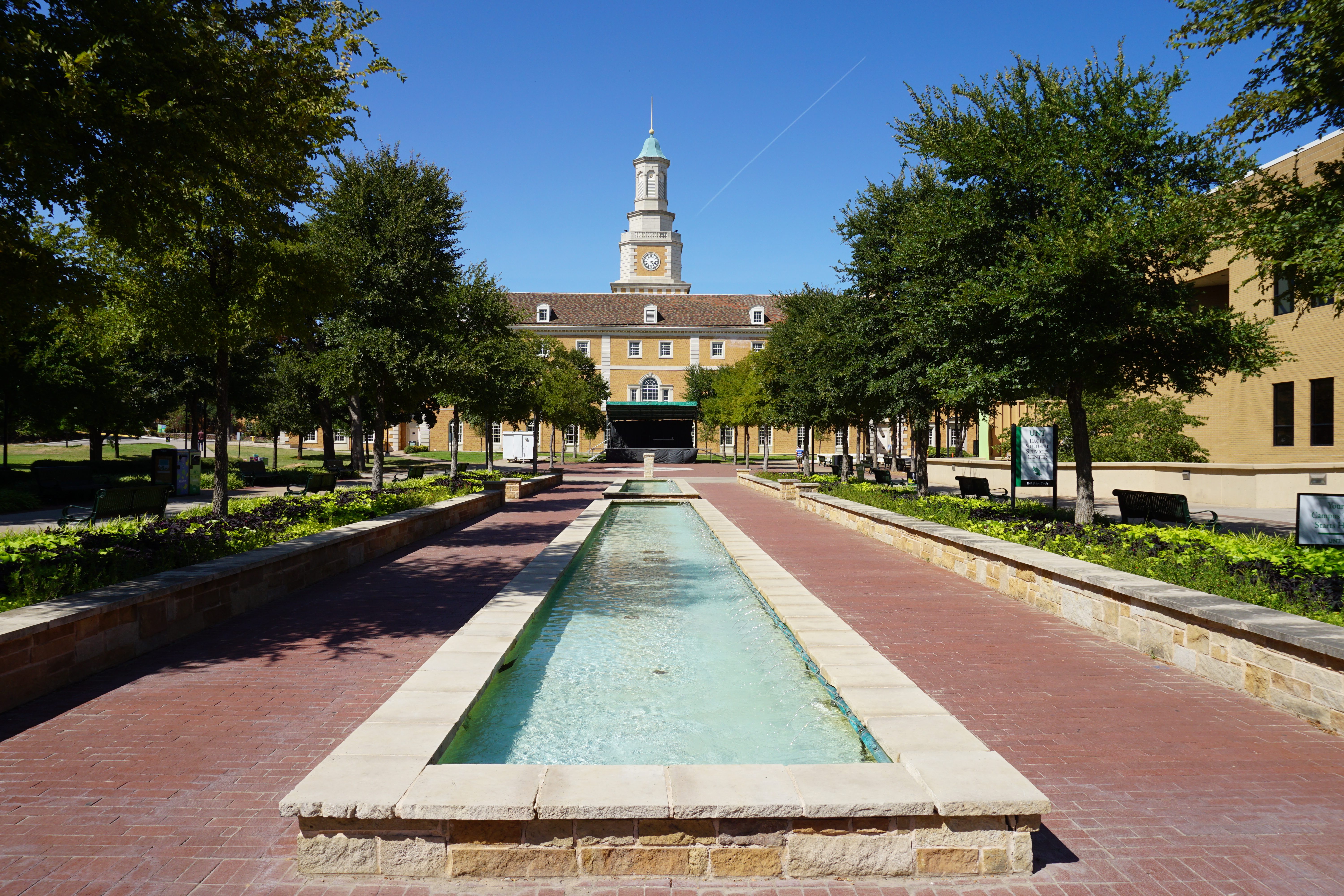
The University of North Texas (via Wikimedia Commons).

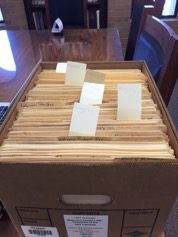
Sternhell’s words resonated with me recently when I went through the collections at the University of North Texas. The first collection was the Resource Center LGBT Collection, which contains 636 boxes of materials about the LGBT movement in Texas. Phil Johnson, the founder of the Dallas Gay Historic Archives, donated many of the materials in this collection. During my two weeks at the University of North Texas, I had come across numerous documents outlining Johnson’s hostility toward organized religion. Johnson blamed religious figures, like Jerry Falwell and Pat Robertson, for creating a hateful social and political environment for the LGBT community. That is why I thought little (at least at first) of coming across a box with a section labeled “Bigots.” This section was right before another titled “Religions.” It seemed likely that Johnson would have made these tags and grouped “Bigots” and “Religions” together.

picture1

The box in UNT’s archive (via the author).

After talking to Courtney Jacobs, the special collections librarian, I found out that I was wrong. Johnson was not the person who created these section dividers. Instead, Jacobs recognized the handwriting as that of the archivist who had organized and arranged the materials when the collection was being processed. The different handwriting on some of the folders, especially the ones that looked older and as if they had been stored away for some time, should have given this away. But, after talking to Courtney for ten minutes about this particular box, it was clear that someone at the University of North Texas had labeled a group of individuals as “Bigots.” On top of this, they separated these individuals from “Religions,” even though the religious groups or individuals in this section said some of the same things that the “Bigots” said about LGBT persons.
This experience in the archives gets to the heart of Sternhell’s last point: how does the arrangement of items in collections, and the labels they are given, influence the historian’s engagement with those items? Right now, I don’t how much these sectional dividers impacted how I interpreted the materials inside the folders. What I do know is this: sometimes historians are far too eager to get to what’s inside a folder to take the time to notice other clues (like different handwriting). I know I’ve learned some important lessons: slow down; never assume; and ask special collections librarians lots of questions.
bugburnt
More by Chris Babits on Not Even Past:
The Rise of Liberal Religion, by Matthew Hedstrom (2013)
Encountering America: Humanistic Psychology, Sixties Culture, and the Shaping of the Modern Self, by Jessica Grogan (2012)
Age of Fracture, by Daniel T. Rodgers (2011)
bugburnt

« Previous Page
Next Page »

Recent Posts

  • The Radical Spanish Empire Roundtable – Introduction
  • All Eyes on the Petition: Reflections on The Radical Spanish Empire
  • Forgery, Invention, and the History of Skepticism in The Radical Spanish Empire
  • Iberian Subaltern Political Philosophies and The Radical Spanish Empire
  • Lawfare and the Legal Construction of Race in The Radical Spanish Empire
NOT EVEN PAST is produced by

The Department of History

The University of Texas at Austin

We are supported by the College of Liberal Arts
And our Readers

Donate
Contact

All content © 2010-present NOT EVEN PAST and the authors, unless otherwise noted

Sign up to receive our MONTHLY NEWSLETTER

  • New
  • Features
  • Reviews
  • Texas
  • Teaching
  • Digital
  • Watch & Listen
  • Authors
  • About