• New
  • Features
  • Reviews
  • Texas
  • Teaching
  • Digital
  • Watch & Listen
  • Authors
  • About

The past is never dead. It's not even past

Not Even Past

Cuba on Not Even Past

When Fidel Castro died last week at age 90 he had survived 11 US Presidents. A dictator who stifled free speech, political opposition, and nonconformity, and a revolutionary who made education, health care, and independence high priorities, his legacy will be debated for many years to come.

We have reported on Cuba regularly over the years and link below to all the articles in our archive.

In our first year online in 2011, Prof Frank Guridy (now at Columbia University) offered an online book discussion group on Cuba, leading discussions of three books you might like to read:

Louis A. Perez, Jr., On Becoming Cuban: Identity, Nationality, and Culture
Jana Lipman, Guantánamo: A Working-Class History between Empire and Revolution

C. Peter Ripley, Conversations with Cuba

We featured Prof Guridy’s own book on the connections between Afro-Cubans and African Americans in February 2012: On the Transnational Black Diaspora. You can see our video interview with him on that page as well.

The Future of Cuba-Texas Relations
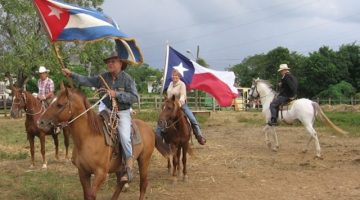
The Future of Cuba-Texas Relations
 Jonathan Brown teaches courses on the history of Latin American revolutions. He is now completing a manuscript on “How the Cuban Revolution Changed the World.” Professor Brown took the first of his four trips to Cuba in 2006.

Capitalism After Socialism in Cuba

Capitalism After Socialism in CubaThe trip in Cuba from Trinidad to Havana was very hard, as our landlady misled us in order to make a commission off a local cab company.

The Cuban Missile Crisis

The Cuban Missile Crisis
by Priya Ramamoorthy, Kavya Ramamoorthy, Smrithi Mahadevan and Maanasa Nathan Westwood High School Senior Division Group Website Over thirteen tense days in October, 1962, nuclear conflict nearly broke out between the United States and the Soviet Union.

I am Cuba, for Sale (1964)
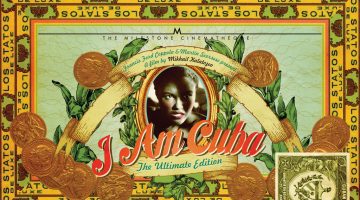
I am Cuba, for Sale (1964)
An extravagant party on the rooftop of a Havana hotel. It’s the late 1950s; hedonistic tourism is booming in the City. A band plays loud. Drinks. Laughter. Our line of vision moves from the hotel’s rooftop to a crowd of tourists below, where we see a woman and follow her into the pool. Underwater….Hailed today a classic for its inventive cinematography, “I am Cuba” was virtually forgotten for three decades.

The Cuban Connection by Eduardo Saénz Rovner (2008)
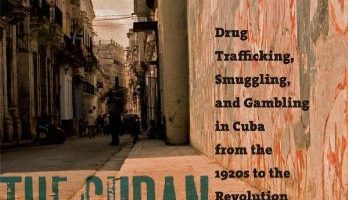
The Cuban Connection by Eduardo Saénz Rovner (2008)In The Cuban Connection, Eduardo Saénz Rovner rethinks Cuba’s position as a hotbed of drug trafficking, smuggling, and gambling and he considers how these illicit activities shaped Cuban national identity from the early twentieth century through the rise of Fidel Castro.

The Old Man and the New Man in Revolutionary Cuba
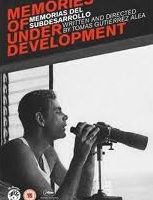
The Old Man and the New Man in Revolutionary Cuba
The forces that created the Cuban Revolution often get lost in polarizing debates about Castro’s Cuba. Two very different films highlight the changes that ripped through Cuban society in the 1950s and early 1960s and created the Cuban Revolution.

Sad and Luminous Days: Cuba’s Struggle with the Superpowers after the Missile Crisis by James G. Blight & Philip Brenner (2002)
Sad and Luminous Days: Cuba’s Struggle with the Superpowers after the Missile Crisis by James G. Blight & Philip Brenner (2002)
Throughout the Cold War and the decade that followed it, historians assumed that Cuban and Soviet leaders cooperated closely in the events associated with the Cuban missile crisis. Havana and Moscow, so went the conventional wisdom, put their lots together in a challenge against U.S.


Che in Gaza: Searching for the Story Behind the Image
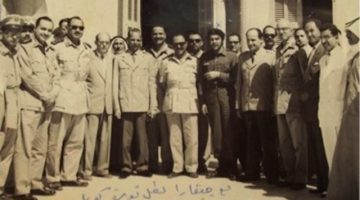
Che in Gaza: Searching for the Story Behind the Image
On June 18th 1959, dressed in full army fatigues and accompanied by several comrades exhibiting an equally imposing revolutionary appearance, Che Guevara landed in Gaza.


Operation Urgent Fury: A Revolution Aborted
Operation Urgent Fury: A Revolution Aborted
On the evening of October 27, 1983, President Reagan addressed the American people on live television to discuss unsettling events taking place on the Caribbean island of Grenada.


.

Che: A Revolutionary Life by Jon Lee Anderson (2010)
Che: A Revolutionary Life by Jon Lee Anderson (2010)
In July 1997, a Cuban-Argentine forensic team unearthed the skeletal remains of Comandante Ernesto “Che” Guevara in Vallegrande, Bolivia. Thirty years earlier, on October 9, 1967, CIA-trained Bolivian Special Forces agents had captured and executed the thirty-nine-year-old revolutionary before dumping his body in a shallow pit near a dirt runway.

Making History: Takkara Brunson
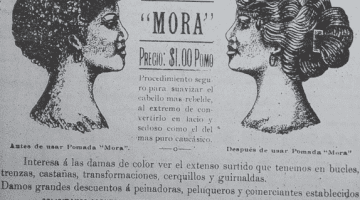
Making History: Takkara Brunson
In the sixth installation of our new series, “Making History,” Zach Doleshal speaks with Takkara Brunson about her research on Afro-Cuban women in pre-revolutionary Cuba. Brunson’s research experiences in Cuba, and stories of the fascinating women who form the core of her research offer a taste not only of life and work in a place few Americans get to visit, but also a window into the making of a social and cultural historian.


From Baseball to Politics
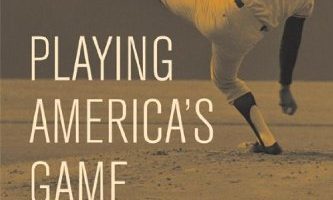
From Baseball to Politics

New works on Afro-Cubans and African-Americans


Che’s Afterlife: The Legacy of an Image by Michael Casey (2009)
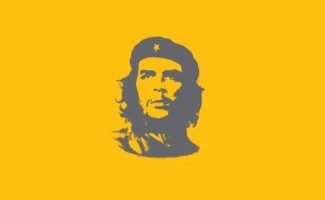
Che’s Afterlife: The Legacy of an Image by Michael Casey (2009)
How can we make sense of the coexistence of bumper stickers depicting Rambo and Che Guevara in a traffic jam in Bangkok, Thailand? Although this book never answer its opening question, such an insight might allow us to understand Casey’s attempt to explore the different uses of an image that remains remarkably vital decades after its capture.


Latin America’s Cold War by Hal Brands (2010)
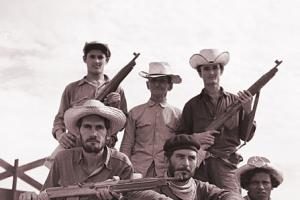
Latin America’s Cold War by Hal Brands (2010)
In this new book, covering the entire period of the Cold War in Latin America, Hal Brands restores agency and initiative to Latin American actors, in the process demolishing many of the platitudes that have governed much of the U.S.foreign policy literature.image Based on prodigious research in a dizzying array of U.S., Latin American, and even East German archives, Brands’s work advances a trenchant interpretation that cannot be ignored.

Conflicting Missions: Havana, Washington, and Africa, 1959-1976 by Piero Gleijeses (2002)
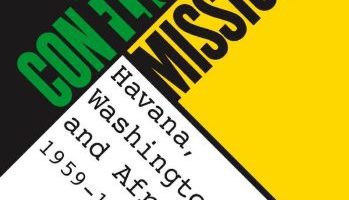
Conflicting Missions: Havana, Washington, and Africa, 1959-1976 by Piero Gleijeses (2002)
Conflicting Missions: Havana, Washington, and Africa, 1959-1976, takes readers beyond the familiar categories of the Soviet-American Cold War. In the wake of decolonization, as charismatic national leaders emerged across Africa – from Algeria to Zaire – statesmen in Washington and Moscow waited anxiously to see if the new governments would align with democracy or communism.
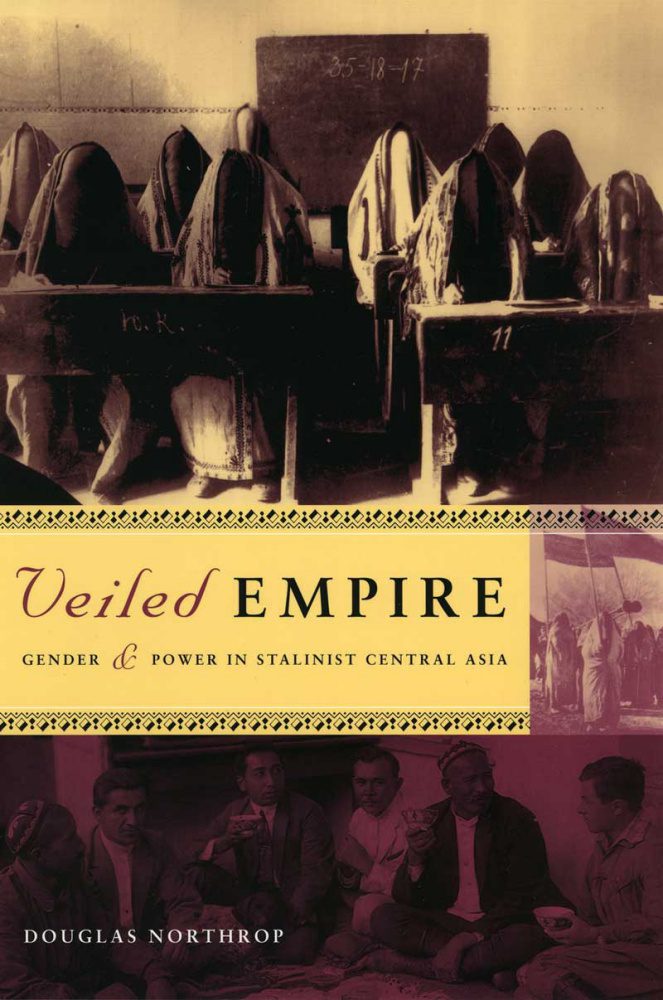


Veiled Empire: Gender and Power in Soviet Central Asia, By Douglas Northrup (2003)

By Natalie Cincotta

80140100336090lWhen the Soviets launched their campaign, known as the hujum, against the veil in Uzbekistan in 1927, their goal was not just to liberate women. Without a class framework or a working class to build socialism in Uzbekistan, Soviet activists instead attempted to transform society through the liberation of women. Northrop argues that a woman’s behavior and dress, expressed namely through the veil, came to symbolize all social values and, as such, became a battleground between Uzbek national identity and the socialist project. According to Northrop, the battle over the veil thus came to represent a process of mutual self-definition.

Northrop’s main aim is to explain the unfolding of Soviet policy in Central Asia through the lens of gender relations and policy. Rooted in a colonial studies framework, Northrop argues that the campaign to unveil women began only after the isolation of Muslim clerics and landowners as class enemies failed to win the rest of the population to their side. Only then did Soviet activists initiate the “liberation” of women as the means to build socialism, through bringing profound changes to Uzbek society, culture, and everyday life. In 1927, these Soviet activists launched a campaign, or hujum, to liberate Muslim women from seclusion and oppression through mass unveiling, which they hoped would dismantle the traditional patriarchal structure of everyday life.

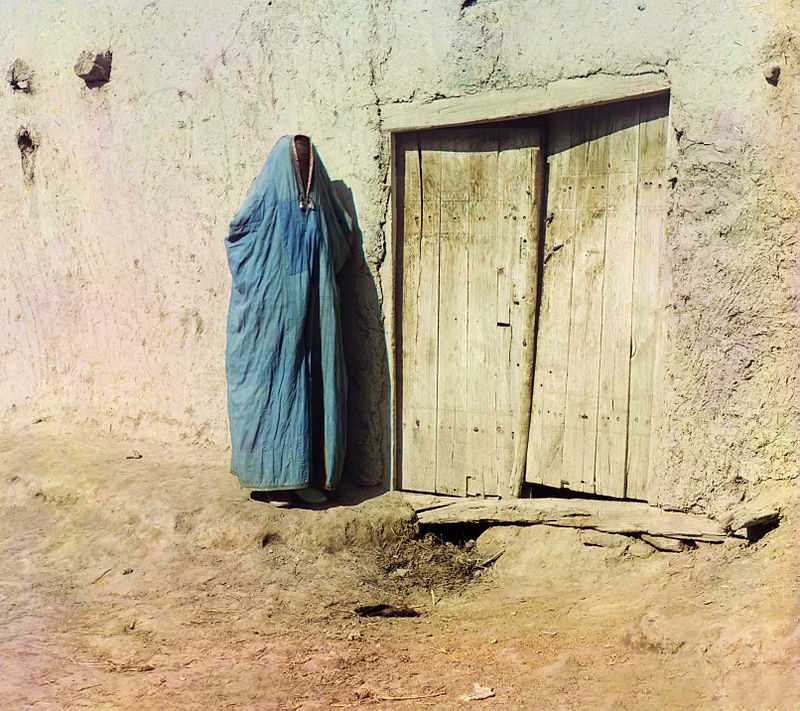
sart_woman_wearing_a_paranja_samarkand

Woman wearing a traditional paranja in Samarkand (present-day Uzbekistan) circa 1910 (via Wikimedia Commons).

Northrop highlights the limits to Soviet power through a thought-provoking consideration of Uzbek responses to this new drive to unveil women. For the most part Uzbeks resisted Soviet policies simply by non-compliance. Others learned to work the system or subvert Soviet language and logic, but wearing the veil became the primary symbolic assertion of anti-Soviet sentiment. Apart from expressing anti-Soviet sentiment, however, exactly how opposition to the hujum fostered Uzbek identity beyond preserving traditional cultural and societal structures remains an elusive aspect of the book.

Northrop’s use of gender as an analytical framework is arguably the most valuable contribution of Veiled Empire. He masterfully considers the way the Uzbek woman’s body became conflated with a social purpose by both Uzbeks and Soviet policy makers, as women’s behavior and dress came to represent practices in everyday life and social values in communities and in the nation as a whole. Northrop shows that unveiling did not necessarily spell out “liberation” for Uzbek women because western notions of feminism, gender, and patriarchy are not universal. For example, veils were not necessarily associated with oppression in Uzbek society, evident in the fact that the Uzbek Zhenotdel (Women’s Bureau) did not make it a chief concern before 1926.  Northrop’s consideration of gender relations from both a Soviet and an Uzbek perspective thus allows him to understand the complexity of underlying tensions during the hujum and connect the gender project to broader Soviet goals. It is unfortunate, however, that women’s experiences are largely absent from this account, due to a lack of sources, as their voices would help further illuminate these tensions and complexities.

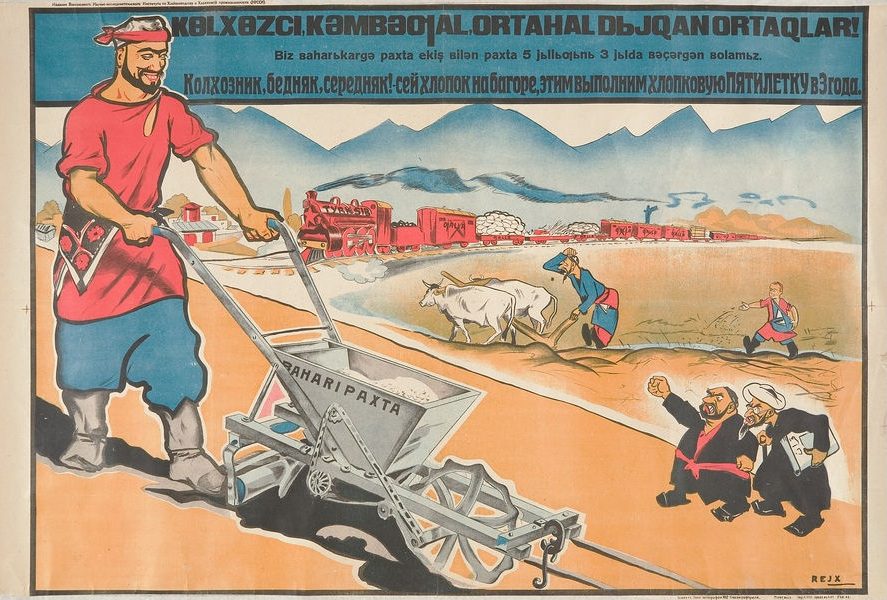
urging_peasants_to_speed_up_cotton_production_-_russian_and_uzbek_tashkent_1920s_mardjani

Soviet propaganda poster urging Uzbek peasants to speed up cotton production. Islamic clerics are depicted disparagingly (via Wikimedia Commons).

Overall, Veiled Empire is an admirable work that illuminates the limits of Soviet power in Central Asia. Using gender as an analytical framework, Northrop highlights how the Soviets attempted to use the “liberation” of women as a means to meeting a broader goal of building socialism. On both the Soviet and Uzbek sides, the veil was made to represent an entire identity and was conflated with social utility. As such, Northrop highlights the ways “oppression” and “liberation” are not as straightforward as Soviet activists hoped they were.
bugburnt
You may also like:

Janine Jones reviews The Politics of the Veil, by Joan Wallach Scott and Politics of Piety: The Islamic Revival and the Feminist Subject by Saba Mahmood (2004).
Christopher Rose recalls Exploring the Silk Route in Uzbekistan.
bugburnt

Restless Youth: The CIA, Socialist Humanism, and Yugoslavia’s 1968 Student Protests

By Aleksej Demjanski

The 1960s saw an explosion of student activism across the globe. This increase in youth movements for social change was so influential that U.S. President Lyndon B. Johnson had the Central Intelligence Agency illegally monitor student movements both at home and abroad. After some investigation, the CIA produced an over two-hundred-page report, titled “Restless Youth,” which discusses their findings on the activities of students and student groups in the United States as well as nineteen other countries across Asia, Africa, Latin America, Western and Eastern Europe.

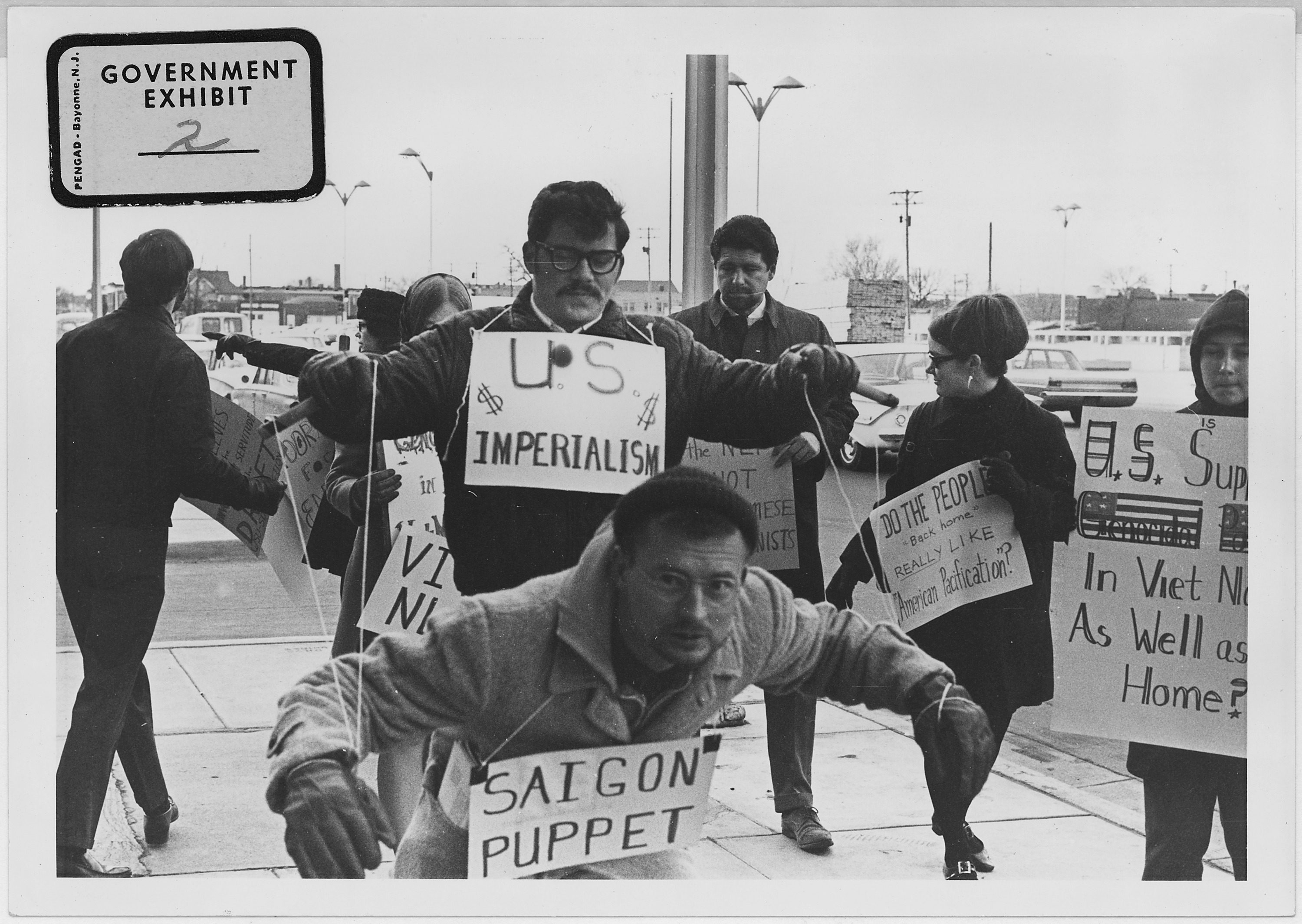
vietnam_war_protesters-_1967-_wichita_kans_-_nara_-_283625

Students in Kansas protest in 1967 against the Vietnam War (via Wikimedia Commons).

The report broadly details the general trends of how the “restless youth,” particularly university students, engaged in a range of anti-establishment activism such as university occupations, street marches, and sit-ins. The CIA report analyzes what issues caught the attention of students, whether they organized ad hoc or within existing organizations, how many students were attending universities, how they connected with other social groups, how they transnationally exchanged ideas, and what ideas inspired them to action. Overall, the report argues that many of the students turned to activism because of their frustration with the socioeconomic and political status quo and that they demanded more from their universities, communities, and governments.

The CIA report also notes that many students, mostly American and European, were inspired to protest by “Marxist social criticism” and the writings of C. Wright Mills, Frantz Fanon, and especially the American critical theorist and sociologist Herbert Marcuse. This Marxist social criticism, also known as Marxist or socialist humanism, stresses the importance of Karl Marx’s early writings and the need for a critical praxis directed against capitalism as well as against traditional Soviet or statist Marxism. Herbert Marcuse was a proponent of socialist humanism and significantly collaborated with the most well-known Marxist humanist philosophical movement of the time – Yugoslavia’s Praxis School.
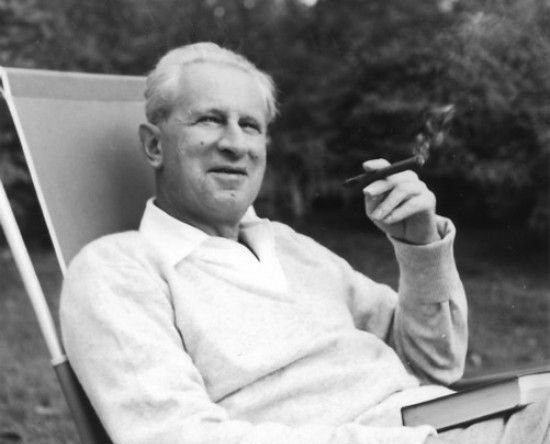
herbert_marcuse_in_newton_massachusetts_1955

Herbert Marcuse in 1955 (via Wikimedia Commons).

The members of Yugoslavia’s Praxis School were prominent professors in the Faculties of Philosophy at both the Zagreb and Belgrade universities who supported Yugoslavia’s protesting university students in 1968. The CIA report has an entire chapter dedicated to the student movement in Yugoslavia, yet, this eleven-page section oddly makes no mention of the Praxis School and the support its members gave to Yugoslavia’s protesting university students. The report clearly makes the connection between Herbert Marcuse, Marxist humanism, and student protests, but it fails to make the broader connection to the socialist humanist Praxis School of Yugoslavia and its affiliates who joined university students in protest in the summer of 1968.

How could the CIA have missed this? Although the authors considered student activism to be a growing threat and a “worldwide phenomenon” fueled in part by this particular philosophical discourse of socialist humanism, they didn’t seem to be interested in the leading socialist humanist movement of the time, despite its influence on students in Yugoslavia and beyond. The Yugoslav government, on the other hand, didn’t miss this connection and became extremely interested in the Praxis School. Although the movement wasn’t pro-capitalist or anti-socialist, the Yugoslav leadership still viewed it as a threat due to its criticism of the ruling party – the League of Communists of Yugoslavia – for not fulfilling its promises to create a more just socialist society. Similar views toward student protests were taken by the authorities in nearby countries: in Czechoslovakia during the Prague Spring and in Poland. The Czechoslovak government also monitored its growing student movement and produced its own report which noted the students’ criticism of Czechoslovak socialism.
picture1

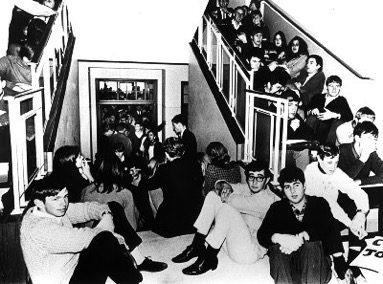
The student occupation of the University of Belgrade (via The Modern Historian).
Following the student occupation at Belgrade University in June 1968, the Yugoslav authorities quietly cracked down on dissenting students and professors. The main target was the leading cohort of the Praxis School, professors in the Faculty of Philosophy at Belgrade University. Slowly, but surely, eight professors from Belgrade – Mihailo Markovic, Ljubomir Tadic, Miladin Zivotic, Zagorka Golubovic, Dragoljub Micunovic, Nebojsa Popov, Triva Indjic, and Svetozar Stojanovic – were removed from their professorships at the university. The Yugoslav authorities claimed that the professors were the “ideological inspiration” and “practical organizers” of the student demonstrations and university occupation and as such needed to be stopped at all costs. They had become too influential and were improperly educating students with ideas that the Yugoslav socialist system of “self-management” was flawed. Aside from being sacked from their university positions the professors also lost financial support for their research and funding for their publication, the Praxis journal, was essentially cut. Although the Belgrade professors didn’t organize the protests, their Marxist humanism consciously or unconsciously provided the intellectual platform for students to criticize the Yugoslav system. The CIA was never able to put these pieces of the puzzle together and failed to capture this source of student discontent both at home and abroad.

bugburnt

CIA Report, “Restless Youth,” Intelligence File, National Security File, Box 3, LBJ Library.
Additional Sources:
Mihailo Marković and R. S. Cohen, Yugoslavia: The Rise and Fall of Socialist Humanism: A History of the Praxis Group. (2005)Paulina Bren, “1968 East and West: Visions of Political Change and Student Protest from across the Iron Curtain,” in Transnational moments of change: Europe 1945, 1968, 1989, P. Kenney and G. Horn, eds. (2004)

bugburnt
You may also like:

Andrew Weiss reviews a book about student protests in 1968 Mexico: Plaza of Sacrifices: Gender, Power, and Terror in 1968 Mexico by Elaine Carey (2005) .
Nancy Bui discusses the 50th Anniversary of the Vietnam War from a Vietnamese American Perspective.
Mark Lawrence looks at an earlier CIA Study: “Consequences to the US of Communist Domination of Mainland Southeast Asia,” from October 13, 1950.
bugburnt

The Enemy Within: Cold War History in FX’s The Americans

By Clay Katsky

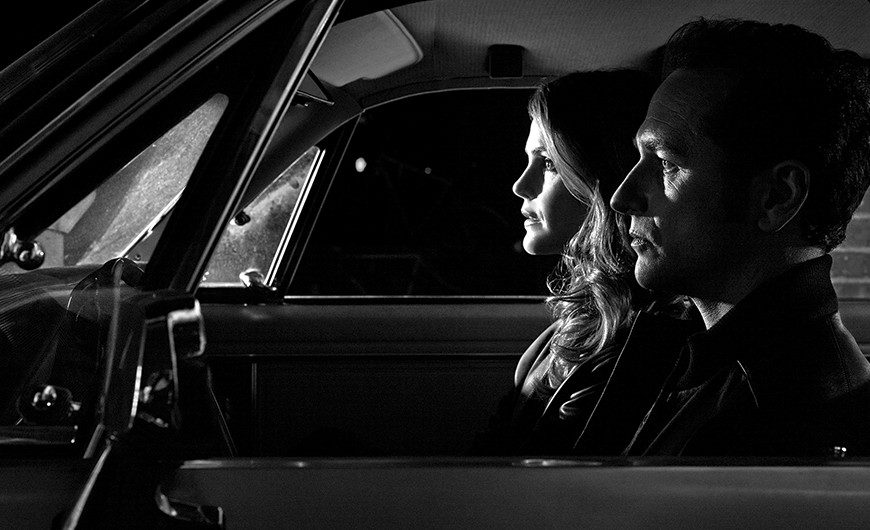
Those who watch the television show The Americans share a secret with its protagonists: they are not a quintessential American couple living in the suburbs of D.C.; they are, in fact, spies for the Soviet Union. Set against the backdrop of a resurgent Cold War in the early 1980s, this serialized spy thriller and period drama follows the fictional lives of Elizabeth and Philip Jennings, played by Keri Russell and Matthew Rhys, who were born in Russia and trained as KGB officers to be “sleeper” agents in America. Activated when Reagan throws détente out the window, no one suspects that they have two deeply separated lives, one as travel agents who live in Northern Virginia with two young children, and a second filled with spy missions where they don disguises to seduce and assassinate targets and gather intelligence by blackmailing officials and recruiting assets. The dichotomy of their lives is by day marked by their genuine devotion to their children and to each other, and by night by the violent and frequently murderous clandestine missions directed by their Russian handlers. These Americans are not what they seem to be.

web_img_gallery_detail_series_dsktp_theamericans_s3_06

Kerri Russell and Matthew Rhys star in The Americans (via FX).

Ultimately, it is Reagan’s hardline against the U.S.S.R. that gives the show context. The first season begins as Reagan assumes the presidency and the third ends with the Jennings family watching his “evil empire” speech together. During the most recent fourth season, a family viewing of the TV movie The Day After, which is about nuclear Armageddon, adds another dimension to a subplot involving powerful bioweapons. The writers of The Americans do a good job of using 1980s popular culture and history to add contextual drama to the show, but sometimes ignore chronological specifics and the technical aspects of espionage tradecraft for the sake of storytelling. Regardless, the late Cold War works well as a general guide for the narrative arc of the series; the escalating tension between superpowers is directly responsible for the increasing drama in the lives of its main characters.

president_reagan_speaking_in_minneapolis_1982

President Reagan in 1982 (via Wikimedia Commons).

Perversely, The Americans sometimes makes you root for the enemy within.  Fueled by terrific performances from Russell and Rhys, the Jennings can come off as sympathetic, and patriotic in their own way. Reminiscent of James Gandolfini in The Sopranos, these are bad people with redeeming qualities. She is an ideologically driven cold-blooded killer who is loyal to her family, while he is more sensitive and compelled by emotion, yet also capable of extreme violence. Both struggle with the conflict between their mission as spies and their duty as parents, which is a major plot device of the show. The tension of the first season is driven by their fear that the FBI will catch them. Right away evading capture is set up as synonymous with protecting their family. The second season expands on the theme of protecting their family from their world – after two other sleeper agents and their young children are murdered the Jennings fear they are next. The danger in the third season comes from within the family, with their daughter suspecting her parents are way more than just travel agents. And in the fourth season an assignment to steal bioweapons puts the whole world in jeopardy, pitting their loyalty to their country against their instinct to protect their children. Making the show about more than just spying and the Cold War, there are strong subplots involving the family’s next door neighbor, the FBI agent who works in the counter-intelligence division, and their daughter’s increasing devotion to Christianity, which comes to a head when she over shares with her pastor. The drama is about the characters, how they develop and how they react to one another in the context of the world around them.

fema_-_2720_-_photograph_by_fema_news_photo

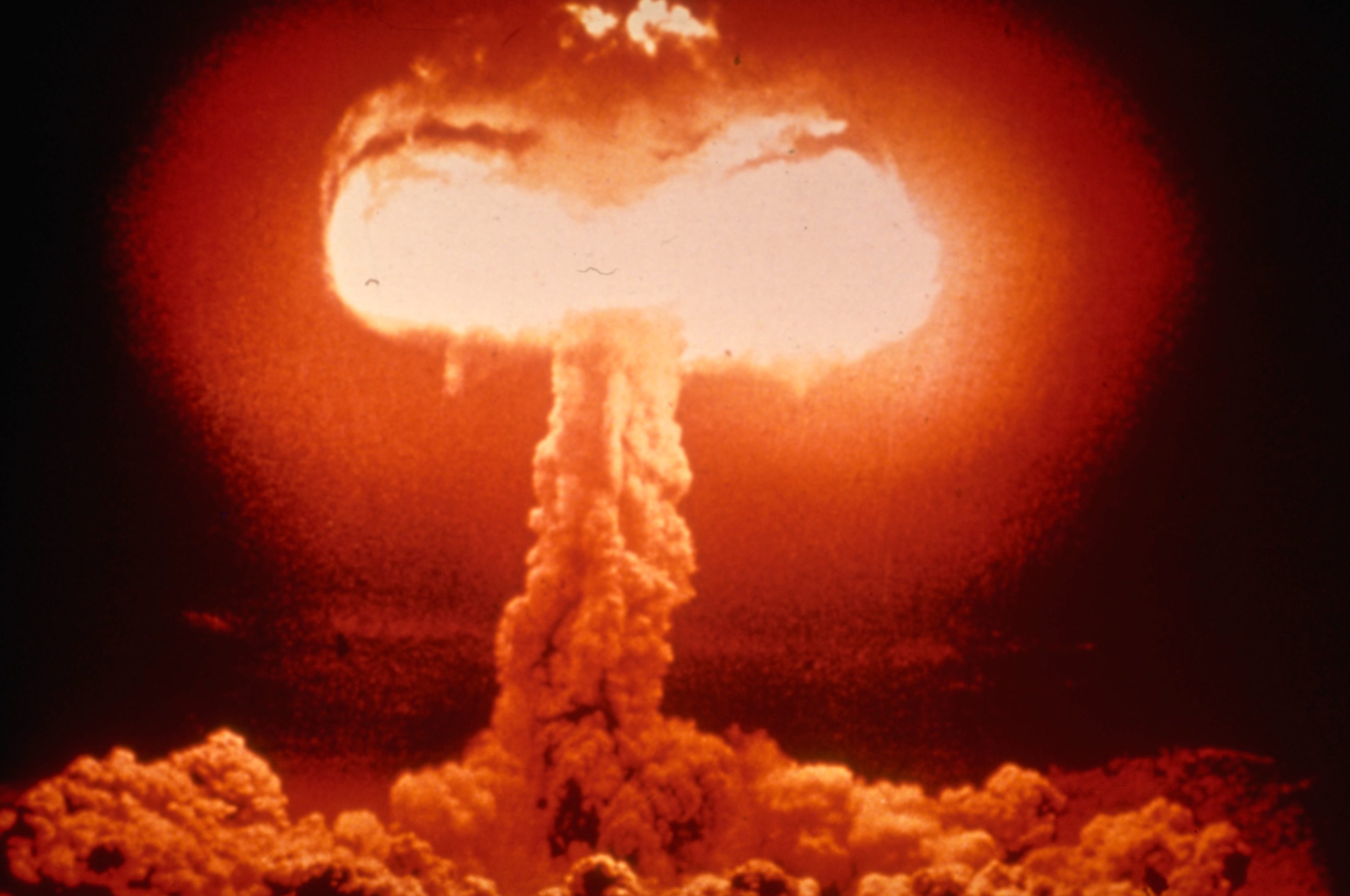
The images of nuclear destruction in The Day After (1983) were troubling to many American families (via Wikimedia Commons).

In The Americans, history is used as the setting. The show underscores Reagan’s determination to defeat the forces of Communism using clips from his speeches – as Soviet agents, the Jennings find the rhetoric palpable. And at their house, the news always plays in the background at night, helping to give a timeline of events while also highlighting the television culture of the time – pop culture events like David Copperfield making the Statue of Liberty disappear are drawn on to both diffuse the tension and offer social nostalgia. But the headlines are also used to drive the drama. When Reagan gets shot, the Jennings go on high alert because they are not sure if their government was involved; and when Yuri Andropov, their former leader at the KGB, takes power in 1982, they know their lives are about to get busier. The writers incorporate the shift towards renewed hostilities that occurred during the late Cold War in order to give the viewer the sense that the Jennings mission is important. The rivalry between the superpowers could have spun out of control very quickly and at any moment, and the “the Americans” are caught in the middle of it.

The show begins as Reagan kicks the Cold War into high gear in 1981 and it will end with the collapse of the Communist superpower – having been renewed for a final two seasons, the story will be told to its conclusion. The Soviet fear of the Strategic Defense Initiative, Reagan’s anti-ballistic missile “Star Wars” project, is a centerpiece of the first few episodes. In reality, 1981 is too early for the Russians (or even Reagan) to be thinking seriously about SDI, but it works as an easy set up. At that time, however, it was mostly Reagan’s rhetoric that threatened to turn the Cold War hot. Nicaragua comes to the fore in the second season, again a little early in terms of chronology, but it works well because the Jennings’ sympathy for the Sandinista movement helps humanize them. Oliver North is credited as a technical advisor on an episode where the Jennings infiltrate a Contra training base. Empathy for the Jennings continues to build as they assist the anti-apartheid movement during the third season, while meanwhile the seeds of mistrust in their government are sown with the opening of the war in Afghanistan. In the fourth season, as their government pushes them to recruit their own daughter, the Soviet mismanagement of that war feeds their growing disillusionment and dovetails with a risky mission to acquire an apocalyptic bioweapon. While this past season was it’s least historically based, it was also its best because it dealt with larger, more existential issues.

evstafiev-spetsnaz-prepare-for-mission

A Soviet Spetsnaz (special operations) group prepares for a mission in Afghanistan, 1988 (via Wikimedia Commons)

The technical focus of the show is on tradecraft, not history. The thrills come from watching the spies operate; and from making dead drops and cultivating assets to planting listening devices and evading surveillance, the Jennings are very busy. But the show’s most exciting aspect is also its least plausible. It is hard to believe that such well-placed agents would be used as workhorses for the KGB. Especially in the first two seasons, the Jennings juggle multiple assignments at the same time and go on a wide variety of missions – simultaneously they are assassins, saboteurs, master manipulators, and experts in surveillance, counterespionage, and combat. As valuable as they would have been to their government, the Jennings are asked to take too many risks and expose themselves too often. But even in its most exaggerated aspects, The Americans feels realistic due to the expert performances from Russell and Rhys, who are so believable in their roles as skilled spies and as doting parents that one cannot help but trust in their inhuman ability to be an expert in anything they need to be.

Two Soviet era subminiature cams. The one to the left is a Kiev-30 (1974-1983), the other one is a Kiev Vega 2 (1961-1964).

Two miniature Soviet spy cameras form the late Cold War (via Wikimedia Commons).

Overall, The Americans is a highly engaging and richly thought out show set in the waning years of the Cold War. It is very exciting to watch two highly trained KGB operatives as they navigate the complexity of staying ideologically loyal to their cause while raising an American family and living a lie. People who remember the 1980s firsthand will enjoy the references and set pieces, and anyone who likes spy thrillers will be instantly hooked on the slow boiling but constant action and drama. It will be interesting to see how the upcoming fifth season incorporates the Able Archer war scare, when the Soviets mistook NATO war games for the start of real life a nuclear engagement. Will it be the Jennings who witness an increase in late night pizza deliveries to the Pentagon and report back to Moscow that nuclear war is imminent? They seem too savvy to drop the ball like that. But what will happen in the end? Will they survive or be caught by the FBI, or will they get called back to Russia to be punished for some failure or perceived disloyalty?
bugburnt
Read more by Clay Katsky on Not Even Past:
Kissinger’s Shadow, By Greg Grandin (2005)

You may also like:
Simon Miles reviews Reagan on War: A Reappraisal of the Weinberger Doctrine, 1980-1984, by Gail E. S. Yoshitani (2012)
Joseph Parrott examines The Rebellion of Ronald Reagan: A History of the End of the Cold War, by James Mann (2010)
bugburnt

US Survey Course: The Long 1970s, The Reagan Revolution, and the End of the Cold War

During the summer of 2016, we will be bringing together our previously published articles, book reviews, and podcasts on key themes and periods in the history of the USA. Each grouping is designed to correspond to the core areas of the US History Survey Courses taken by undergraduate students at the University of Texas at Austin.

bugburnt

Nixon_1972

As a starting point, Dolph Briscoe IV recommends The Seventies: The Great Shift in American Culture, Society, and Politics, by Bruce J. Schulman (De Capo Press, 2001)

Dolph Briscoe IV also suggests Nixonland: The Rise of a President and the Fracturing of America, by Rick Perlstein (Scribner, 2008)

Jack Loveridge reviews Fear and Loathing on the Campaign Trail ’72, by Hunter S. Thompson (Gonzo Journalism 1972).

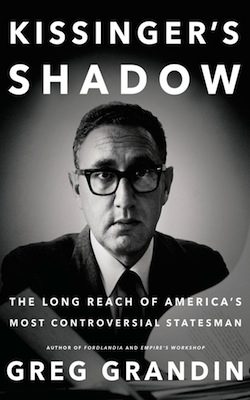
Clay Katsky recommends Kissinger’s Shadow, by Greg Grandin (Metropolitan Books, 2015).

Christopher Rose asks the question What’s Missing from ‘Argo’?(2012)

Books on Reagan:

800px-Gorbachev_and_Reagan_1988-2

Simon Miles suggests The Age of Reagan: A History, by Sean Wilentz (Harper Perennial, 2008) and Reagan on War: A Reappraisal of the Weinberger Doctrine, 1980-1984, by Gail E. S. Yoshitani (Texas A & M University Press, 2012)

And Joseph Parrot recommends The Rebellion of Ronald Reagan: A History of the End of the Cold War, by James Mann (Penguin, 2010)

On 15 Minute History

Operation Intercept

U1643747_400-150x150At 2:30 pm on Saturday September 21 1969, US president Richard Nixon announced ‘the largest peacetime search and seizure operation in history.’ Intended to stem the flow of marijuana into the United States from Mexico, the three-week operation resulted in a near shut down of all traffic across the border and was later referred to by Mexico’s foreign minister as the lowest point in his career.

Guest James Martin from UT’s Department of History describes the motivations for President Nixon’s historic unilateral reaction and how it affected both Americans as well as our ally across the southern border.

The International Energy Crisis of the 1970s

Most Americans probably associate the 1973 oil crisis with long lines at their neighborhood gas stations, but those lines were caused by a complex patchwork of international relationships and negotiations that stretched around the globe.

Guest Chris Dietrich explains the origins of the energy crisis and the ways it shifted international relations in its wake.

Some broader perspectives:

Henry-Kissinger-and-Chairman-Mao-with-Zhou-Enlai-behind-them-in-Beijing-early-70s.

Here are all of our articles, book recommendations, and podcasts on the Cold War.

Aragorn Storm Miller reviews Rise of the Vulcans: The History of Bush’s War Cabinet, by James Mann (Penguin, 2004)

Mark Battjes recommends Worldmaking: The Art and Science of American Diplomacy, by David Milne (Macmillan, 2015)

bugburnt

US Survey Course: Vietnam War

During the summer of 2016, we will be bringing together our previously published articles, book reviews, and podcasts on key themes and periods in the history of the USA. Each grouping is designed to correspond to the core areas of the US History Survey Courses taken by undergraduate students at the University of Texas at Austin.

bugburnt

Vietnam War main image

On November 12, 2015, Not Even Past and the the Institute for Historical Studies at UT Austin sponsored a roundtable to discuss the Lessons and Legacies of the War in Vietnam. During that month, Not Even Past published a series of articles to mark the fiftieth anniversary of the end of the Vietnam War.

We start with Mark A. Lawrence’s feature article: The War in Vietnam Revisited.

Next, Nancy Bui, the founder and President of the Vietnamese American Heritage Foundation considers the Vietnam War from a Vietnamese American Perspective.

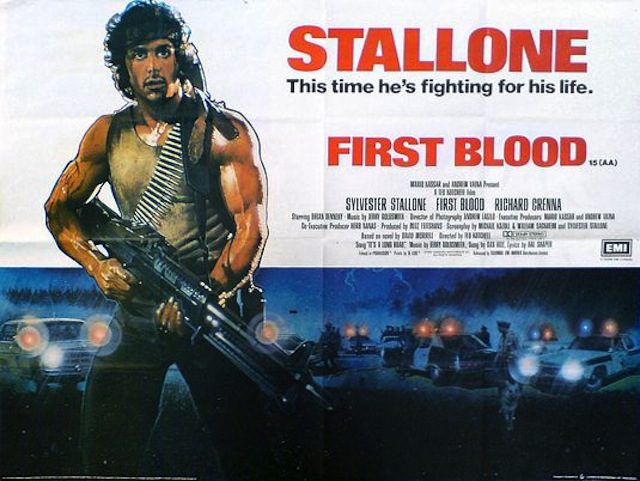
And Janet Davis shares a short meditation on cultural memory and the Vietnam War in two popular films: First Blood and Jaws

First-Blood-film-poster.-Via-Wikipedia1

bugburnt

Over the years, Not Even Past has published a number of articles on the War in Vietnam by Mark Atwood Lawrence. This rich body of material covers wide range of topics and case studies giving our readers a chance to consider the War from a number of different angles:

LBJ and Vietnam: A Conversation

The Prisoner of Events in Vietnam

Changing Course in Vietnam — or Not

CIA Study: “Consequences to the US of Communist Domination of Mainland Southeast Asia,” October 13, 1950

The Lessons of History? Debating the Vietnam and Iraq Wars

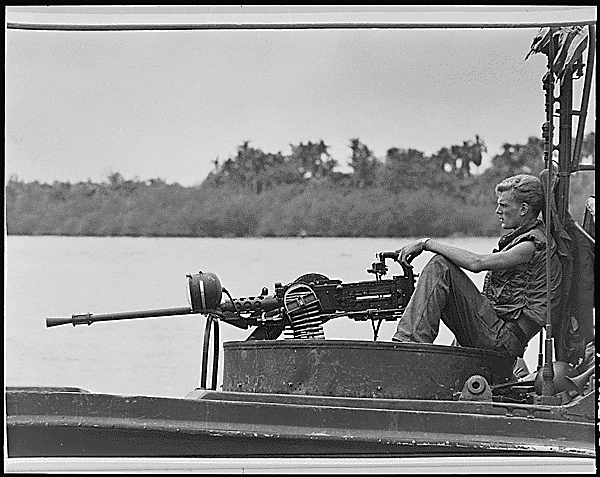
US_river_patrol_boat_in_Vietnam_0

bugburnt

Others have considered the War in Vietnam in relation to broader topics:

Peniel Joseph explains how Muhammad Ali helped make black power into a global brand

Deirdre Smith shares some research on Vietnam between the United States and Yugoslavia.

And, Michael J. Kramer discusses on representing LBJ and power through the medium of dance in The Seldoms Bring LBJ and the 1960s Into the Present in Their Investigation of How Power Goes.

Recommended Reading:

vietnam-books

Mark A. Lawrence shares a list of Must Read Books on the Vietnam War

Jack Loveridge recommends Fear and Loathing on the Campaign Trail ’72, by Hunter S. Thompson (1972)

Clay Katsky suggests Kissinger’s Shadow, by Greg Grandin (Metropolitan Books, 2015)

And finally, Mark A. Lawrence shares a list of books on International History and the Global United States including his edited collection The Vietnam War: An International History in Documents (Oxford University Press, 2014).

15 Minute History:

America and the Beginnings of the Cold War

Potsdam_conference_1945-8-150x150

The Cold War dominated international politics for four and a half decades from 1945-1989, and was defined by a rivalry between the United States and the Soviet Union that threatened—literally—to destroy the world. How did two nations that had been allies during World War II turn on each other so completely? And how did the United States, which had been only a marginal player in world politics before the war, come to view itself as a superpower?

In this episode, historian Jeremi Suri discusses the beginnings of the Cold War (1945-1989) its origins in the “unfinished business” of World War II, the role of the development of atomic weapons and espionage, and the ways that it changed the United States in just five short years between 1945 and 1950.

The US and Decolonization after World War II

William_Orpen_–_The_Signing_of_Peace_in_the_Hall_of_Mirrors_Versailles_1919_Ausschnitt-150x150

Following World War II, a large part of the world was in the hands of European powers, established as colonies in the previous centuries. As one of the nations that came out on top of the geo-political situation, the United States was looked to with hope by aspiring nationalist movements, but also seen as a potential source by European allies in the war as a potential supporter of the move to restore the tarnished empires to their former glory. What’s a newly emerged world power to do?

Guest R. Joseph Parrott takes a look at the indecisive position the United States took on decolonization after helping liberate Europe from the threat of enslavement to fascism.

bugburnt

US Survey Course: Cold War

During the summer of 2016, we will be bringing together our previously published articles, book reviews, and podcasts on key themes and periods in the history of the USA. Each grouping is designed to correspond to the core areas of the US History Survey Courses taken by undergraduate students at the University of Texas at Austin.

bugburnt

Feratures copy

We start with two posts by Mark Atwood Lawrence on messages sent by George F. Kennan, a senior U.S. diplomat based in Moscow, and Nikolai Vasilovich Novikov, the Soviet ambassador in Washington, outlining their views on the intention of each nation in 1946. These sources and much more come from one of our featured books, America in the World: A History in Documents from the War with Spain to the War on Terror.

As the US and Soviet Union gathered information on each other, spies and bugs became key, as Brian Selman shows in his article on the bug problem at the US embassy in Moscow: Call Pest Control.

During World War II the United States shipped an enormous amount of aid to the Soviet Union through the Lend-Lease program, a program the Russians minimized and the West exaggerated during the Cold War. This is discussed on NEP by Charters Wynn. And here is a video to accompany the piece.

Cali Slair examines documents pertaining to the global attempts to eradicate Smallpox, and highlights the stockpiling of the virus by the US and Soviet Union during Cold War.

In the US, there were fears that hybrid corn would sow the seeds of Communism in the United States, as Josephine Hill reveals in her discussion of the cartoonist Daniel Robert Fitzpatrick.

Charlotte Canning traces the diplomatic role played by US theatre during the first half of the twentieth century.

Mary C. Neuburger discusses the history of US tobacco company’s importing cigarettes into the Eastern Bloc during the Cold War and her book Balkan Smoke: Tobacco and the Making of Modern Bulgaria.

“Before 1948, the Cold War was largely confined to Europe and the Middle East, areas that both U.S. and Soviet leaders considered vital to their nations’ core foreign policy objectives after the Second World War. By 1950, however, the Cold War had spread to Asia.” Mark Atwood Lawrence explains in his article CIA Study: “Consequences to the US of Communist Domination of Mainland Southeast Asia,” October 13, 1950

R. Joseph Parrott takes us to Cold War Mozambique and connections between Eduardo Mondlane, the first president of the Mozambique Liberation Front (Frente de Libertação de Moçambique or FRELIMO) and the US.

And, he looks back at America’s Pro-Apartheid Cold War Past.

Finally, Andrew Straw shares the story of his mother’s trip to Moscow in preparation for the 1980s Olympics.

bugburnt

From the LBJ Archives:

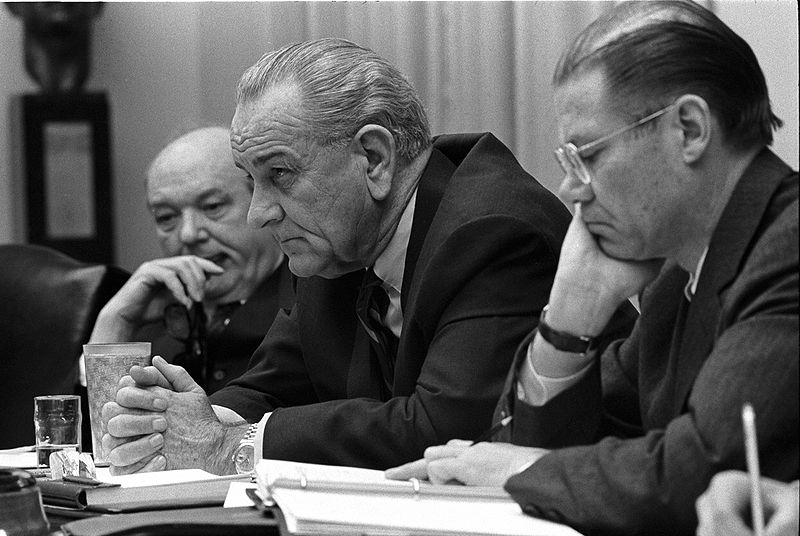
800px-Dean_Rusk_Lyndon_B._Johnson_and_Robert_McNamara_in_Cabinet_Room_meeting_February_1968

Jonathan C. Brown discusses a rare phone call between Lyndon Baines Johnson and Panamanian President Roberto F. Chiari.

Elizabeth Fullerton discovers documents pertaining to the mysterious destruction of a US aircraft in Turkey in 1965 held in the Papers of Lyndon Baines Johnson.

And, Deirdre Smith examines documents that give a first-hand impression of the nature and texture of relations between the United States and Yugoslavia as it proceeded through the 1960s.

bugburnt

On 15 Minute History:

America and the Beginnings of the Cold War

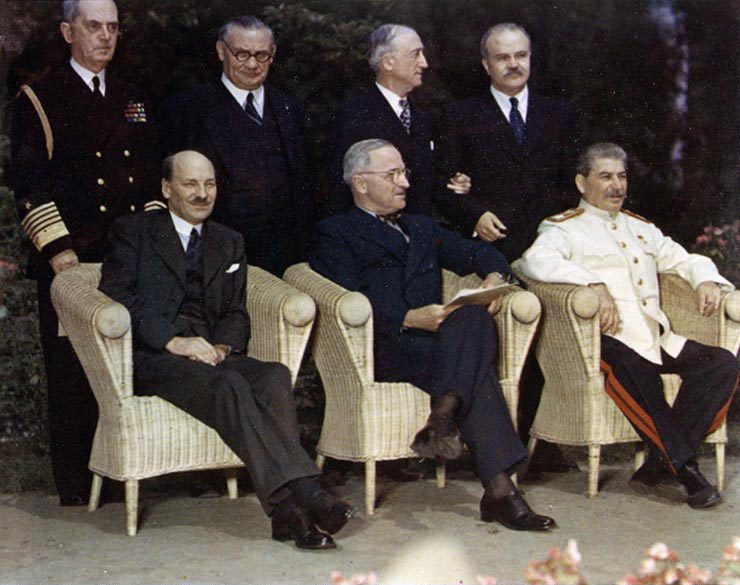
Potsdam_conference_1945-8

The Cold War dominated international politics for four and a half decades from 1945-1989, and was defined by a rivalry between the United States and the Soviet Union that threatened—literally—to destroy the world. How did two nations that had been allies during World War II turn on each other so completely? And how did the United States, which had been only a marginal player in world politics before the war, come to view itself as a superpower?

In this episode, historian Jeremi Suri discusses the beginnings of the Cold War (1945-1989) its origins in the “unfinished business” of World War II, the role of the development of atomic weapons and espionage, and the ways that it changed the United States in just five short years between 1945 and 1950.

Operation Intercept

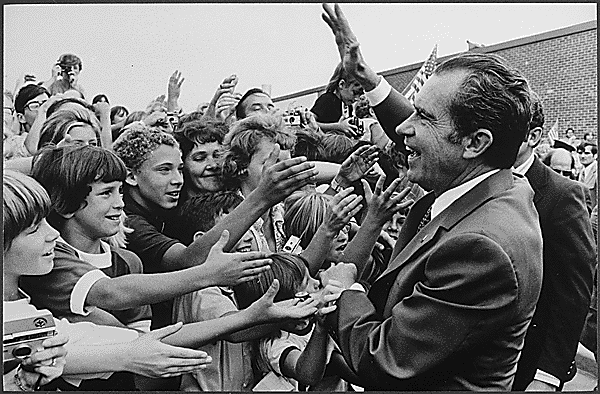
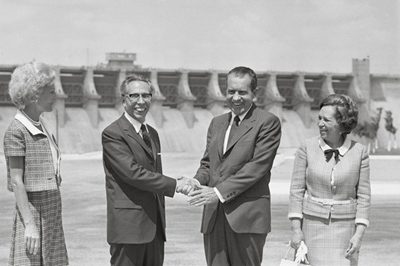
Original Caption: President Richard Nixon and Mexico's President Gustavo Diaz Ordaz shake hands at a ceremony on the Mexico side of the Rio Grande River 9/8 near Del Rio after they dedicated the Amistad Dam, in background.

At 2:30 pm on Saturday September 21 1969, US president Richard Nixon announced ‘the largest peacetime search and seizure operation in history.’ Intended to stem the flow of marijuana into the United States from Mexico, the three-week operation resulted in a near shut down of all traffic across the border and was later referred to by Mexico’s foreign minister as the lowest point in his career.

Guest James Martin from UT’s Department of History describes the motivations for President Nixon’s historic unilateral reaction and how it affected both Americans as well as our ally across the southern border.

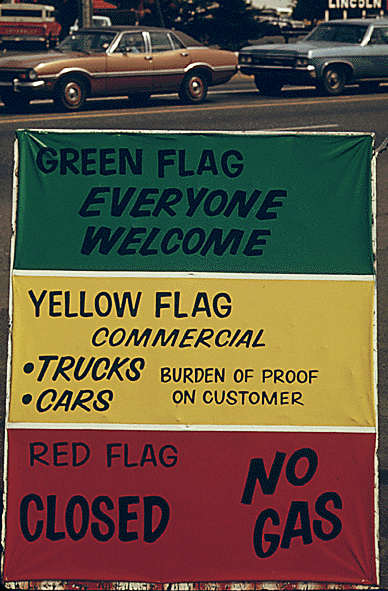
Energy Crisis of the 1970s

FLAG_POLICY_DURING_THE_1973_oil_crisis

Most Americans probably associate the 1973 oil crisis with long lines at their neighborhood gas stations, but those lines were caused by a complex patchwork of international relationships and negotiations that stretched around the globe.

Guest Chris Dietrich explains the origins of the energy crisis and the ways it shifted international relations in its wake.


bugburnt

Recommended Reading and Films:

At home:

Lav copy

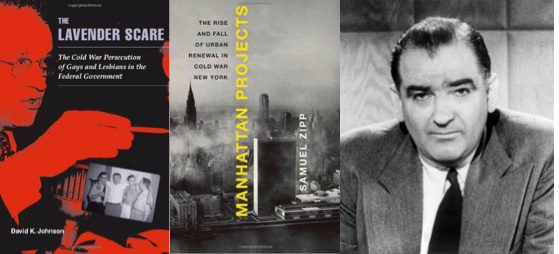
R. Joseph Parrott recommends The Lavender Scare: The Cold War Persecution of Gays and Lesbians in the Federal Government, by David K. Johnson (University of Chicago Press, 2006).

Kyle Shelton reviews, Manhattan Projects: The Rise and Fall of Urban Renewal in Cold War New York, by Samuel Zipp (Oxford University Press, 2010).

And, Dolph Briscoe IV recommends Clint Eastwood’s J. Edgar (2011)

Cold War Politics on the International Stage:

diplomatic copy

Yana Skorobogatov reviews The Atomic Bomb and the Origins of the Cold War, by Campbell Craig and Sergey Radchenko (Yale University Press, 2008)

David A. Conrad suggests Racing the Enemy: Stalin, Truman, and the Surrender of Japan, by Tsuyoshi Hasegawa (Belknap Press, 2006)

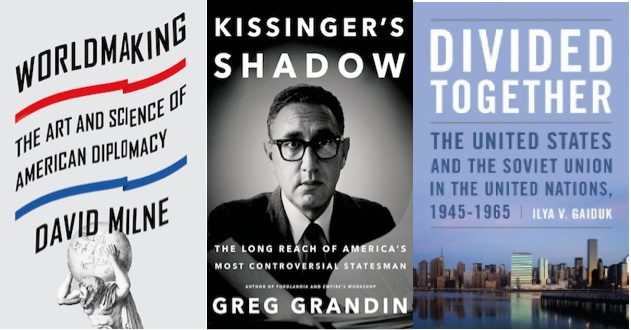
Michelle Reeves recommends Divided Together: The United States and the Soviet Union in the United Nations, 1945-1965, by Ilya Gaiduk (Stanford University Press, 2013) and For the Soul of Mankind: The United States, the Soviet Union, and the Cold War by Melvyn P. Leffler (Hill and Wang, 2008).

Clay Katsky recommends Kissinger’s Shadow, by Greg Grandin (Metropolitan Books, 2015)

If you are interested in US diplomacy during the Cold War see Mark Battjes‘s review of Worldmaking: The Art and Science of American Diplomacy, by David Milne (Macmillan, 2015).

For a gripping history of the Cold War’s final years Jonathan Hunt recommends The Dead Hand: The Untold Story of the Cold War Arms Race and Its Dangerous Legacy, by David E. Hoffman (Anchor, 2009).

R. Joseph Parrott reviews The Rebellion of Ronald Reagan: A History of the End of the Cold War, by James Mann (Penguin, 2010)

800px-Gorbachev_and_Reagan_1985-4

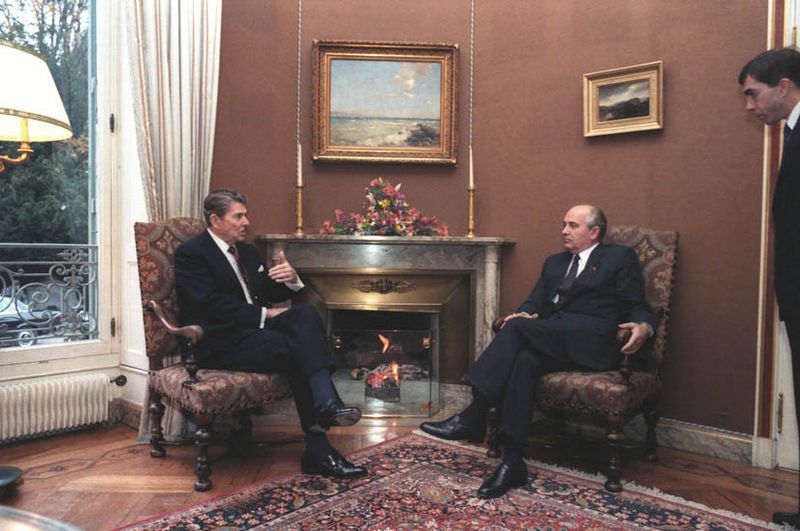
President Reagan meeting with Soviet General Secretary Gorbachev for the first time during the Geneva Summit in Switzerland, 1985 (Image courtesy of Wikimedia Commons)

Cold War around the World:

Cold War World copy

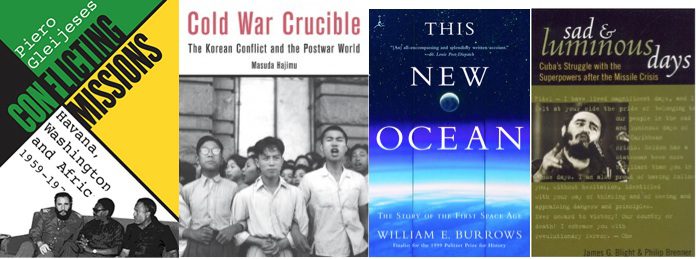
Kazushi Minami suggests Cold War Crucible: The Korean Conflict and the Postwar World, by Hajimu Masuda (Harvard University Press, 2015)

Michelle Reeves discusses Hal Brands’ argument about US influence in Cold War Latin America (Cambridge University Press, 2010).

Aragorn Storm Miller recommends Sad and Luminous Days: Cuba’s Struggle with the Superpowers after the Missile Crisis, by James G. Blight & Philip Brenner (Rowman and Littlefield, 2002).

Yana Skorobogatov on Conflicting Missions: Havana, Washington, and Africa, 1959-1976, by Piero Gleijeses (University of North Carolina Press, 2002)

Toyin Falola shares some Great Books on Africa and the U.S, including Thomas Borstelmann, Apartheid’s Reluctant Uncle: The United States and Southern Africa in the Early Cold War (Oxford University Press, 1993).

And finally, John Lisle takes us even further afield, into space, in his review of This New Ocean: The Story of the First Space Age, by William Burrows (Random House, 1998).

bugburnt

Kissinger’s Shadow, by Greg Grandin (2015)

By Clay Katsky

Kissinger Front CoverTickets to “An Evening with the Honorable Henry Kissinger” at the LBJ Library’s Vietnam War Summit sold out in less than one minute. The attention that Kissinger continues to command in 2016 could be linked to the premise of Greg Grandin’s new book. Grandin, a history professor at NYU, portrays the former National Security Advisor and Secretary of State as extraordinarily influential on U.S. foreign policy before, during, and after leaving office. But from the author’s unambiguously leftist point of view, Kissinger’s legacy is anything but honorable. While Grandin cites his most positive achievements, opening China and stabilizing relations with the Soviet Union, the book’s main contention is that Kissinger’s worldview and access to power led him to create a new imperial presidency “based on even more spectacular displays of violence, more intense secrecy, and an increasing use of war and militarism to leverage domestic dissent and polarization for political advantage.” Kissinger brought the old national security state into the post-Vietnam War era.

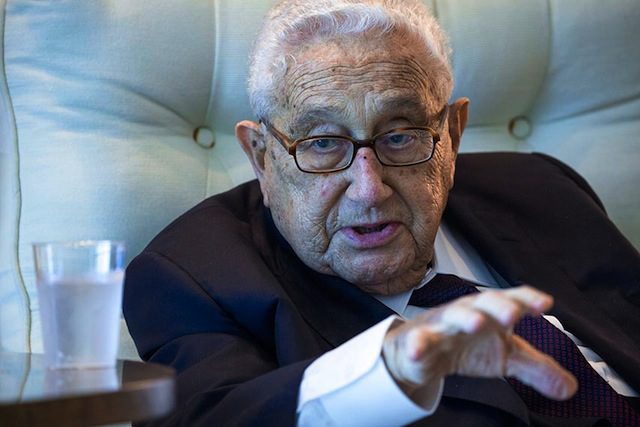
Kissinger relaxes at the LBJ Presidential Library before his public appearance on Tuesday, April 26, 2016 at The Vietnam War Summit. Courtesy of the LBJ Library : photo by David Hume Kennerly.

Kissinger relaxes at the LBJ Presidential Library before his public appearance on Tuesday, April 26, 2016 at The Vietnam War Summit. Courtesy of the LBJ Library : photo by David Hume Kennerly.

Starting with Kissinger’s legendarily long Harvard undergraduate thesis, Grandin seeks to uncover the ideas, insights, and assumptions that influenced his theories on diplomacy and drove his desire to fashion a new world order based on a balance of power. In focusing on Kissinger’s own writings, the book combines intellectual and diplomatic history. And it offers something new by examining Kissinger’s unique mixture of realism and idealism, which Grandin labels a kind of “imperial existentialism” in which conjecture is more preferable for action than fact because hard facts can be polarizing. Most historians have labeled Kissinger an arch-realist, yet Grandin insists that his more philosophical writings stressed the importance of conjecture in decision-making. In tribute to Kennedy’s handling of the Cuban Missile Crisis, Kissinger exalted decisiveness above all else: “In reaching a decision, he must inevitably act on the basis of an intuition that is inherently unproveable. If he insists on certainty he runs the danger of becoming prisoner to events.” But Grandin’s link to Cheney’s 1% Doctrine, which he describes as the United States taking action as if mere threats are forgone conclusions, seems tentative and is based on little evidence. Kissinger had hoped that showing strength in Cuba would lead to bolder foreign polices and legitimize American power, but in office his agenda shifted to preventing a decline in American prestige stemming from the pull out of Vietnam.

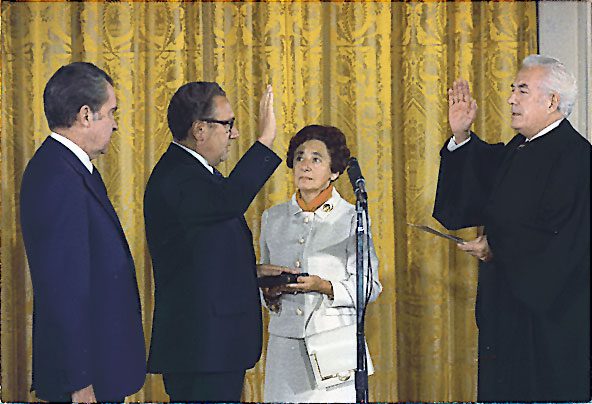
Kissinger being sworn in as Secretary of State by Chief Justice Warren Burger, September 22, 1973. Kissinger's mother, Paula, holds the Bible upon which he was sworn in while President Nixon looks on. Via Wikipedia.

Kissinger being sworn in as Secretary of State by Chief Justice Warren Burger, September 22, 1973. Kissinger’s mother, Paula, holds the Bible upon which he was sworn in while President Nixon looks on. Via Wikipedia.

According to Grandin, power and prestige were crucial elements in Kissinger’s perception of American security interests. Consciousness of power comes from a willingness to act, and he believed the best way to produce willingness was to act. But nuclear weapons complicated Cold War power dynamics because leaders were afraid to use them. Taking stock of Kissinger’s early academic career at Harvard, Grandin points out that in 1956 he wrote that the more powerful the weapons “the greater becomes the reluctance to user them.” Strength turned to weakness. But Grandin’s emphasis on the future statesman’s earliest writings freezes his worldviews in the 1950s. This in spite of the fact that Kissinger’s early musings on limited nuclear warfare later evolved into his belief that action in small wars in marginal areas could produce enough awareness of power to break the impasse of nuclear power. In this regard, Kissinger saw Southeast Asia as more of an opportunity than a burden. But Grandin doubts his escalation in Vietnam was based on any geostrategic reasoning. Like détente it served a more domestic purpose and, therefore, he brands the extensive bombing of Cambodia as both Kissinger’s most heinous crime and his most enduring contribution to U.S. foreign policy.

In terms of its legality, the bombing set an important precedent for U.S. warfare because it targeted a neutral country. Kissinger justified violating Cambodian sovereignty by citing the need to destroy Communist “sanctuaries” along its border with Vietnam. Grandin links such logic to more recent attacks on terrorist “safe havens,” from George W. Bush’s invasion of Afghanistan in 2002 to Barack Obama’s extensive use of drone attacks in Pakistan and Syria. Although Kissinger fell out of favor with the conservative establishment when Reagan began hammering him on détente, this connection is based on good evidence. Desperate to distance itself from talk of power balances and American decline, the New Right began to show Kissinger the door in the late 1970s. But Grandin explains that Kissinger’s defense of the Vietnam War and his arguments for escalation into Cambodia had already become deeply embedded in the ideology of Republican establishment. While Reagan distanced himself from the Secretary of State during his 1976 presidential primary campaign, by 1980 Kissinger was back speaking at the Republican National Convention.

Kissinger’s legacy in the realm of diplomacy is the focus of the book’s second half. Looking at other parts of Asia, Grandin examines his encouragement of the Indonesian invasion of East Timor and his ambivalence towards selective genocide in East Pakistan (now Bangladesh). Turning to Africa, he exposes in great detail Kissinger’s support for apartheid governments, and in terms of the Middle East, he blames him for locking the United States into a perpetual crisis by vehemently pursuing American hegemony in the region. Kissinger’s impact was global, spanning “from the jungles of Vietnam to the sands of the Persian Gulf.”

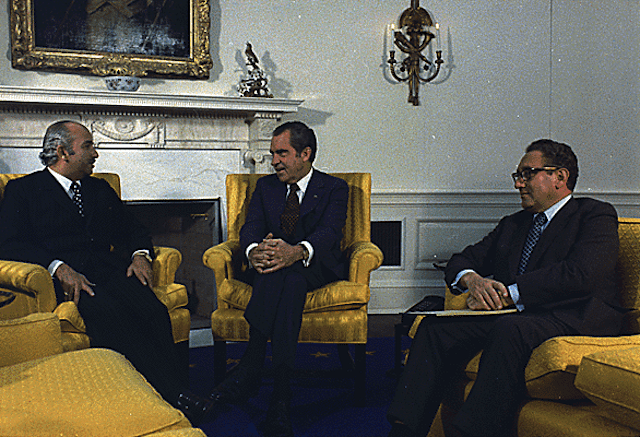
Meeting in the Oval Office between Richard Nixon, Henry Kissinger, and Egyptian Foreign Minister Ismail Fahmi, 31 October 1931. Via Wikipedia.

Meeting in the Oval Office between Richard Nixon, Henry Kissinger, and Egyptian Foreign Minister Ismail Fahmi, 31 October 1931. Via Wikipedia.

Grandin’s most interesting chapter is domestically focused and intellectually based. The Church Committee inaugurated a new era of foreign policy oversight that Kissinger described as “a merciless congressional onslaught.” Congress’ season of inquiry into matters of national security during the 1970s produced a new relationship between secrecy and spectacle. According to Grandin, the spectacle of continuous congressional hearings nullified the need for secrecy partly because oversaturation leads to public indifference. And when important controversies become mere visual entertainment, public attention fades as crimes are turned into procedural questions or differences of opinion between political parties. Further confusing the issue, arguments over whether the ends justify the means usually leave the hawks in Congress in agreement, and so for the general public such inquiries often act to justify both sides. For his contribution, Kissinger is described as a master at reframing controversial policies into technical matters. But Grandin’s conclusion that Kissinger decided to go covert with the coup against Allende in Chile because Congress was breathing down his neck over Vietnam seems circumstantial. Still, his insight into the parallel nature of secrecy and spectacle fits well anecdotally – in the following decade, Reagan’s full-scale invasion of Grenada smacks as a distraction from the covert wars being carried out in Central America.

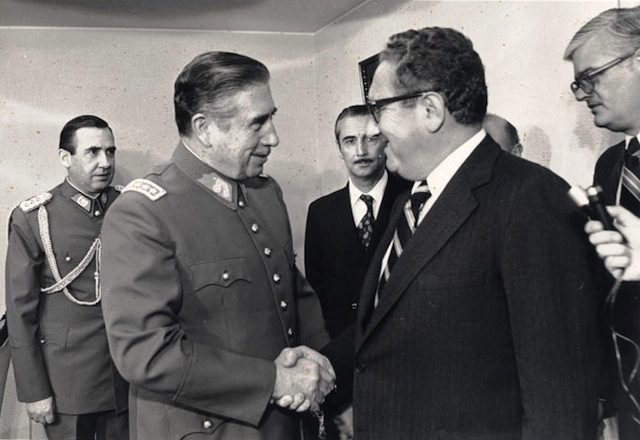
Chilean dictator Augusto Pinochet shaking hands with Kissinger in 1976. Via Wikipedia.

Chilean dictator Augusto Pinochet shaking hands with Kissinger in 1976. Via Wikipedia.

Kissinger’s Shadow connects the sustained American militarism and the increased political polarization that followed the end of the Cold War. Grandin convincingly argues that Kissinger’s influence on U.S. foreign policy has reverberated into the twenty-first century. While he might rely too heavily on a career’s worth of Kissinger’s writing as ammunition to attack him with, the author’s bias against the now elder statesman does not nullify the facts that he presents and most of his interpretation of those facts. The support that many Americans continue to give to a broad policy of intervention and perpetual war may have started out as a product of the superpower rivalry, but Kissinger’s enduring popularity has allowed such machinations to transcend the Cold War.

Greg Grandin, Kissinger’s Shadow: The Long Reach of America’s Most Enduring Statesman (Metropolitan Books, 2015).

bugburnt

You may also like our collection of essays on US Presidents and Mark Battjes’ recent review of David Milne’s Worldmaking: The Art and Science of American Diplomacy (2015)

Great Books on Women’s History: Asia

Not Even Past asked the UT Austin History faculty to recommend great books for Women’s History Month. The response was overwhelming so we have been posting their suggestions throughout the month. This is our last set of book recommendations; this week we feature books on women and gender in East Asia and South Asia. 

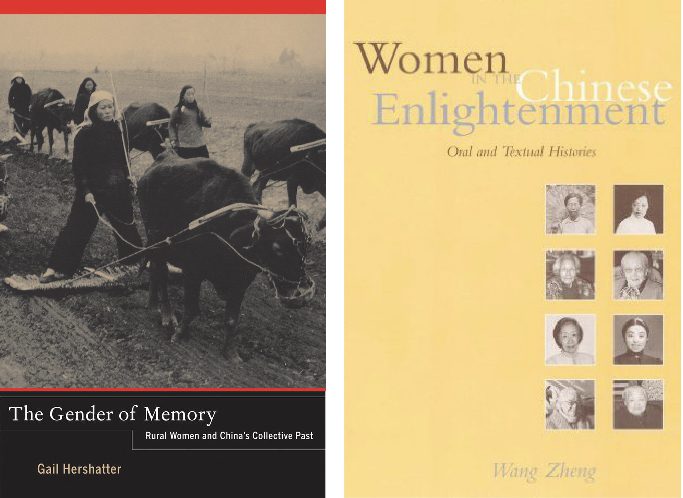
chinese womens books

Huaiyin Li recommends:

Zheng Wang, Women in the Chinese Enlightenment: Oral and Textual Histories (1999)

Focusing on the life stories of five prominent women activists in twentieth-century China, this book examines Chinese feminism in the Republican era and its fate under the socialist state.  Its depiction of the feminists’ pursuit of national salvation and self-emancipation contrasts sharply with the Chinese Communist Party’s master narrative of women’s liberation under its leadership.

Gail Hershatter, The Gender of Memory: Rural Women and China’s Collective Past (University of California Press, 2011)

Based on interviews with 72 village women in Shaanxi province, this book shows how the Chinese Communist Party’s policy reshaped women’s agriculture work, domestic routines, activism, marriage, childbirth, and parenting from the 1950s through the 1970s.  It also addresses the intriguing questions of how memories are gendered and how gender figured in the making of socialism in Chinese agriculture. (Reviewed on Not Even Past).

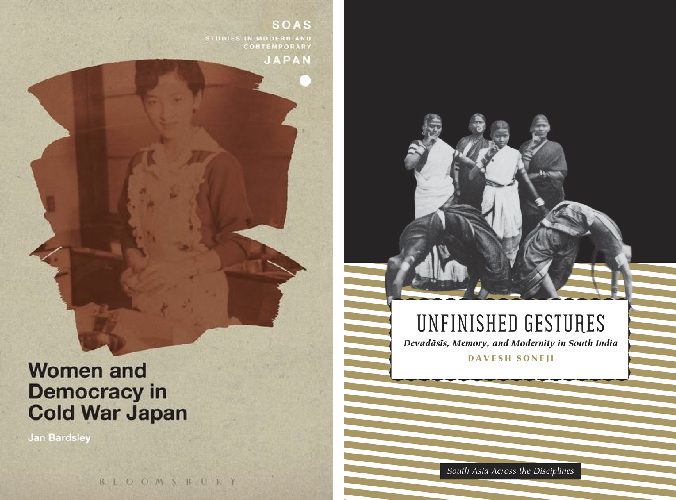
asia womens

Nancy Stalker recommends:

Jan Bardsley, Women and Democracy in Cold War Japan (2014)

(Bloomsbury, 2016) is an engaging new work that reveals gender roles and gender politics in the 1950s through close readings of diverse popular media.  Focusing on newsworthy events centered around women, such as the wedding of the imperial prince to a commoner and Japan’s first Miss Universe title, Bardsley reveals the media construction of the “housewife” embedded within discourses on postwar democracy, Cold War geopolitics, and US – Japan relations.

Cynthia Talbot recommends:

Davesh Soneji, Unfinished Gestures: Devadasis, Memory and Modernity in South India (2012).

This book combines historical research and ethnographic fieldwork to track the fate of South India’s devadasis, originally Hindu temple dancers who came to be regarded as prostitutes as India was transformed by colonial modernity.  Typically unmarried and residing in quasi-matrilineal communities, devadasis often served as concubines or courtesans for elite men but came under increasing condemnation by social reformists beginning in the mid-nineteenth century; they were officially outlawed in 1947.  Soneji goes beyond the standard narrative of social change in colonial India by including an extensive examination of the role of dance in Indian royal courts and a sensitive exploration of the memories of ex-devadasis in this innovative, well-written work.

bugburnt

For more books on Women’s History:

Great Books (Europe)

Great Books (Crossing Borders)

Great Books (US)

Indrani Chatterjee, On Women and Nation in India

Our 2013 list of recommendations:  New Books on Women’s History


bugburnt

Great Books on Women’s History: United States

Not Even Past asked the UT Austin History faculty to recommend great books for Women’s History Month. The response was overwhelming so we will be posting their suggestions throughout the month. Here are some terrific book recommendations on women and gender in the United States.

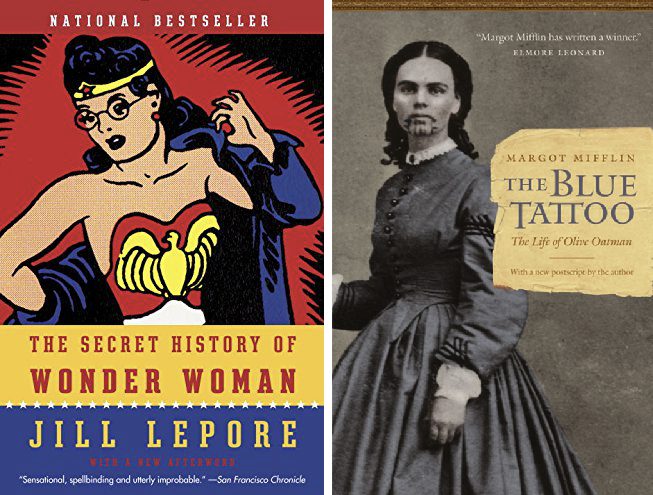
wonder blue tatt

Penne Restad recommends:

Jill Lepore, The Secret History of Wonder Woman (2014).

A lively, often surprising, narrative history that chronicles the adventures of Wonder Woman, the comic strip devoted to her prowess, and Marston, the man who imagined her, in the center of the struggle for women’s rights in the U.S.

Erika Bsumek recommends:

Margot Mifflin, The Blue Tattoo: The Life of Olive Oatman (2011).

In 1851, the 13 year old Oatman was part of a Mormon family traveling west. She was captured by the Yavapai Indians and then traded to the Mohave, who adopted her. The book tells her story and provides some valuable context on the various Mormon sects, the tensions and troubles faced by American Indians in the face of American expansion, and how one young woman experienced it all.

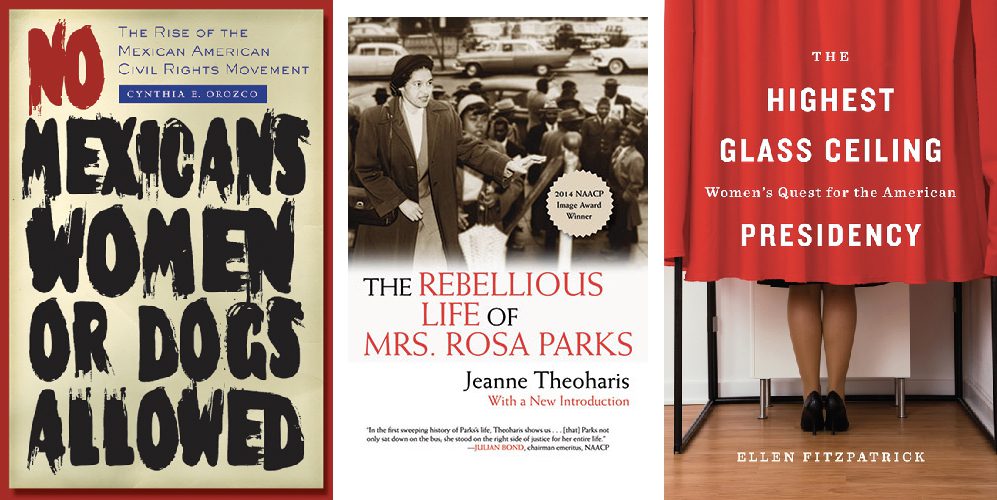
mexrosaglass

Laurie Green recommends:

Jeanne Theoharis, The Rebellious Life of Mrs. Rosa Parks. (2013)

Think you know who Rosa Parks was? Jeanne Theoharis’s biography will change your understanding of the woman who became famous for triggering the Montgomery Bus Boycott in 1955 when she was “too tired” to relinquish her seat on a city bus to a white passenger. The book tells you the real story of Parks’s militant activism from the 1930s to the 1990s and her frustration with being recognized as a symbol, not a leader.

Emilio Zamora recommends:

Cynthia E. Orozco, No Mexicans, Women, or Dogs Allowed; The Rise of the Mexican American Civil Rights Movement (2009)

The book is a re-examination of the League of United Latin American Citizens, the longest running Mexican American civil rights organizations.  Orozco is a well-known historian who incorporates women and gender in her histories of Mexican Americans.  In this instance, women are placed at center stage in the cause for equal rights and dignity.

Jackie Jones recommends:

Ellen Fitzpatrick, The Highest Glass Ceiling: Women’s Quest for the American Presidency (2016).

A great read and couldn’t be more timely! The book focuses on three women candidates for the presidency:  Victoria Woodhull (ran in 1872), Margaret Chase Smith (1964), and Shirley Chisholm (1972).

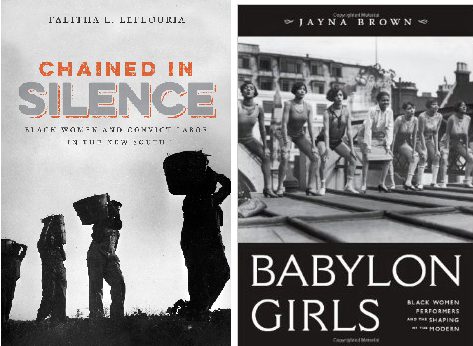
chainedbabylon

Daina Berry recommends:

Talitha LeFlouria, Chained in Silence: Black Women and Convict Labor in the New South (2016)

From the UNC Press website:

In 1868, the state of Georgia began to make its rapidly growing population of prisoners available for hire. The resulting convict leasing system ensnared not only men but also African American women, who were forced to labor in camps and factories to make profits for private investors. In this vivid work of history, Talitha L. LeFlouria draws from a rich array of primary sources to piece together the stories of these women, recounting what they endured in Georgia’s prison system and what their labor accomplished. LeFlouria argues that African American women’s presence within the convict lease and chain-gang systems of Georgia helped to modernize the South by creating a new and dynamic set of skills for black women. At the same time, female inmates struggled to resist physical and sexual exploitation and to preserve their human dignity within a hostile climate of terror. This revealing history redefines the social context of black women’s lives and labor in the New South and allows their stories to be told for the first time.

Charlotte Canning recommends:

Jayna Brown, Babylon Girls: Black Women Performers and the Shaping of the Modern (2008)

An award-winning cultural history of the African American women who were variety performers on chorus lines, in burlesques, cabarets, and vaudeville from 1890 to 1945. Despite the oppression they experienced, these women shaped an emerging urban popular culture. They pioneered social dances like the cakewalk and the Charleston. It is an ambitious view of popular culture and the ways in which women were integral to its definition.

 scimed

Bruce Hunt and Megan Raby recommend:

Kimberly Hamlin, From Eve to Evolution: Darwin, Science, and Women’s Rights in Gilded Age America (2014)

While there is an enormous literature on the reception of Darwin’s evolutionary theory, this is the first book to examine the responses of women. This book is a lively account of how ideas about human evolution figured in debates over women’s rights in the late 19th century, by a recent UT American Studies PhD.

Megan Seaholm recommends:

Jennifer Nelson, More Than Medicine:  A History of the Feminist Women’s Health Movement (2015)

Nelson provides an excellent addition to the growing literature about the women’s health movement that began in the 1960s.  She concentrates on reproductive health and reproductive rights from abortion referral services organized before Roe v. Wade through the National Black Women’s Health Project organized in 1984.  This is a good read and an important contribution.

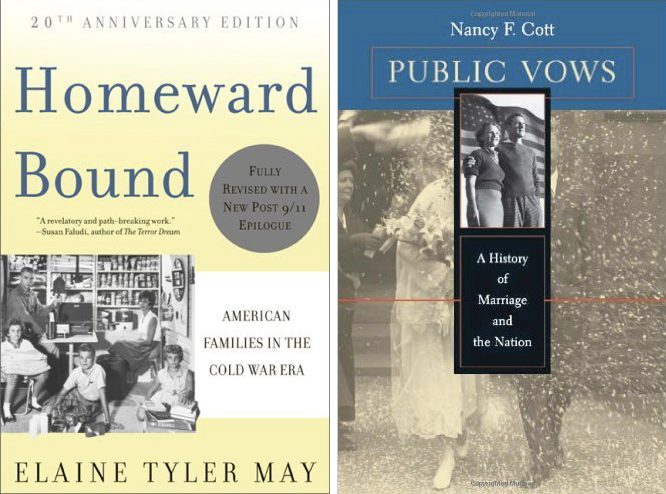
famfam

Mark Lawrence recommends:

Elaine Tyler May, Homeward Bound:  American Families in the Cold War Era (1990)

Elaine Tyler May examines the resurgence of traditional gender roles in the years after the Second World War, arguing that a desire to enjoy postwar prosperity and to escape the dangers of the nuclear age drove Americans back to conventional norms.  The book brilliantly blends women’s, social, political, and international history.

Judith Coffin recommends:

Nancy Cott,  Public Vows : A History of Marriage and the Nation (2000)

The changing stakes of marriage for the nation and for men and women — gay and straight. Readable, smart, and connected to the present. Nancy Cott helped write several amicus (friend-of-the-court) briefs in the marriage cases before the Supreme Court.

bugburnt
For more books on Women’s History:

Great Books (Europe)

Great Books (Crossing Borders)

Indrani Chatterjee, On Women and Nation in India

Our 2013 list of recommendations:  New Books on Women’s History

bugburnt

« Previous Page
Next Page »

Recent Posts

  • Lesson Plans: The Vietnam War and American Society
  • Lesson Plans: Protest and Social Unrest
  • Lesson Plans: Radio and Communications Technology
  • The Long-Lasting and Perpetuating Effects of Lynching Postcards and Photography
  • Lesson Plans: The Cold War
NOT EVEN PAST is produced by

The Department of History

The University of Texas at Austin

We are supported by the College of Liberal Arts
And our Readers

Donate
Contact

All content © 2010-present NOT EVEN PAST and the authors, unless otherwise noted

Sign up to receive our MONTHLY NEWSLETTER

  • New
  • Features
  • Reviews
  • Texas
  • Teaching
  • Digital
  • Watch & Listen
  • Authors
  • About