• New
  • Features
  • Reviews
  • Texas
  • Teaching
  • Digital
  • Watch & Listen
  • Authors
  • About

The past is never dead. It's not even past

Not Even Past

Alexei Navalny’s Legacy and Anti-Putin Resistance

Moscow’s southeast neighborhoods of Maryino and Lyublino always seem to be where the authorities locate controversial events. On March 1, 2024, it was Maryino who hosted the funeral of Russian dissident Alexei Navalny.  The church that held the ceremony is a post-Soviet building and dominates the center of a neighborhood otherwise filled with high-rise apartments, broad streets, shopping centers, and a string of parks and ponds along the Moscow River. On the day of the funeral, striking photos showed the lines of people paying their respects against the backdrops of apartment blocks. Other photos soon appeared online from inside the church despite authorities forbidding photography.  Having world historical events occur in a neighborhood you usually associate with medical visits, shopping, haircuts, and eating Uzbek food and sushi is surreal. With Navalny’s death, however, my wife and I also had a grim sense of both déjà vu and inevitability. 

When assassins shot journalist Anna Politkovskaya at her home in central Moscow in 2007, I was teaching English to cheery businesspeople a few blocks away.[1]  When assassins shot politician Boris Nemtsov on a bridge by the Kremlin in 2015, I was researching in the Moscow archives. My reaction was writing a post for Not Even Past about how Russian TV coverage immediately made light of Nemtsov’s “ladies’ man” reputation.[2]  Over the next month, I walked past the murder scene to view the mound of flowers on the sidewalk.  The pile was usually small because the city ordered the street cleaners to remove them daily.  When we awoke to Navalny’s death on February 16, we were saddened but not very surprised.
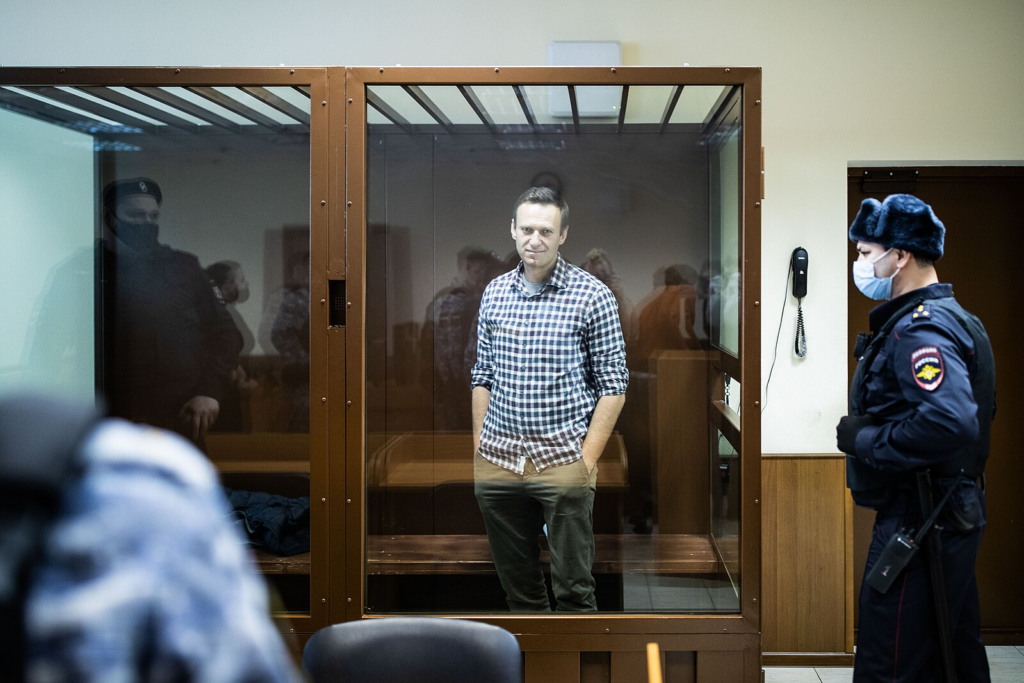
Alexey Navalny in court, February 2021.
Source: Wikimedia Commons

Born to a Ukrainian father and a Russian mother, Navalny was involved with several political parties before gaining international attention for leading protests against fraud in the 2011 Russian parliamentary elections. His profile rose in 2013 as he became a candidate for the Moscow mayoral position.  Afterward, he organized protests and investigated corrupt politicians while facing increasing legal troubles and threats. Navalny believed that Putin had him poisoned in August 2020, leading him to nearly die. He sought medical care in Germany even as Russian authorities seized his assets and apartment.[3]  So why did Navalny return to Russia knowing he would face certain imprisonment and likely death? 

Political dissidents making a crucial choice about remaining in exile or returning home have a long history that weaves through the Russian Imperial and Soviet periods to the present.  Vladimir Lenin and Leon Trotsky were in exile in Switzerland and Brooklyn, respectively, when the February Revolution overthrew Tsar Nicholas II in 1917. They only returned home (Lenin with German assistance) after the government had fallen.  During Joseph Stalin’s rule in the Soviet Union, Trotsky was forced into exile once again, this time to Mexico City, where he was assassinated in 1940.  Historian Barbara Martin has highlighted how Soviet dissidents such as Alexander Solzhenitsyn and Roy Medved faced this conundrum in the post-Stalinist Soviet Union. While life in exile was safer and provided academic and political freedoms, leaving felt like a dereliction of duty or abandoning your home. It also lessened dissidents’ authority among their fellow citizens.[4]  Navalny seemed to take this point to heart and hence accepted the risk of confrontation with the regime, likely believing that his brave anti-Putin legacy would be cemented even at great personal risk.
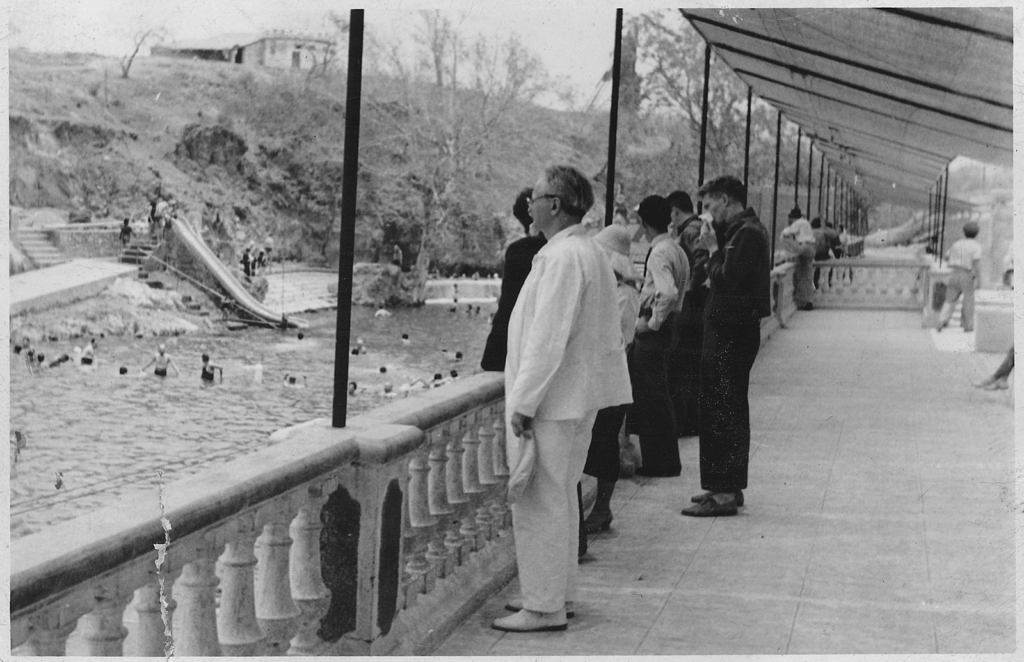
A political dissident in exile. Leon Trotsky (wearing a white suit) in Mexico, 1938.
Source: Wikimedia Commons

Navalny’s return to Russia in January 2021 was stunningly brave, even as the end result was strikingly predictable. However, he is also a complex figure, and his actions, words, and legacy are intertwined in a set of wider issues and conflicts.

Consider for a moment the Russians in the apartments overlooking his funeral, not the mourners. Assessing Navalny’s popularity through Russian opinion polls, many of them problematic, is difficult.[5] But as I lived and visited Russia, even during Navalny’s poisoning, exile, return, and arrest saga, I heard many people expressing negative voices against him. Some recurring comments were skepticism about his anti-corruption campaigns or the simple belief that he was just another self-aggrandizing politician.  With the 2014 Maidan Revolution in Ukraine, the Russian occupation of Crimea, and the Russian intervention in Eastern Ukraine, cynicism turned to accusations of treason and other conspiracy theories, all repeated in various iterations in the Russian official media. 
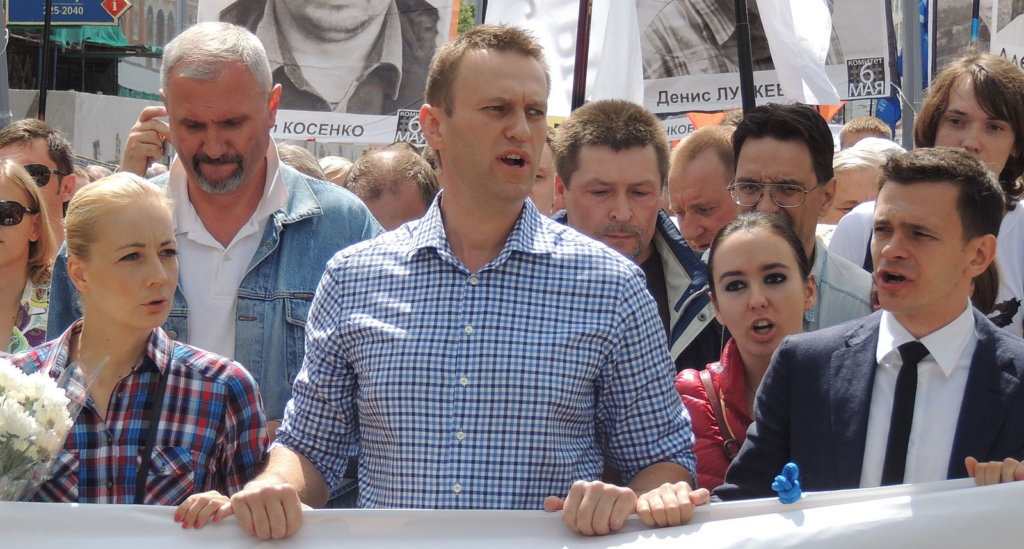
Navalny protesting in Moscow, 2013.
Source: Wikimedia Commons

Part of this seems obvious. Russia’s full-scale invasion of Ukraine in 2022 solidified the state media’s portrayal of Navalny as a foreign agent. Furthermore, numerous new laws have designated Navalny, his organization, and most anti-Putin journalists and organizations as treasonous foreign terrorists acting on behalf of the West or Ukraine. The onslaught of such accusations wears people down.  And yet, sociologist Jeremy Morris argues that his contacts’ reaction to Navalny has little to do with propaganda. Many Russians simply dislike Navalny’s image and consider his campaigns naïve and inconsequential.[6] In other words, you can trust that conversations with Russians in Russia about his death are often very different than the coverage by non-Russian media. 

Aside from propaganda and everyday anti-Navalny sentiment, his politics and statements have also been a point of contention among other anti-Putin politicians and activists.  While Navalny is often portrayed as a stereotypical “Russian liberal,” earlier in his political career, he spoke the language of Russian ethno-nationalism. He amplified racial stereotypes directed towards Russia’s large immigrant and Muslim communities, as well as its other numerous non-Russian ethnic groups. He attended the far-right Russian marches, which blamed most of Russia’s ills on immigrants and called for mass deportations.  He moderated such stances over time and apologized. Still, his early remarks defined his image for many non-Russian ethnic groups within and outside of Russia.[7]  Even as his wife, Julia Navalnaya, took the reigns of his organization, the question of where non-ethnic Russians stand within their vision of Russia remains uncertain.[8]

The logo of "Russia of the Future," Alexey Navalny's party.
The logo of Alexey Navalny’s party – “Russia of the Future.” Source: Wikimedia Commons

In the context of the Russian occupation of Crimea in 2014, Ukrainians and Crimean Tatars (the indigenous Muslim minority of Crimea) had good reasons to be skeptical of his denunciations of the full-scale Russian invasion in February 2022.  Beginning with the 2014 occupation of Crimea, Navalny had denounced Russian methods but echoed the Russian nationalist ethos that Russia and Crimea possessed a kind of supernatural bond.[9]  As someone who was researching Stalin’s ethnic cleansing of Crimea at the time the occupation began, this was disappointing, to say the least.   He made such statements as Russian authorities began a new wave of repressions, arrests, and sometimes murders of Crimean Tatars, Crimean Ukrainians, and Russians who protested Putin.[10] 

One point that many of Navalny’s varied detractors may agree on (albeit for different reasons) is that the Western media is too focused on Navalny himself and less on the audiences he represents.  At the very least, the acknowledgment of Navalny should come with a recognition of the bravery and defiance of individuals and victims outside the media spotlight.  There are thousands of other political prisoners in Russia and occupied Ukraine, and Putin’s army and occupation kill Ukrainians every day.  These prisoners suffer from malnourishment, torture, and death.  In Ukraine, the use of torture, rape, and mass executions is now well documented.[11]  In Russia, dissident Vladimir Kara-Murza is now serving a 25-year sentence for condemning the war and has become chronically ill.[12]  Last year, Crimean Tatar activist Dzhemil Gafarov died in a southern Russian prison after being tortured and denied medical release.[13]  The list of absurd arrests for anti-war activities is far too long to recount here. One of the latest examples is the 7-year prison sentence for Russian poet Alexander Byvshev, who questioned the morality of Russia’s invasion.[14]  In other words, the legacy of sacrifice and resistance to Putin is multi-national and multi-ethnic in scope and is far more diverse and broad than just Navalny, the individual.
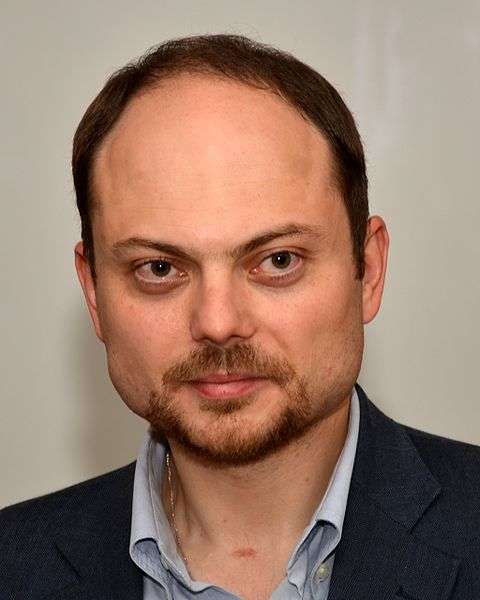
Vladimir Kara-Murza is now serving a 25-year sentence for condemning Russia's invasion of Ukraine.
Vladimir Kara-Murza is now serving a 25-year sentence for condemning Russia’s invasion of Ukraine.
Source: Wikimedia Commons.

In the month since his death, Russia-related news has remained grim.  Russian attacks have killed dozens of Ukrainian civilians and left the country’s second-largest city, Kharkiv, without power.  Putin has “won” his latest election with absurd margins. He used the election celebrations to signal “enthusiastic voting” in Russian-occupied Ukraine and, almost with a sense of accomplishment, finally mentioned the now-deceased Navalny by name. However, the events of last week showed that Putin does not control everything in Russia. ISIS-K militants launched a horrific terrorist attack on a Moscow concert venue, killing well over 100 people.  Putin’s reaction has been a confused mix of attempting to blame Ukraine and the West, while Russian society and the state have descended into targeting Muslim immigrants and ethnic minorities with threats, deportations, and violence.

Both Russia’s present and its future seem grim. That is perhaps when it is best to think of Alexei Navalny. If nothing else, a consensus seems to have developed that Navalny was remarkable for being a Russian optimist and having the audacity, no matter how flawed or naïve, to believe that Russia’s current course could be reversed. Realistic or not, I do think about that possibility every day and whether – just maybe – there might be some truth to his belief.


Andrew Straw is a historian of Soviet Crimea. He has taught courses on Russian and Soviet history at the University of Texas and Huston-Tillotson University. At the moment, he teaches high school world history and is an instructor for the University of Texas OnRamps history program. He continues research as an independent scholar and is preparing a book proposal that will focus on Stalin’s Crimea policy and Crimean Tatars in the immediate postwar period. He can be reached at astraw@utexas.edu or on Twitter at @astrawism1


[1] https://www.iwmf.org/community/anna-politkovskaya/

[2] https://notevenpast.org/tag/boris-nemtsov/

[3] https://www.bbc.com/news/world-europe-54369664.amp

[4] https://www.bloomsbury.com/us/dissident-histories-in-the-soviet-union-9781350192447/

[5] https://www.levada.ru/2021/02/05/vozvrashhenie-alekseya-navalnogo/

[6] https://postsocialism.org/2024/02/16/russia-lost-its-greatest-and-most-naive-optimist-a-curmudgeons-obituary-of-alexei-navalny/

[7] https://www.euronews.com/2023/07/07/racist-or-revolutionary-is-alexei-navalny-who-many-westerners-think-he-is

[8] https://www.themoscowtimes.com/2024/02/29/navalnys-difficult-relationship-with-indigenous-russians-a84291

[9] https://www.themoscowtimes.com/2023/03/07/navalnys-policy-shift-on-crimea-may-be-too-little-too-late-a80396

[10] https://unn.ua/en/news/at-least-60-people-died-from-repressions-in-crimea-during-russian-occupation-ctrc

[11]https://www.theguardian.com/commentisfree/2024/mar/25/russia-weaponising-sexual-violence-ukraine-values

[12] https://www.npr.org/2023/04/17/1168667764/vladimir-kara-murza-prison-sentence

[13] https://khpg.org/en/1608812709

[14] https://www.reuters.com/world/europe/russian-anti-war-poet-gets-seven-year-jail-term-over-poem-ukraine-war-2024-03-22/

The views and opinions expressed in this article or video are those of the individual author(s) or presenter(s) and do not necessarily reflect the policy or views of the editors at Not Even Past, the UT Department of History, the University of Texas at Austin, or the UT System Board of Regents. Not Even Past is an online public history magazine rather than a peer-reviewed academic journal. While we make efforts to ensure that factual information in articles was obtained from reliable sources, Not Even Past is not responsible for any errors or omissions.
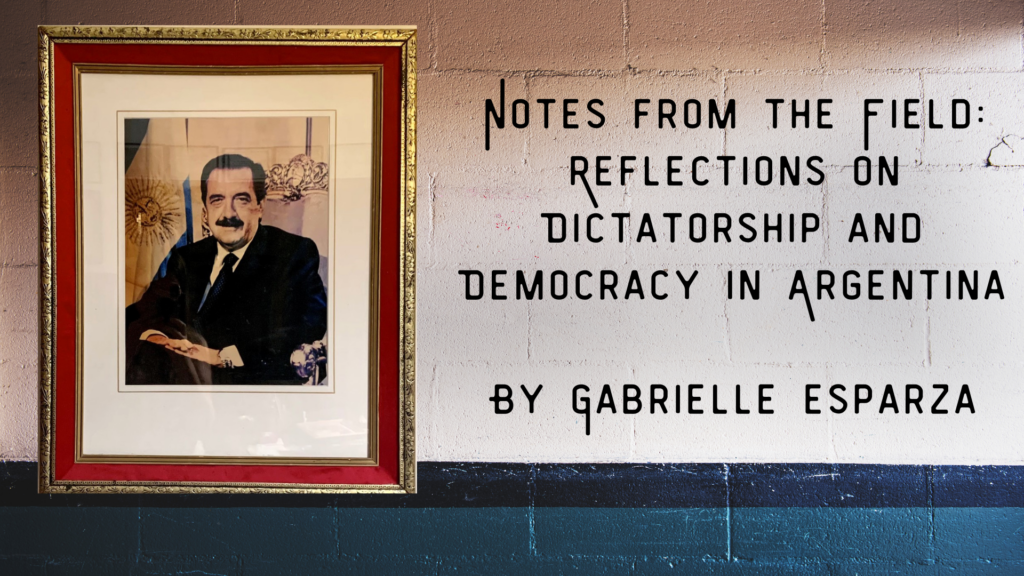
Notes from the Field: Reflections on Dictatorship and Democracy in Argentina

In January 2023, I traveled nearly three hundred miles from my apartment in Buenos Aires to meet a stranger in Paraná, Argentina. We had chatted sporadically via WhatsApp, but I had agreed to spend a long weekend in her home months before we ever met. As I stepped off the bus, I had little sense of what awaited me, yet I was excited to finally meet Luz.

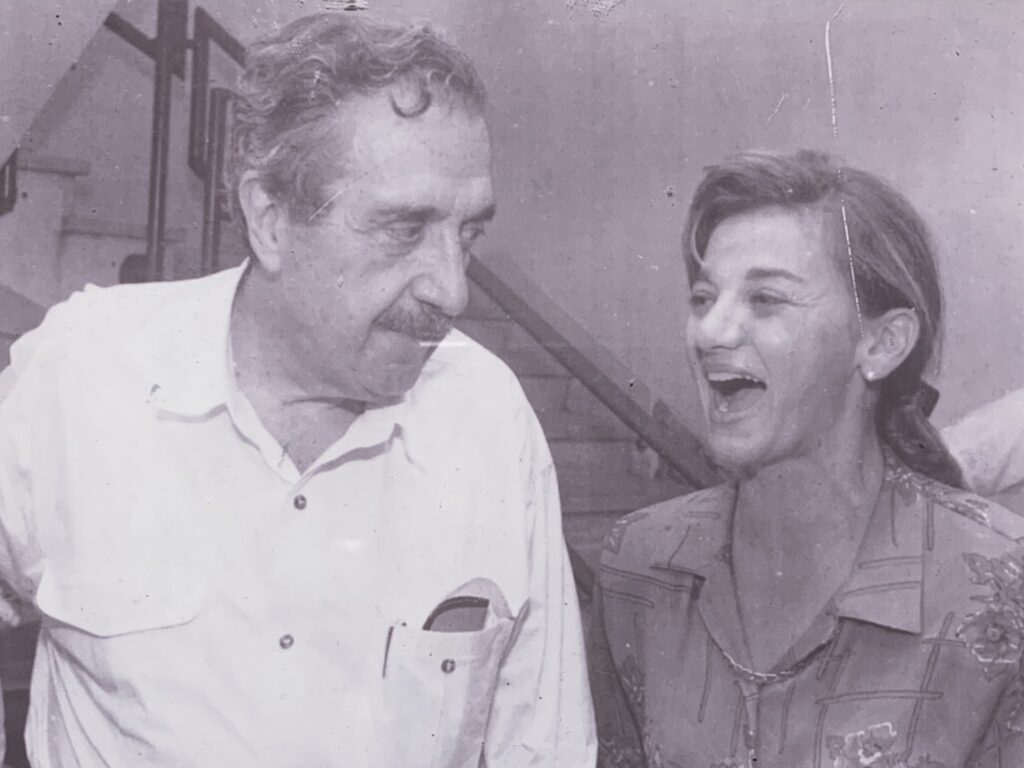
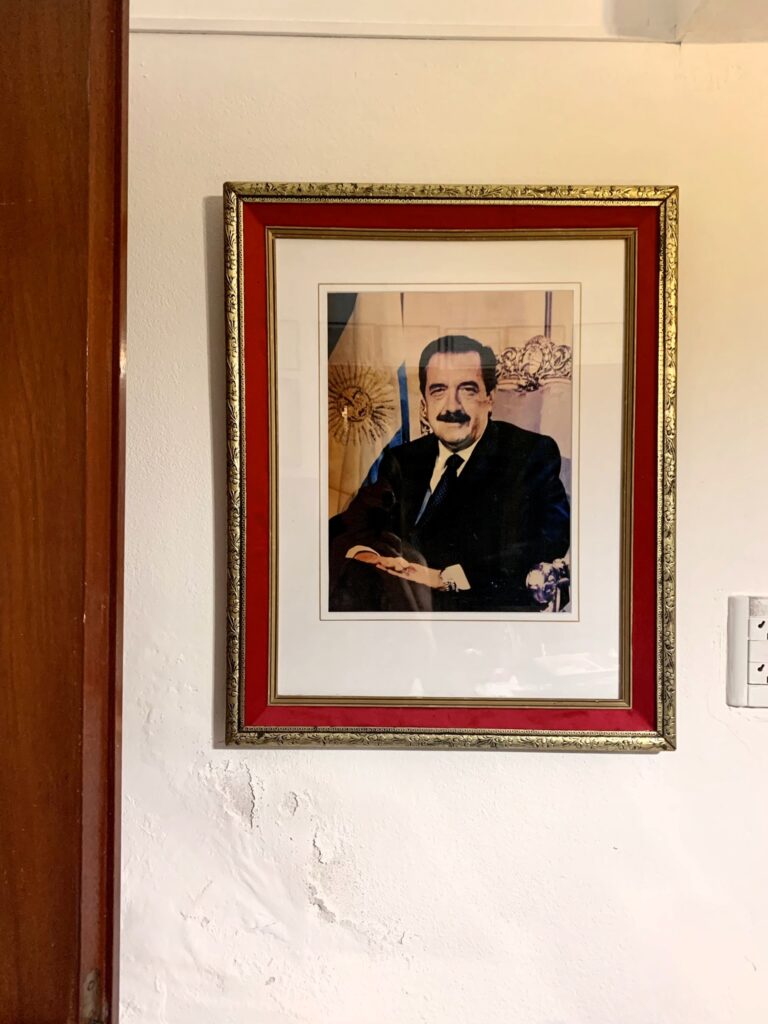
Our meeting happened by chance. A few months earlier, I started research in the Archivo General for my dissertation on President Raúl Alfonsín. He had led Argentina’s 1983 democratic transition, following the country’s longest and most brutal dictatorship. Between 1976 and 1983, the military junta forcibly disappeared an estimated 30,000 people. I had mentioned this project to Álvaro, another doctoral student working in the archives. That weekend he texted me from his friend’s home. “You’ll never believe this,” he said, “but my friend’s parents were friends of Alfonsín.” Accompanying his text was a photo of Luz, walking alongside the president. Álvaro said that he had told Luz about my project, and she had invited me to visit.

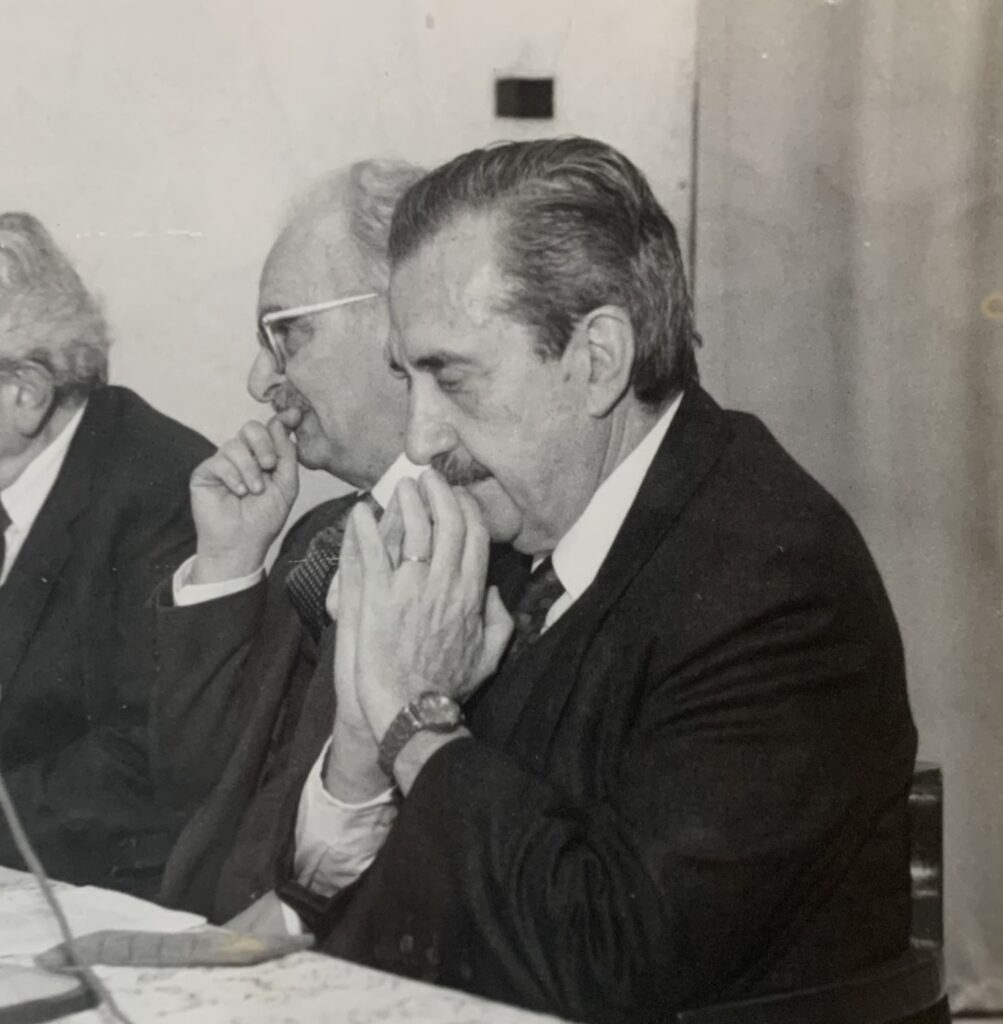
Raúl Alfonsín and Enrique Pereira at a book talk in the Biblioteca Popular in Paraná (courtesy of Luz Buscema)

Luz’s invitation was unexpected and unusual but also very exciting. I quickly followed up by WhatsApp. She promised to share books and photos from her late husband Enrique’s personal archives. Enrique had held local political office for Alfonsín’s party, la Unión Cívica Radical (the Radical Civic Union, UCR). He had also spent thirty years writing a history of the UCR and its important figures. After Enrique’s death, Luz had undertaken the process of editing and publishing his life’s work. Now she offered to share these materials and her memories of Alfonsín’s presidency with a curious historian from the United States.

Luz alongside President Alfonsín (courtesy of Luz Buscema)

Arriving in Paraná in January, I immediately felt overwhelmed. The bus ride from Buenos Aires lasted a little over eight hours, and Luz greeted my tired face with a flurry of questions. I worried that my Spanish would sound rough or that she would regret inviting me. On the way to her home, I tried to organize my thoughts. I had never collected interviews in such an intimate way, and I was anxious not to overstep or offend my host. Luz, on the other hand, seemed eager to begin sharing her stories.

I spent the first full day in Paraná sorting through Enrique’s papers and photos. As I read his work, I gained a better sense of his life and career. Luz helped fill in the gaps—the tiny details that remained outside of her husband’s papers. She remembered difficult years under the military dictatorship. Prior to 1976, Luz and Enrique had participated in local politics and labor unions. The military regime would criminalize these activities, and those who participated risked arrest, torture, or disappearance. Despite the high levels of repression, Luz and Enrique continued to engage in their old social circles and to organize secret political meetings.

This framed photo of President Raúl Alfonsín greets all visitors to Luz’s home (author’s photo)

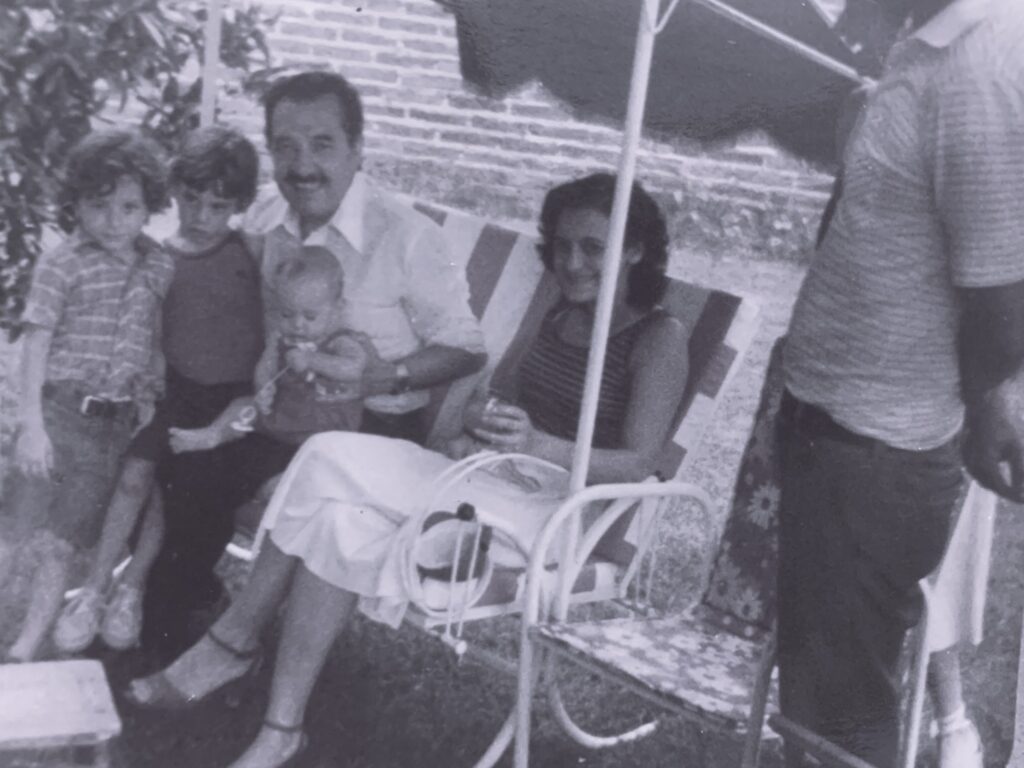
A palpable sense of fear permeated Luz’s memories. She spoke of how the couple navigated the constant threat of repression. “We thought one of us should stay . . . stay alive to take care of the children,” Luz said. Often this meant that she stayed home while her husband attended meetings. Other times the couple ignored their fears and opened their own home as a space for political gatherings. They hosted a talk by future president Raúl Alfonsín at their home in 1981—two years before the dictatorship’s end. Luz explained how they had carefully instructed guests to arrive at varying times and in small groups to avoid suspicion. “The only one who wasn’t afraid was Alfonsín,” recalled Luz.

Raúl Alfonsín in the backyard of Luz and Enrique in December 1981 (courtesy of Luz Buscema)

Later, I asked Luz why she agreed to host meetings in her home despite her fears. “I always liked open doors,” she replied. Perhaps that also explained why she willingly invited a stranger to spend the weekend in her home. This openness struck me as remarkable, and our conversations enriched my project. Luz’s recollections might not become the focus of my dissertation, but her stories echo throughout its pages. Often overshadowed in the official narratives, experiences like those of Luz and Enrique are a powerful reminder of the everyday courage and resilience that quietly shaped Argentina’s path toward democracy.

Gabrielle Esparza is a Ph.D. candidate in Latin American history, with a focus on twentieth-century Argentina. Her dissertation revisits President Raúl Alfonsín’s democratic project to examine the intersection of welfare policy and democratization in post-dictatorship Argentina. She holds a B.A. in History and Spanish from Illinois College and received a Fulbright English Teaching Assistantship to Argentina in 2017. There she taught at the Universidad Nacional de La Plata. Gabrielle graduated with her M.A. in History from the University of Texas at Austin in 2020. Her master’s thesis The Politics of Human Rights Prosecutions: Civil Military Relations during the Alfonsín Presidency, 1983-1989 examines the evolution of President Raúl Alfonsín’s human rights policies from his candidacy to his presidency, which followed Argentina’s most repressive dictatorship.


The views and opinions expressed in this article or video are those of the individual author(s) or presenter(s) and do not necessarily reflect the policy or views of the editors at Not Even Past, the UT Department of History, the University of Texas at Austin, or the UT System Board of Regents. Not Even Past is an online public history magazine rather than a peer-reviewed academic journal. While we make efforts to ensure that factual information in articles was obtained from reliable sources, Not Even Past is not responsible for any errors or omissions.
The Wars of Oppenheimer

Banner image for The Wars of Oppenheimer by David Conrad

It’s a three-hour, ultra-big-screen, deeply-researched box office mega-hit about… J. Robert Oppenheimer, project manager. Leslie Groves, the manager’s manager. Kitty Oppenheimer, the manager’s kids’ manager. Lewis Strauss, the wanna-be manager. Harry Truman, the buck-stops-here manager. James Byrnes, President Truman’s manager. The scientists of the Manhattan Project were thoroughly unmanageable. The bomb? It was everybody’s fault, and nobody’s in particular. Nuclear war by committee. It’s Oppenheimer: Destroyer of Responsibility.

Director and screenwriter Christopher Nolan isn’t wrong. The essence of the Manhattan Project, several characters remind us, was compartmentalization. The less any one project member knew about how to make an atom bomb, the less he or she could reveal to an enemy — especially a Soviet, an enemy of the Allied variety.

One of the movie’s smartest choices is to place the story of mankind’s first nuclear weapon in its ideological context. It excels at depicting the intellectual context, the scientific rivalries, and the egos surrounding the bomb. It deals tolerably well with the political context, the way World War II‘s messy wrap-up determined how the bomb was used. But where Oppenheimer sets itself apart from most other movies on the topic is in its depiction of the bomb as a turning point in the debate over communism: a debate that had raged for years and would only intensify as the nuclear era began.

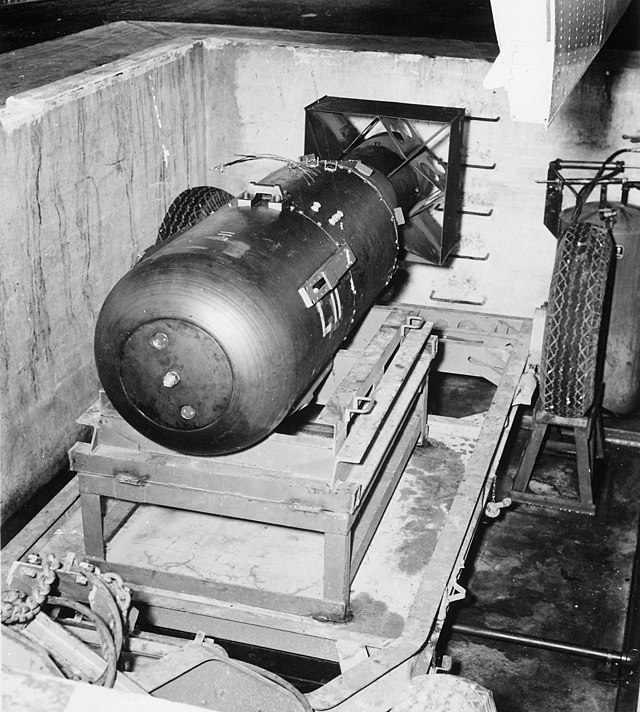
"Little Boy," the nuclear bomb that was dropped on Hiroshima on August 6, 1945.

“Little Boy,” the nuclear bomb that was dropped on Hiroshima on August 6, 1945. The bomb killed tens of thousands of Japanese civilians.
Source: Wikimedia Commons.

Around a third of the movie takes place many years after the bomb, when Oppenheimer’s (Cillian Murphy) security clearance is under review and his occasional colleague Lewis Strauss (Robert Downey, Jr.) is seeking Senate confirmation to join President Eisenhower’s cabinet. If this sounds obscure and more “inside baseball” than a gripping thriller, it is, and Nolan leans into its wonkiness with the confidence of a director who answers to no one. Unlike the rest of the movie, these flash-forward scenes are shot in black and white, a palette that cinematographer Hoyte van Hoytema uses beautifully. Nolan, who is known for trippy time-bending films like Interstellar and Tenet, collapses about a decade’s worth of bureaucratic infighting into an interwoven, frenetic, emotional, and at times corny parallel movie that he grafts onto his more conventional biopic.

It is in this seemingly tacked-on portion of the film that the theme of communism vs. anti-communism stakes out its central position. The postwar rift between “the free world” of liberal capitalism and the opposing world of the communist bloc was dangerous because, after the bombs reached a certain strength, either side could have started the war to end all wars as well as terminating all known life. However, because that hasn’t yet happened (as of the publication of this article), Nolan has to illustrate the tension indirectly. While a McCarthy-era committee grills Oppenheimer and his wife Kitty (Emily Blunt) about their prewar communist sympathies, the bitter and conniving Strauss faces a divided U.S. Senate and a rebellion of atomic scientists.

The end result is two clear camps, Strauss’ and Oppenheimer’s. And in their pride and addiction to power, both ramp up pressure until the other is destroyed. Excessive makeup and monologuing from Strauss and unearned heroics from the Oppenheimers notwithstanding, this petty skirmish after the war is key to the movie’s message.

Oppenheimer reminds us that, if we seek the origins of the Second World War in the First, the people who lived it had a more recent and more relevant frame of reference: the Spanish Civil War (1936-39). This was the first major trial by combat between fascism on the one hand and communism and republican democracy on the other. It was the romantic struggle that drew in Langston Hughes, Ernest Hemingway, and Casablanca‘s Rick Blaine. It was the proving ground for foreign, notably American, idealists who risked their lives or at least sent money to ensure that freedom –  in the left-wing sense of progressive thinking and non-traditional living – would not go quietly into the night as Europe’s balance of power tilted sharply to the right.

Lewis Strauss
Lewis Strauss during his tenure as the chairman of the Atomic Energy Commission (AEC).
Source: Library of Congress

Oppenheimer and his family and friends sent money through the robust international organization of the Communist Party. Nolan shows Oppenheimer as politically naive but stubbornly loyal to his communist girlfriend Jean (Florence Pugh) and fellow-traveling best friend Chevalier (Jefferson Hall). He also shows Oppenheimer’s support for unionizing and integrating academia, two supposed vectors for communist infiltration.

Nolan details how Oppenheimer’s politics made him a difficult pick to keep the U.S. military’s highest secret. Matt Damon’s character, General Leslie Groves, is a show-stealer as a buttoned-up, blunt-talking Pentagon man — the Pentagon man, since he was the one who built it — who forms a surprisingly close relationship with the Bhagavad Gita-quoting egghead he chooses for the job. Casey Affleck appears in one indelible scene as a hardened anti-communist who sees through Oppenheimer’s prevarications about his past. Nolan also shows how Oppenheimer and the scientists he recruited, a team that included a number of left-leaning academics and Jewish scientists, reacted to the realization that the atomic bombs would fall not on the Germans whose bomb program they’d been racing, but on a largely defeated Japan. Though the movie chooses not to show Japan at all, a scene in which Oppenheimer visualizes his Los Alamos team with Hiroshima- and Nagasaki-style burns is one of the film’s most powerful moments.

Oppenheimer dodges a real discussion of the surrender of Japan, about which whole movies have been devoted (see, for example, Japan’s Longest Day by Kihachi Okamoto). It mentions the Potsdam Conference, where Truman (Gary Oldman, in another instance of too much makeup) received Groves’s news about the successful Trinity Test, but viewers must read on their own about the conference’s significance for Japan’s surrender planning. He shows Byrnes (Pat Skipper), Truman’s Secretary of State and “Assistant President,” but conveys nothing about how the bomb changed Byrnes’ and, therefore, Truman’s thinking about the Soviet role vis a vis Japan. Relevant but outside the film’s scope are discussions about nuclear science in postwar Japan and the long shadow Hiroshima and Nagasaki cast over Japanese politics and art. These are directions the movie could have gone, but for Nolan the atomic bomb is not about Japan.

By the same token, the people who made the bomb are not defined by it. Oppenheimer emerges from the movie as an intellectual on par with the likes of Albert Einstein (Tom Conti) and Niels Bohr (Kenneth Branagh). He butts heads, always with the greatest professional respect, with Enrico Fermi, Edward Teller, Ernest Lawrence, and Werner Heisenberg, all brilliantly cast and sharply written. They all feel as though they could star in their own movies with the bomb as a mere footnote. The birth of nuclear weapons, it seems, was an almost accidental consequence of their combined genius. Their governments weaponized them, Nolan’s film tells us, and most of them had the good grace to feel uneasy about it.

Albert Einstein and Robert Oppenheimer.
Albert Einstein and Robert Oppenheimer. Source: Wikimedia Commons

Nolan’s is not a reductive kind of hero worship; these (almost) household-name scientists do, amazingly, feel like real people, and none are more flawed than Oppenheimer himself. The research that Nolan did to get these men right is obvious, and his Oppenheimer, like the real one, says that he feels blood on his hands and anxiety about the planet’s future. Yet equally obvious is the fact that Nolan sees the bomb-builders as visionaries, and if they felt they had no choice but to beat Hitler to the bomb, if they declined to take responsibility for what happened in Japan, then Nolan will go no further down those roads than they. What happened happened, now on to the Cold War.

Oppenheimer is Nolan’s second visit to World War II after 2017’s Dunkirk, and hopefully, it will not be his last. His understanding of the era — its mindsets, its cadences — is remarkable, and his handling of very big and very different personalities within the era is impressive. The film is his best-looking to date. There are beats that don’t work and paths not taken that deserved a closer look, but complex themes come through clearly and speak well of Nolan’s skills as a historian. Oppenheimer‘s success with audiences is a good thing well deserved.

But don’t miss Barbie, either.


David A. Conrad received his Ph.D. from UT Austin in 2016 and published his first book, Akira Kurosawa and Modern Japan, in 2022. He is currently working on a second book, which will also focus on postwar Japan. David lived in Japan’s Miyagi prefecture for three years and can’t wait to go back to his home away from home.

The views and opinions expressed in this article or video are those of the individual author(s) or presenter(s) and do not necessarily reflect the policy or views of the editors at Not Even Past, the UT Department of History, the University of Texas at Austin, or the UT System Board of Regents. Not Even Past is an online public history magazine rather than a peer-reviewed academic journal. While we make efforts to ensure that factual information in articles was obtained from reliable sources, Not Even Past is not responsible for any errors or omissions.
Roundtable Review of The Peacemaker: Ronald Reagan, the Cold War, and the World on the Brink

Banner image for Roundtable Review of The Peacemaker: Ronald Reagan, the Cold War, and the World on the Brink

From the editors:

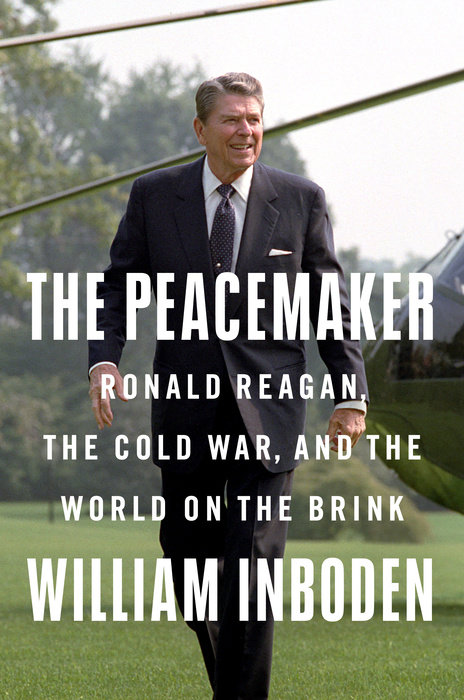
William Inboden is the William J. Power, Jr. executive director of the Clements Center for National Security at the University of Texas at Austin. A former State Department official who served on the National Security Council under President George W. Bush, Inboden is also a distinguished scholar of international history. His most recent book, entitled The Peacemaker: Ronald Reagan, the Cold War, and the World on the Brink, presents a definitive account of the Reagan administration’s foreign policy achievements.

Book cover for The Peacemaker: Ronald Reagan, the Cold War, and the World on the Brink

To mark The Peacemaker‘s publication, Not Even Past invited historians Joseph A. Ledford and Ashlyn Hand to review its contents. Ledford and Hand are rising stars in the world of historical scholarship. Their reviews deftly describe Inboden’s key insights, showing how Reagan strove to bring peace and order to the deeply unsettled world of the 1980s. Few presidents have grappled with greater international uncertainty. But as Inboden’s book demonstrates, Reagan was able to build a lasting legacy through his skillful navigation of the late Cold War’s uncharted waters.


Banner image for The Peacemaker: Ronald Reagan, the Cold War, and the World on the Brink

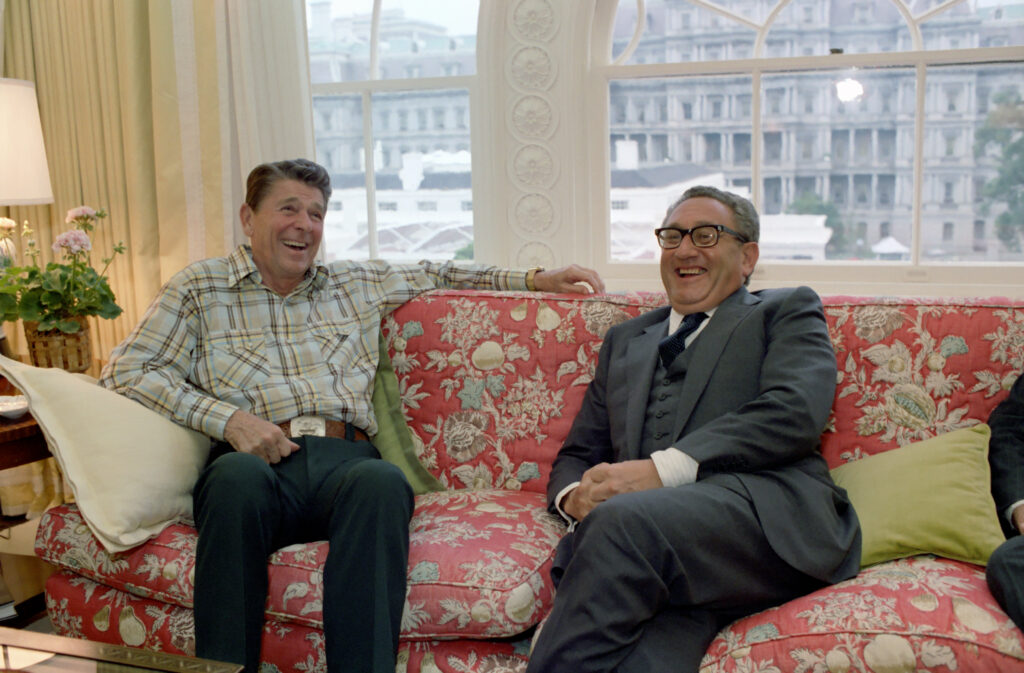
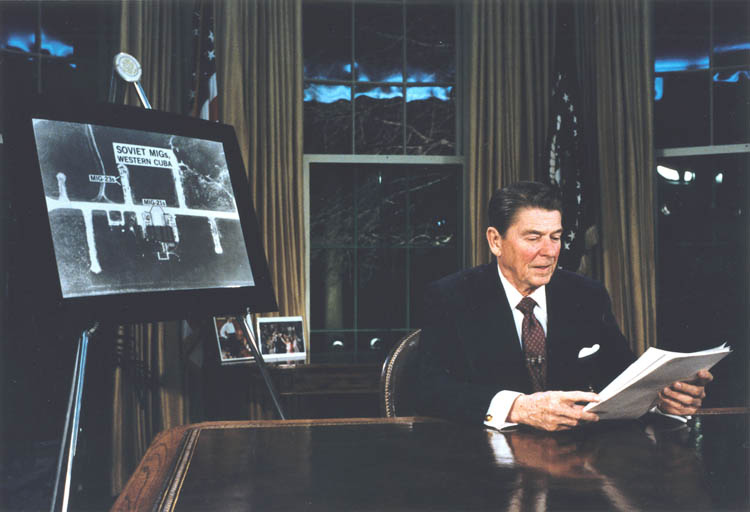
Speaking to a private scholarly gathering at the Library of Congress in 1986, former Secretary of State Henry Kissinger remarked that, “When you meet the President, you ask yourself, ‘How did it ever occur to anybody that he should be Governor, much less President?’” Still, Kissinger confessed of President Ronald Reagan: “He has a kind of instinct that I cannot explain.” In The Peacemaker, William Inboden not only provides clarity on Reagan’s instinct, but also furnishes the preeminent account of his statecraft, from the origins of Reagan’s 1980 presidential campaign to his December 4th, 1992, address to the Oxford Union, replete with insightful anecdotes and perceptive analysis.

A cavalcade of declassification over the past decade has helped Inboden offer greater insight into Reagan’s policymaking. To explain Reagan’s statecraft, Inboden identifies in Reagan’s foreign policy seven themes that derive from both the archives and his worldview: allies and partners; history; force and diplomacy; religious faith and religious freedom; tragedy; battle of ideas; and expansion of liberty. These seven themes reflect a hawkish but nuclear abolitionist Reagan deeply engaged in crafting and executing his foreign policy—a president determined to harness American power and allied support to challenge the Soviet Union and secure peace. The dynamic nature of liberal democracy and market capitalism, Reagan fervently believed, advantaged the United States and sustained his diplomatic and military campaign against the Soviets. Reagan sought not only diplomacy underpinned by a mighty American military buildup but also the spread of political and religious freedoms to uplift the oppressed and undermine authoritarians.

President Ronald Reagan and former Secretary of State Henry Kissinger, 1981.
President Ronald Reagan swaps pleasantries with former Secretary of State Henry Kissinger at the White House in June 1981. Source: National Archives.

Inboden’s seven themes weave through an engrossing narrative, which also serves an important methodological purpose. Foreign policy decisions are neither made in an isolated context nor arrived at with absolute certainty. Drawing on his policymaking experience and historical craft, Inboden successfully captures in narrative form the precariousness of policymaking as the Reagan administration lived it. In doing so, Inboden eloquently reconstructs the messy reality of the international affairs in which Reagan dealt.

At once judicious and bold, The Peacemaker presents three interrelated arguments about Reagan’s bid to master 1980s geopolitics. First, alongside Franklin Delano Roosevelt, Reagan had the most significant modern presidency. In January 1981, Reagan confronted the Soviet Union at the zenith of its military power during the Cold War—a fearsome Soviet Union that had invaded Afghanistan, aided revolution across the globe, and tightened its grip behind the Iron Curtain. An onslaught of other geopolitical threats faced the president, too. In Africa, apartheid persisted, and the last vestiges of colonialism precipitated civil war. Latin America was awash in blood from the Cold War’s destructive forces. The Iranian Revolution destabilized the Middle East, and the rise of terrorism confounded policymakers. These grave issues posed vexing challenges, in addition to the problems besetting Western Europe and Asia. Inside America, Reagan grappled with a crisis of confidence and institutions, a consequence of 1970s domestic tumult and economic downturn.

As Inboden shows, however, the Reagan Revolution cast the foundations of a new world order out of the deadly frost of the Cold War. By January 1989, the United States appeared rejuvenated economically, politically, and militarily. A wave of democracy flowed from Argentina, Chile, and El Salvador to South Korea, the Philippines, and Taiwan. The “evil empire” slouched toward the ash heap of history. Reagan achieved arms reduction with the Soviet Union and, in turn, lessened the chances of nuclear annihilation. “The Iron Curtin and Berlin Wall may have appeared to the naked eye to still be standing,” Inboden observes, “but the forces that would bring them down were already boring away within” (476). The Cold War ended in short order. With the added benefit of structural forces moving to its advantage, the United States reached unipolarity under the leadership of Reagan’s successor and vice president, George H. W. Bush.

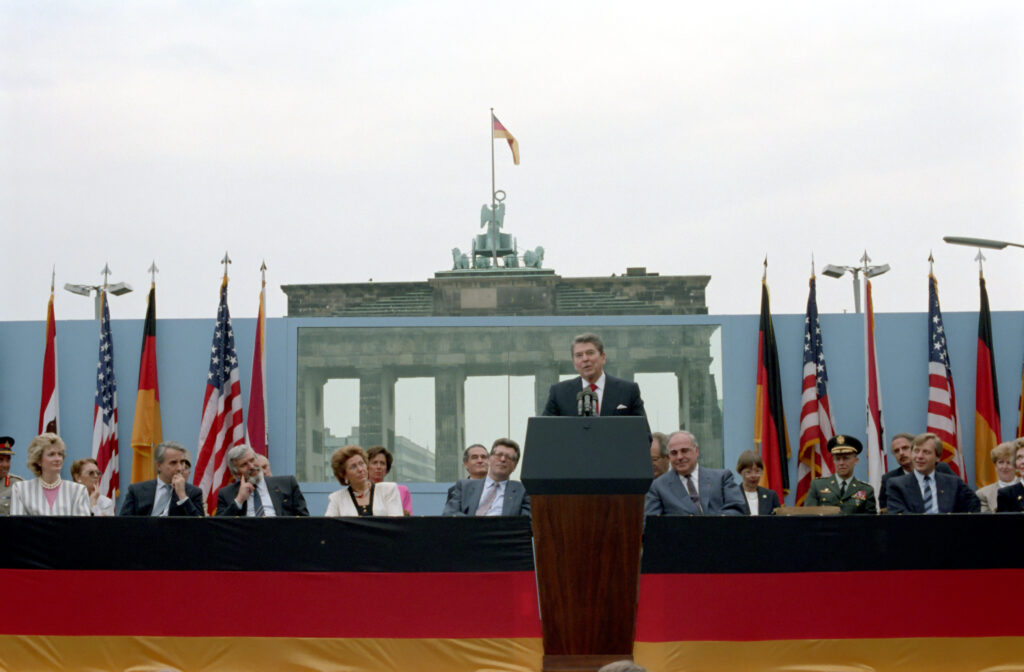
Reagan delivers his famous Berlin Wall speech in front of the Brandenburg Gate on June 12th, 1987.
“Tear Down This Wall!”: Reagan delivers his famous Berlin Wall speech in front of the Brandenburg Gate on June 12th, 1987.

Second, and stemming from the first argument, Reagan’s grand strategy for waging the Cold War brought the Soviet Union to a “negotiated surrender,” one in which Reagan pursued diplomacy to curb hostilities and reduce the nuclear threat while marshalling all the resources of the United States to extirpate Soviet communism from the earth. Paul Nitze’s walk in the Geneva woods initiated a sprint toward arms reductions, culminating in Reagan signing the Intermediate-Range Nuclear Forces Treaty. During this arms race to zero, as Inboden details, Reagan embarked on the Strategic Defense Initiative, a missile defense system that scientist Edward Teller encouraged, and a cross-section of experts ridiculed, but the Soviets feared. Reagan upgraded the US armed forces, building unrivaled weaponry using new technologies. He unified the Western alliance against the Soviet Union, Warsaw Pact satellites, and other Soviet-supported authoritarians. And, crucially, he brought the Reagan Doctrine to bear on Soviet advancement in the Global South while inspiring dissidents under the yoke of communism with stirring rhetoric and covert assistance.

Third, and responsible for the second argument, Reagan effected a Cold War grand strategy through economic restoration, defense modernization, political and religious liberty promotion, nuclear weapons abolition, anti-communist insurgency financing, and the obsolescence of mutually assured destruction, a set of actions codified by National Security Decision Directives 12, 13, 32, 54, 71, 75, 166, 238, and 302. Here, Inboden daringly—and ultimately persuasively—argues that these prongs of Reagan’s strategy combined to stress the Soviet system and create the conditions that influenced the ascendence of Mikhail Gorbachev, a reformer who embraced Reagan’s diplomatic overtures to mitigate the deleterious effects of American power.

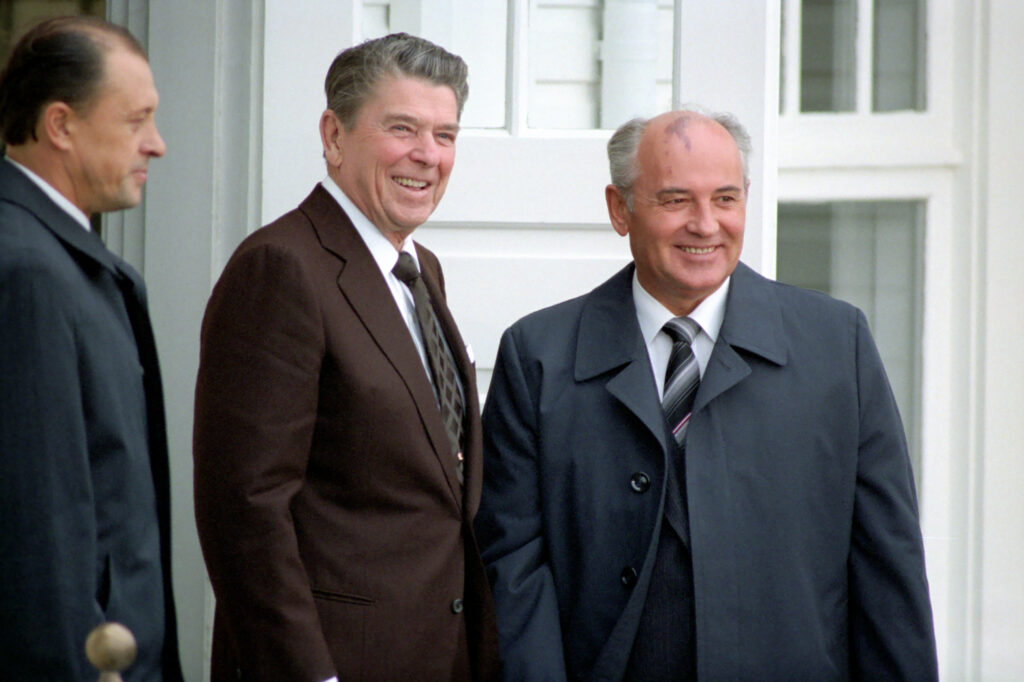
Reagan and Mikhail Gorbachev, October 1986.
Reagan and Mikhail Gorbachev pose for a photograph during their Reykjavik summit in October 1986. Source: National Archives.

From this vantage, Reagan’s record may seem unblemished. Yet, despite rendering an overall positive judgement, Inboden does not pull punches on Reagan’s mistakes. In the Global South, Reagan’s policies could be counterproductive and tragic. In Lebanon, for instance, Inboden sharply criticizes Reagan’s handling of the Marine barracks bombing, particularly the president’s decision to not retaliate. “His failure to do so,” Inboden judges, “damaged American credibility, hurt relations with an important ally [France], and invited further terrorist attacks” (256). In Nicaragua, Reagan’s harbor mining operation proved a self-inflicted political disaster. “The mines,” Inboden contends, “did far more damage to America’s global reputation than to the Sandinista economy” (286). So, too, did Reagan’s support for disreputable anticommunist leaders and insurgents compromise his administration’s moral standing.

Inside the White House, meanwhile, Reagan often expressed indifference to perennial squabbling among staff and avoided personal confrontations. His inattention to the minutiae of being president manifested infamously in the Iran-Contra affair, a harebrained scheme involving arms-for-hostages deals with Iran and the diversion of the profits to the Contras in violation of the Boland amendments. Reagan arguably made his greatest blunder with Iran-Contra. As Inboden puts it: Iran-Contra “violated several of his own strategic principles, such as: Negotiate from strength. Keep faith with allies. Incentivize adversaries to engage in good behavior; do not reward bad behavior. Build public support for policies rather than keeping them secret. Even ‘trust but verify’” (423).

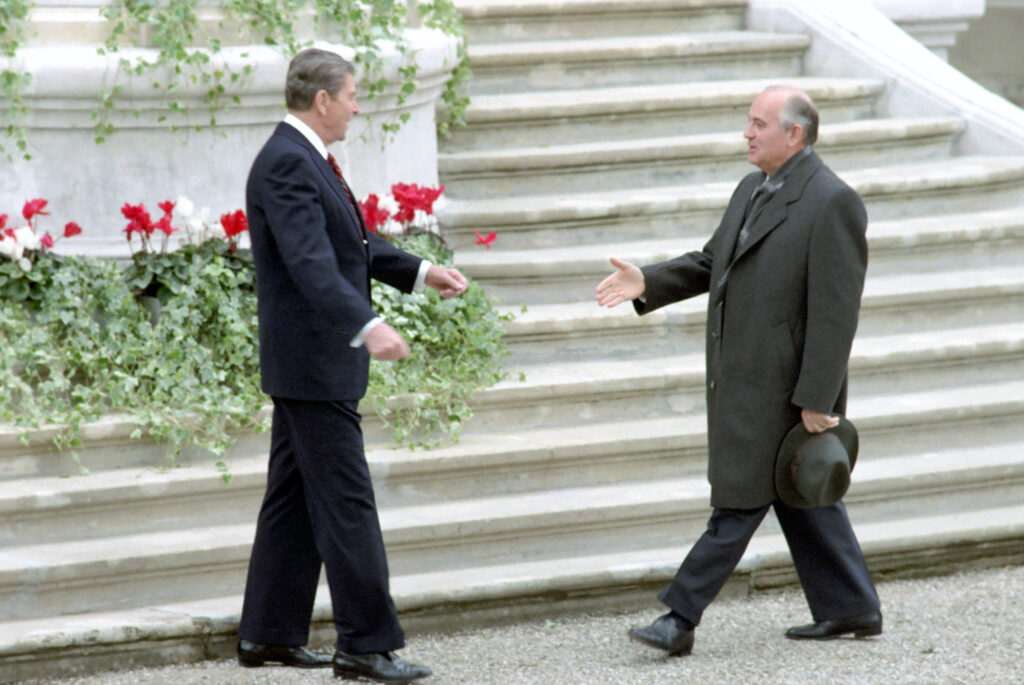
By contrasting Iran-Contra with the Geneva Summit, however, Inboden encapsulates the enigmatic Reagan in a single passage. During Iran-Contra, Inboden notes, Reagan exhibited his legendary stubbornness, disregarded sage advice from trusted cabinet members, and deluded himself into thinking that arms for hostages was not his cardinal objective. The scandal could have been easily avoided if Reagan had not followed his worst instincts. At Geneva, conversely, Reagan confidently pursued his creative strategy for ending the Cold War across ten sessions with Gorbachev, laying the groundwork for the conflict’s resolution. He formed a true relationship with Gorbachev while pressuring him on arms reductions and human rights. Reagan was in his element. His courage and convictions both impressed and distressed the Soviet leader.

Reagan greets Gorbachev at the first session of the Geneva summit in November 1985.
Reagan greets Gorbachev at the first session of the Geneva summit in November 1985. Source: National Archives.

Although Reagan could not quote Thomas Schelling’s chapter and verse, he abhorred nuclear weapons, committed to a singular vision of world order, and possessed an uncanny ability to cut to the heart of policy matters. In a revealing anecdote, Inboden recounts Reagan’s visit to the North American Air Defense Command in 1979, during which General James Hill informed him that America did not maintain a defense against nuclear weapons, only the facility to counterattack. Reagan concluded that relying on mutually assured destruction was no way to live. This grim realization reinforced Reagan’s belief in nuclear abolition and his resolve to peacefully end the Cold War. As Inboden lucidly demonstrates, Reagan articulated the genesis of his plan in the 1970s, established the means during his first term, and delivered on the ends in his second term.

Inboden’s vivid portrayal of Reagan refutes the reversal thesis that he somehow transformed during his second term. The Cold War changed, not Reagan. The 40th president called for the zero option in 1981 and made good on his promise in 1987 by seeking “peace through strength.” (65) Only one version of Reagan served as president, and he comes alive in The Peacemaker.

Joseph A. Ledford is an America in the World Consortium Postdoctoral Fellow at the Henry A. Kissinger Center for Global Affairs at the Johns Hopkins School of Advanced International Studies.


Banner for Winning the Battle of Ideas by Ashlyn Hand

In The Peacemaker: Ronald Reagan, the Cold War, & the World on the Brink, William Inboden offers the first comprehensive analysis of Ronald Reagan’s foreign policy. It is a brilliantly written narrative of complicated characters and strategic vision during the final decade of the Cold War. The Cold War was not a foregone conclusion, and Inboden’s book evokes the peril and urgency of the time. The sobering reality of a potential hot war—one with the capability of obliterating humankind–sits in the narrative like a member of Reagan’s inner circle and demands intellectual empathy from the reader.

Inboden argues that Reagan understood the Cold War fundamentally as a battle of ideas made more complex because of great power competition. This contrasted with the more common understanding of the Cold War as a classic great power competition with an ideological element. This difference in framing meant that Reagan saw Soviet communism as an enemy to be defeated rather than party to a conflict to be managed or contained.

Reagan announcing his administration's Strategic Defense Initiative, March 1983
Reagan announcing his administration’s Strategic Defense Initiative–nicknamed “Star Wars”–in March 1983. Source: Wikimedia Commons.

But how to defeat communism without launching World War III? Inboden describes Reagan’s goal as “negotiated surrender,” in which Reagan applied sufficient pressure and exploited Soviet vulnerabilities to puncture the Soviet system while extending a hand in diplomatic outreach. Inboden recognizes that these goals were, at times, in contradiction. Still, he maintains that Reagan himself “held tenaciously to both” (4).

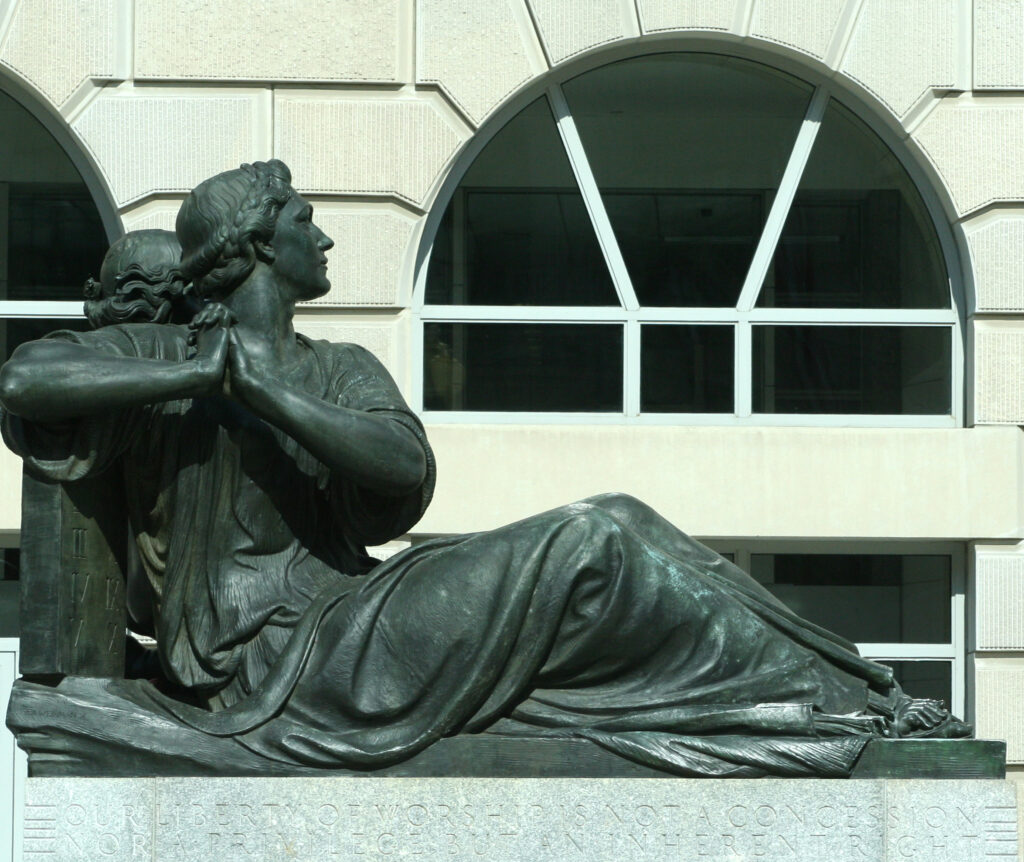
One central theme in The Peacemaker is Reagan’s commitment to religious freedom and the expansion of liberty. Vis-à-vis the Soviet Union, Reagan pushed for the protection of Jewish refuseniks and persecuted religious believers like the Siberian Seven, a group of Pentecostals who sought refuge in the American Embassy in Moscow in 1978. But as Inboden addresses, Reagan’s Cold War lens could prevent him from acknowledging the brutality of regimes in places like El Salvador and Argentina (106).

A statue symbolizing religious freedom situated in the exterior plaza of the Ronald Reagan International Trade Center in Washington, D. C.
A statue symbolizing religious freedom situated in the exterior plaza of the Ronald Reagan International Trade Center in Washington, D. C. The statue forms part of the Oscar Straus Memorial Fountain. Source: Wikimedia Commons.

Inboden also highlights the role of historical memory in shaping foreign policy decision-making. Whether it be Bill Casey’s likening Soviet communism to Nazism or the ever-present fear of another Vietnam, the centrality of history is a recurring theme.

The book unfolds chronologically, giving the reader a taste of the sheer volume of strategic challenges facing the Oval Office–a reality Secretary of State George Shultz called the “simultaneity of events” (7).  The number of issues vying for presidential attention at any one moment is overwhelming, a situation sometimes made more stressful by the eclectic cast of characters in Reagan’s cabinet. Relying on newly released documents and meticulous archival research, Inboden captures the idiosyncrasies, missteps, and glories of the Reagan team.

In the end, the Cold War outlasted Reagan’s time in office. Still, Inboden maintains, “Reagan had transformed the art of the possible. Things inconceivable in 1980 became reality by 1989” (475). The Peacemaker is key reading material to better understand foreign policy challenges of the Cold War and the strategic vision of the 40th president.


The views and opinions expressed in this article or video are those of the individual author(s) or presenter(s) and do not necessarily reflect the policy or views of the editors at Not Even Past, the UT Department of History, the University of Texas at Austin, or the UT System Board of Regents. Not Even Past is an online public history magazine rather than a peer-reviewed academic journal. While we make efforts to ensure that factual information in articles was obtained from reliable sources, Not Even Past is not responsible for any errors or omissions.
Prisoners of the Cold War

banner image for Prisoners of the Cold War

I grew up watching reruns of The Prisoner, a classic sixties television series created and produced by the famously eccentric TV icon Patrick McGoohan. McGoohan also stars in the series, playing a disillusioned British spy struggling to escape his allotted role in the Cold War. A striking opening montage sets the plot in motion. McGoohan’s spy is shown storming into his boss’ office, where, after a ferocious argument, he resigns from his job. Immediately thereafter, he jumps into his sleek Lotus sportscar (this is, after all, the age of Bond) and heads for home. But danger is hot on his heels: two unidentified thugs, disguised as undertakers and driving a hearse, surreptitiously pursue the Lotus across central London. The hearse arrives at the spy’s townhouse; the thugs emerge and flood the house with gas; the spy, in the parlor, is knocked unconscious. Sometime later, he reawakens in what initially looks like the same room. But a glance out the window reveals otherwise. The spy has been kidnapped, and his captors have transported him . . . not to a cell block, but to a picturesque seaside resort town.

A contemporary photograph of Portmeiron, Wales, the seaside resort town used to portray the fictitious "Village" in The Prisoner
A contemporary photograph of Portmeiron, Wales, the seaside resort town used to portray the fictitious “Village” in The Prisoner. Source: Wikimedia Commons.

At first glance, “The Village,” whose outwardly cheerful inhabitants go by numbers instead of names, appears to be a harmonious, democratic utopia. But McGoohan’s character, rechristened “Number Six” upon arrival, quickly discovers that his new home is actually a prison for spies. Real power is concentrated in the hands of Number Two, a sinister Village grandee who torments, brainwashes, and interrogates residents on behalf of a mysterious, unseen Number One. To this treatment, Number Six refuses to submit. “I am not a Number!” he declares at the beginning of every Prisoner episode. “I am a free man!” The statement becomes a sort of motto for the show, which revolves around Number Six’s attempts escape from the Village and expose Number One.

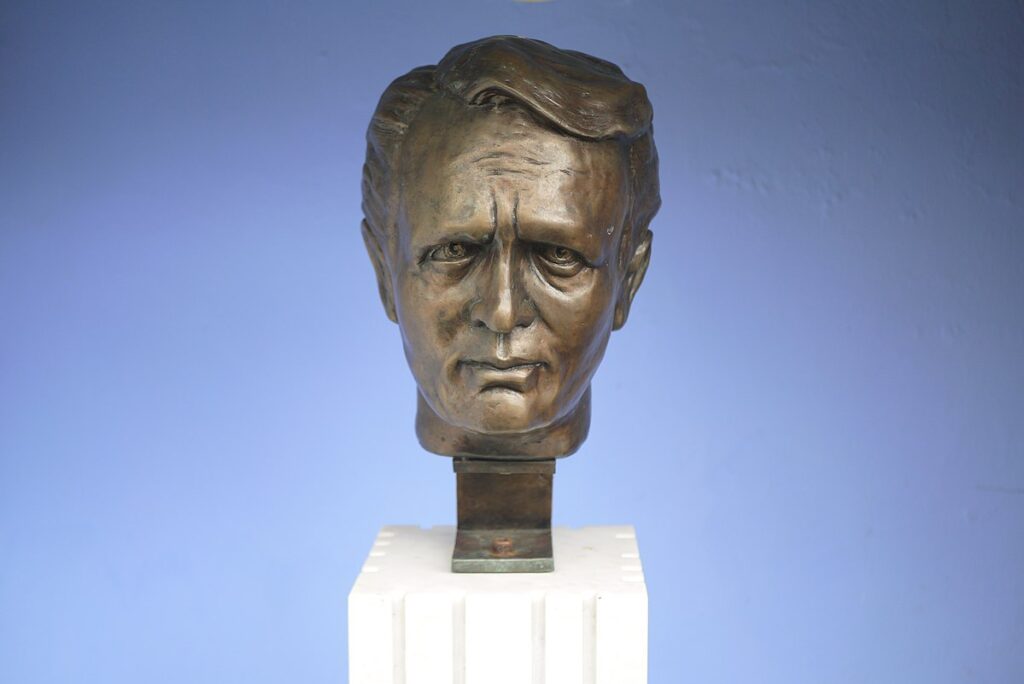
A bust of Patrick McGoohan on display in Portmeiron
A bust of Patrick McGoohan on display in Portmeiron. Source: Wikimedia Commons.

Over the course of sixteen episodes, the Village keeps Six engaged in a deadly game of cat and mouse, always managing to prevent him from slipping out of its grasp. But in The Prisoner’s seventeenth and final installment, McGoohan’s character manages to turn the tables with help from a couple of unlikely allies. The first, a young man referred to by the Villagers as Number Forty-Eight, embodies the defiant weirdness of late sixties counterculture, communicating exclusively by means of hip, irreverent, but also basically incomprehensible slang. The second ally, in a twist, is Number Two, who has become just as dissatisfied with his role as Number Six.

Suddenly, the well-ordered Village has to contend with what one of its leaders describes as “two forms of revolt. The first—uncoordinated youth rebelling against nothing it can define. The second—an established, successful, secure member of the Establishment turning upon and biting the hand that feeds him.” The Villagers respond by staging a show trial, charging Forty-Eight and Two with a series of absurd and revealing “crimes” (“unhealthy habits of speech and dress not in accordance with general practice”; “betraying the trust of the Establishment”; “going over to the Other Side”; and so on). However, the trial descends into chaos, giving Number Six and the two defendants a chance to make their escape. Arming themselves, they shoot their way out of the Village, hijack a van, and flee to London.

It’s a moment of triumph—or, at least, it should be. Yet something remains indefinably but very definitely wrong. The clues are everywhere. At one point, McGoohan’s Six confronts a cloaked figure whom he believes to be Number One, only to discover his own doppelganger concealed beneath the cloak. Later, after the escapees reach London, Number Two quietly joins a throng of officials entering the Houses of Parliament, calling into question his rebellion against the “Establishment.” Most alarming of all, though, are the recurring suggestions that Number Six is still under Village control, even though he believes himself to be living freely back in London. The Prisoner’s enigmatic final scenes raise a disturbing possibility: maybe the Village itself is more than just a physical location; maybe, instead, it’s a system of people and ideas, a system apparently capable of extending itself throughout the world.

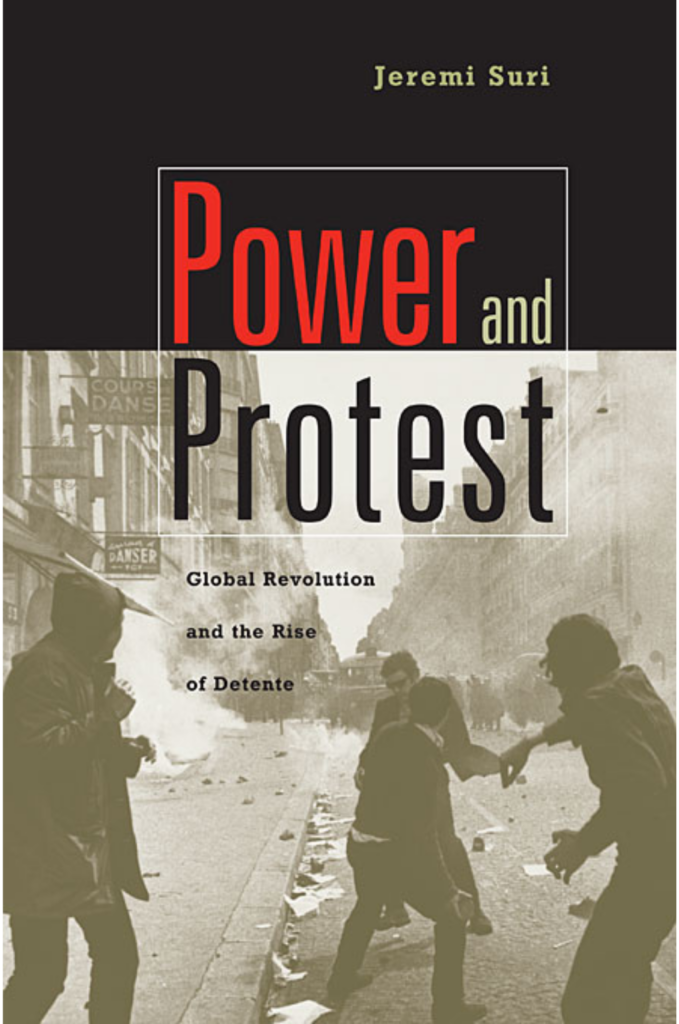
As a child, I watched The Prisoner as a straightforward (if unusual) espionage thriller. Recently, I tried rewatching it—and discovered not a thriller but a prescient political allegory. The power struggle that plays out in the Village, pitting jaded elites and rebellious “free men” against an increasingly repressive and reactionary “Establishment,” reproduces in miniature the one historian Jeremi Suri has described in Power and Protest, his prize-winning book on the origins of détente during the Cold War. Unlike The Prisoner, Power and Protest is not designed to entertain: Suri’s book is serious, scholarly, and challenging. But it is packed with bold claims which make it a must-read for anyone interested in international relations. It also sheds light on the development and political significance of sixties counterculture—the same counterculture Patrick McGoohan channeled to create The Prisoner.

book cover for Jeremi Suri's book, power and protest

Suri’s narrative begins in the 1950s when rising East-West tensions and the threat of nuclear destruction placed new strains on political systems the world over. In response, frustrated statesmen in China (Mao Zedong), France (Charles De Gaulle), the Soviet Union (Nikita Khrushchev), and the United States (John F. Kennedy) experimented with new, charismatic styles of politics designed to transcend the deadlocked Cold War. At the same time, an international “language of dissent” invented by anti-establishment writers took root on university campuses on both sides of the Iron Curtain. Young people rejected the logic of the Cold War and denounced the overblown, usually unfulfilled promises of charismatic politicians. They also “grew visibly more violent” until, in 1968, their “rebellion produced revolution.” Challenges from above and below, from the Village elite and their restive, unruly prisoners, pushed the international system to the breaking point.

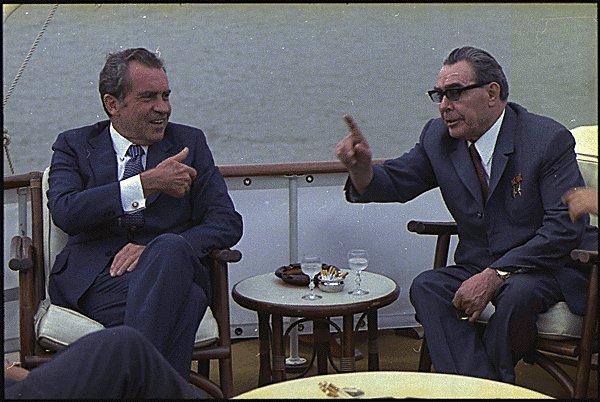
However, as the rest of Suri’s book shows, the international system fought back. In order to defeat the global “revolution” of 1968, a new fraternity of world leaders—led by West Germany’s Willy Brandt, the Soviet Union’s Leonid Brezhnev, U. S. president Richard Nixon, and a chastened, more conservative Mao—“colluded to stabilize their societies and preserve their authority.” Détente, the programmed de-escalation of the Cold War, helped repair their damaged reputations and allowed them to prioritize social welfare instead of military preparedness. Unfortunately, the new politics of peace and well-being was also “profoundly conservative” and deeply manipulative. “The promise of detente,” Suri explains, “became a stick with which to beat domestic critics. . . . It made the sacrifices of the Cold War appear ‘normal,’ and it further isolated policymakers from their publics. In this way, detente contributed to the pervasive skepticism of our postmodern age.”

Richard Nixon and Leonid Brezhnev conversing during Brezhnev's 1973 visit to the United States
Richard Nixon and Leonid Brezhnev conversing during Brezhnev’s 1973 visit to the United States. Source: National Archives.

Power and Protest thus narrates the prehistory of the “post-truth” world we live in today. It also reveals that The Prisoner, produced on the eve of revolution in 1967–68, was both remarkably insightful and ultimately blind to the limitations of its own anti-establishment critique. In an early episode, Number Six asks Number Two “which side” of the Iron Curtain Number One and his henchmen stand on. Two’s response speaks volumes. “It doesn’t matter which side runs the Village,” he tells Six. “[B]oth sides are becoming identical. What has been created is an international community, a blueprint for world order. When both sides realize they’re the same, they’ll see this is the pattern for the future.” Like the revolutionaries of 1968, Six chooses to rebel against this dystopian vision of a peaceful but uniformly repressive international system. But ultimately, neither the Prisoner nor his real-world counterparts were able to realize their desire for freedom. Instead, thanks to the détente they inadvertently catalyzed, they remained prisoners of the Cold War.


John Gleb is a doctoral candidate in the Department of History at the University of Texas at Austin and a Graduate Student Fellow at the Clements Center for National Security.

The views and opinions expressed in this article or video are those of the individual author(s) or presenter(s) and do not necessarily reflect the policy or views of the editors at Not Even Past, the UT Department of History, the University of Texas at Austin, or the UT System Board of Regents. Not Even Past is an online public history magazine rather than a peer-reviewed academic journal. While we make efforts to ensure that factual information in articles was obtained from reliable sources, Not Even Past is not responsible for any errors or omissions.
Review of Beatriz Allende: A Revolutionary Life in Cold War Latin America (2020), by Tanya Harmer

banner image for Review of Beatriz Allende: A Revolutionary Life in Cold War Latin America (2020), by Tanya Harmer

At about nine o’clock on the morning of September 11, 1973, Beatriz Allende, the daughter of Socialist President Salvador Allende, arrived with her younger sister Isabel at the Chilean presidential palace in the heart of downtown Santiago.[1] The military coup that would end her father’s presidency, and Chile’s dream of a peaceful revolution, had begun around dawn that day. Though seven months pregnant at the time, Beatriz had come to join forces with the presidential bodyguard to defend, by force of arms if necessary, the legitimate presidency of her father and her country’s democratic transition to socialism.

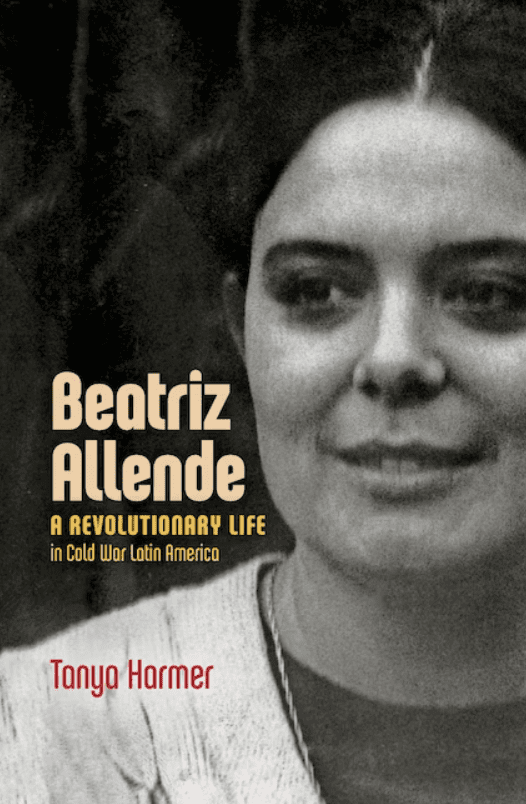
Beatriz had acted as her father’s right hand on the executive team since he took office. But in recent months, as signs of an imminent overthrow became clear, President Allende had begun to pull his daughter back from the political front lines in order to protect her. That morning, in spite of her resistance, he ordered Beatriz to leave, along with her sister and five other women. In the words of Tanya Harmer, author of Beatriz Allende: A Revolutionary Life in Cold War Latin America, Allende’s effort to shield his daughter from the impending attack “amounted to an act of betrayal from the person Beatriz loved most,” and he did it “because she was a woman” (212). Harmer’s recent monograph provides serious readers of history with a riveting close-up of how Chileans experienced their revolutionary years, focused especially on how leftist longings for a more just and equitable society challenged culturally-determined presuppositions. Like Harmer’s acclaimed masterwork, Allende’s Chile and the Interamerican Cold War (2011), this book prioritizes local agency and conflict over international interference to show how Chileans struggled to define their own history. 

The primary subject of this volume, Beatriz Allende, shines in public memory as Allende’s favorite child, the middle daughter who became the son he never had. Educated in revolutionary politics from an early age, Beatriz followed in her father’s footsteps, first into the medical profession and then into Socialist Party militance. Though not outright wealthy, the family belonged to Chile’s comfortable intellectual middle class. They vacationed at the upscale seaside town of Algarrobo and, like any Chileans of means, they had domestic servants who did all their cooking and cleaning. The Allende clan could not be called armchair socialists, by any means, but they did not actually belong to the masses of working poor their political cause championed.   

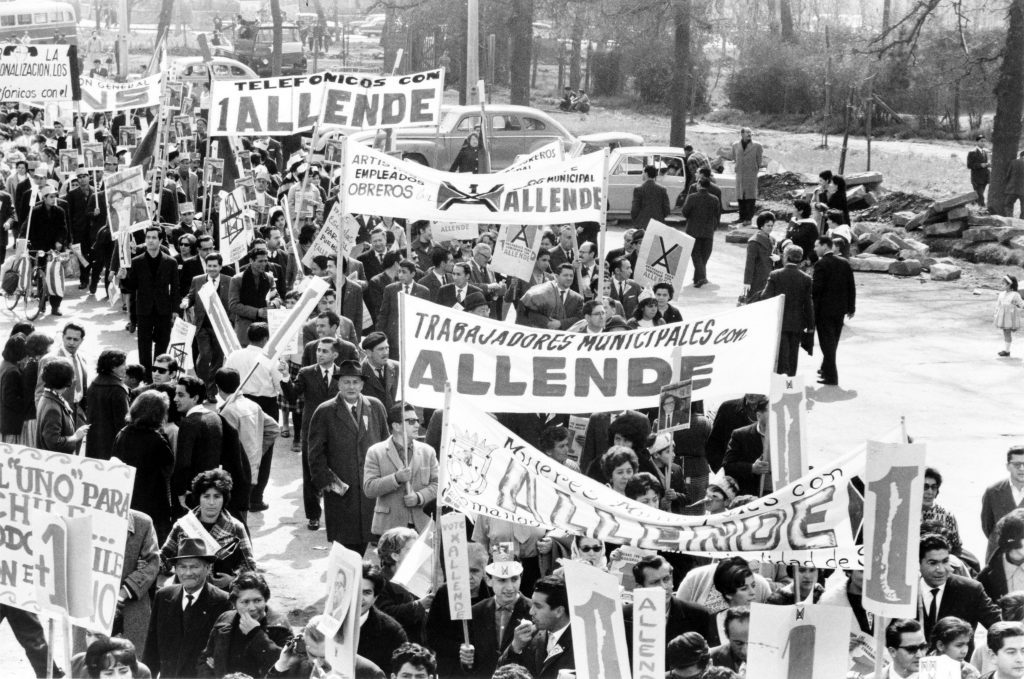
A large crowd marches along a tree-lined street in Santiago in this black-and-white photograph from 1964. Members of the crowd are holding aloft several large banners, all of which indicate support for Salvador Allende. Two banners are easily legible; they read "Telefonicos con 1 Allende" and "Trabajadores municipales con Allende."
Supporters of Salvador Allende’s 1964 presidential campaign parade in the streets of Santiago. Allende lost the election of 1964 but would go on to win the presidency six years later. Source: Wikimedia Commons.

As a medical student at the University of Concepción, Beatriz grew close to the Enríquez brothers, Luciano Cruz, and Bautista Van Schouwen. Together with Beatriz’s first cousin, Andrés Pascal, they would become founding members of Chile’s most radical leftist organization, the Movimiento de Izquierda Revolucionaria, usually remembered by its acronym, MIR. After some training in Cuba, and in opposition to her father’s lifelong commitment to the peaceful road to socialism, Beatriz embraced MIR’s option for armed insurrection as the only path to a meaningful revolution. She never made the switch to MIR, instead acting as a permanent go-between, informally linking MIR with Salvador Allende’s leftist coalition. In 1967, she did become a part of a very secret armed faction of the Socialist Party, called Organa, that mobilized in support of Bolivia’s ELN—Ejército de Liberación Nacional—as it attempted, in vain, to revive Che Guevara’s ill-fated insurrection there. Committed to actual armed participation, she found that the elenos (as ELN members styled themselves) protected her, partly because she was a woman, but mostly because she was Salvador Allende’s daughter and more valuable to their cause if she managed to stay alive.

Beatriz married a Cuban intelligence agent, Luis Fernández Oña, in 1970. Through him, she had already become a backchannel liaison between Allende’s coalition and the Cuban high command. After the coup in 1973, Beatriz fled to Cuba with her husband. She had her second child in Cuba, and she found herself thrust into a very public role, representing the exiled Chilean left, and the many victims of the military dictatorship back home. As the government of General Augusto Pinochet became an international pariah, Beatriz became an international celebrity, but it was not a role she wanted.

Though fascinated by Cuba, Beatriz found no peace there. Cuban authorities detained Loti, her long-time housekeeper—who had been caught in a lesbian relationship—and sent her off for reeducation. Fidel’s revolution considered homosexuality, and even feminism, to be capitalist vices that would naturally fade away in the socialist utopia of tomorrow. Moreover, classless revolutionary Cuba could offer no replacement for Loti. As a consequence, in her early thirties, with her fine medical training and her unfulfilled revolutionary aspirations, Beatriz Allende found herself isolated in a foreign land, facing the unknown challenge of traditional feminine domesticity for the first time (249). To make matters worse, news of the assassinations of former comrades, including Miguel Enríquez and Orlando Letelier, began to trickle in, making Beatriz feel increasingly helpless. That fatal combination drove her into a severe depression. She died by her own hand in 1977.

While Harmer’s work is rich in personal details and human drama, she did not set out to write a biography. Her study focuses on the catalytic agency of an extraordinary person pivotally situated in the unfolding of many previously untold historical connections. In the process, she reveals many previously unrecounted historical connections. The author’s sensitivity to the particularities of Chilean revolutionary culture is unparalleled. Elegantly written and abundantly sourced in memoirs, letters, and periodical sources—much of them from Cuba—Harmer’s skillful treatment of extensive personal interviews makes this work unique and remarkable. Harmer has created a rigorous, unbiased, but very gendered study, showing how the patriarchal patterns of even the most revolutionary movements consigned Beatriz Allende and others like her to a very particular kind of evolving agency. Ultimately, the author attributes her protagonist’s untimely demise to the internal contradictions and unviability of that gendered but revolutionary role.

Through the lens of this one conflicted revolutionary life, Harmer shines light on the many contingencies that contributed to the Chilean revolutionary phenomenon. Her study examines, for example, the growing influence of Chilean youth in the long decade of the 1960s. Compounded by the disruptions of an enormous earthquake in 1960, which united young people in massive solidarity efforts, sheer numbers, a fact that can be attributed to the post-war baby boom, made Chilean twenty-somethings a new and powerful contingent. Universities became the room where it happened. As Harmer observes, “university student numbers rose from 7,800 in 1940 to just over 20,000 in 1957, and 120,000 by 1970” (10). That university experience, as Beatriz knew it, represented a quantum leap in the political potential of the younger generation.

But even that giant leap would not be enough. In the most hopeful early days of the Popular Unity experiment, Harmer observes that “the opposition was strong and united. Indeed, the Left’s defensive measures . . . paled in comparison with the Right’s organization, resources, and propensity for violence” (196). Right wing women, as historian Margaret Power observed in her foundational study from 1998, formed the ideological bedrock of that opposition.[2] But there were left wing women, too, with unique struggles, decisive agency, and an untold story. Harmer has opened a new window on them.  

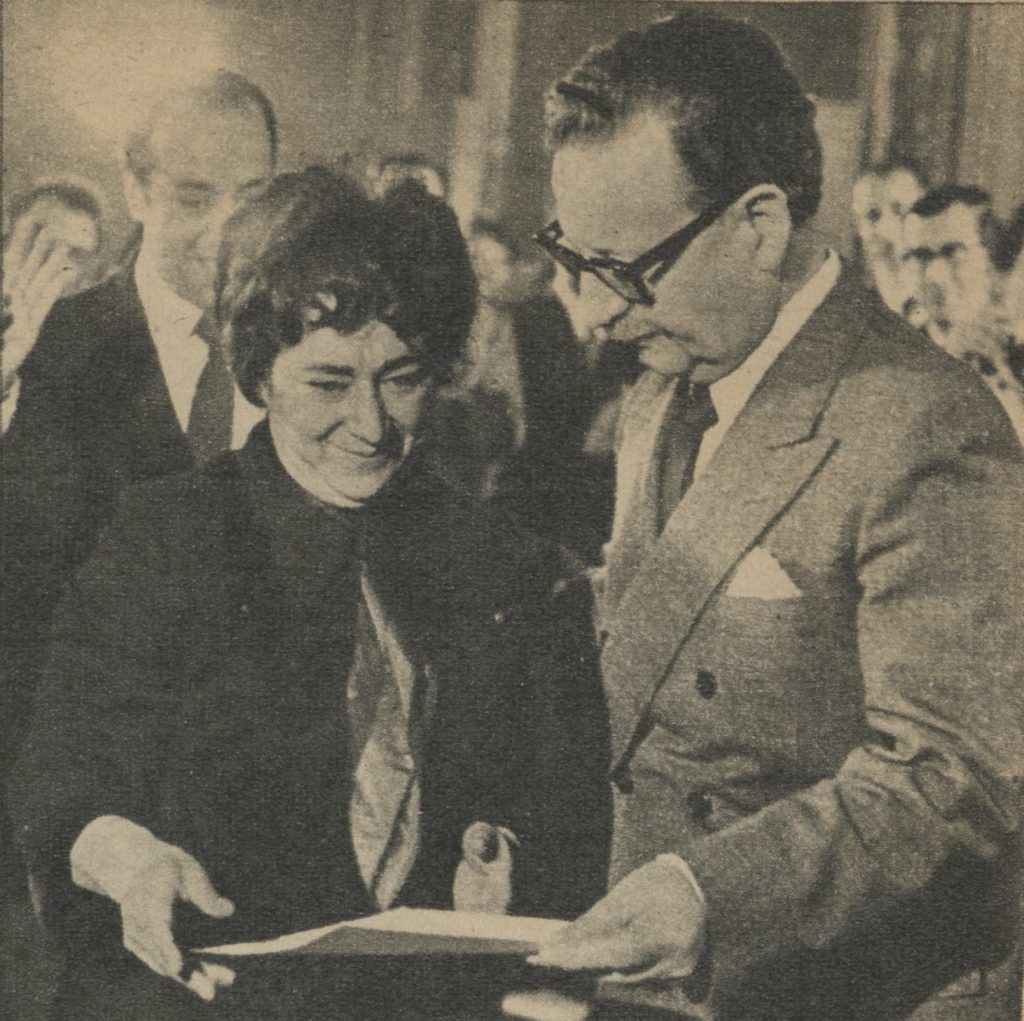
A black-and-white photograph of Salvador Allende and his Minister of Labor and Social Welfare, Mireya Baltra, in the midst of a large crowd of people wearing suits. Both Allende and Baltra are smiling; the President is handing his minister a document.
President Allende photographed with his Minister of Labor and Social Welfare, Mireya Baltra, a member of the Communist Party of Chile. Source: Wikimedia Commons.

Despite its many strengths as a work of multilayered analysis, the book has some flaws. One is a simple editorial failure: a propensity to reproduce grammatical and orthographic errors in the Spanish language. Población, a Chilean settlement of the urban poor, has an accent mark in the singular form. Poblaciones, in the plural, does not, but Harmer’s work consistently maintains that telltale accent mark. This kind of defect does not detract from the overall argument, nor from the English reader’s appreciation. Chilean scholars, on the other hand, ever mindful of their legalistic traditions, especially when it comes to proper Spanish grammar and spelling, may be frustrated by these minor orthographic failings.

A second misunderstanding goes deeper. The author observes that, in her mid-thirties, Beatriz didn’t even know how to fry an egg. This is by no means an overstatement, but the author leaves it at that, as if to say, it would only occur to the unjust patriarchal universe to expect that women should be frying eggs (185, 233). In making such statements, Harmer elides over the fact that an ignorance of domestic skills in Chile often revealed more about social class than about gender roles. This was especially true for the revolutionary left. What good was a revolutionary who could shoot an AK-47, but then needed to be fed by someone else at the guerrilla hideout?

Among pobladores, Chile’s shantytown dwellers, anyone who could not buy fresh bread, fry an egg and slice a tomato would be esteemed pituco—haughty or snobbish—a fish out of water. In the informal economy of extreme poverty, where women could earn cash frying the eggs uptown, their unemployed menfolk often took care of housekeeping by default. Egg frying, a fact of life for the poor, became an asset and a virtue for a true guerrilla fighter.

Harmer recognizes that with regard to gender equality, it would be “unfair to expect the Left to have adopted practices not found anywhere else in society” (14). In fact, it would be anachronistic. And Beatriz Allende never identified as a feminist, but as a revolutionary guerrilla fighter. But cultural presuppositions allotted her only a supporting role. In exile after the coup, travelling between solidarity events, she commented to a friend that she had grown tired of being “Allende’s daughter” (260). She wanted to be Tania, the legendary compañera of Che Guevara, who supposedly died fighting by his side in the Bolivian altiplano (257). Though Beatriz Allende never achieved that dream, her experience made it possible for other women to dream it, too. Her prominence helped to shape a vocabulary that, as Harmer points out, contributed to “a searing call to end gender violence” during the 2019 protests in Chile (274). That call went viral worldwide.


[1] Isabel Allende, the daughter of the President, should not be confused with her second cousin, Isabel Allende, the acclaimed author of the novel The House of the Spirits (1982).

[2] Margaret Power, Right Wing Women in Chile: Feminine Power and the Struggle Against Allende, 1964-1973 (New York: Routledge, 1998)

The views and opinions expressed in this article or video are those of the individual author(s) or presenter(s) and do not necessarily reflect the policy or views of the editors at Not Even Past, the UT Department of History, the University of Texas at Austin, or the UT System Board of Regents. Not Even Past is an online public history magazine rather than a peer-reviewed academic journal. While we make efforts to ensure that factual information in articles was obtained from reliable sources, Not Even Past is not responsible for any errors or omissions.
Review of Master of the Game: Henry Kissinger and the Art of Middle East Diplomacy (2021)

banner of Review of Master of the Game: Henry Kissinger and the Art of Middle East Diplomacy (2021)

This is no ordinary work of history. That’s a good thing. As opposed to many scholarly studies, this book has an author with real-world experience in his field. Martin Indyk, who served as U.S. Ambassador to Israel and Assistant Secretary of State for Near Eastern Affairs under Clinton and Special Envoy for Middle East Peace under Obama, knows the Middle East like the back of his hand.

The same could not be said of his biographical subject before the Yom Kippur War. While orchestrating détente with the Soviet Union and an end to America’s presence in Vietnam, Henry Kissinger had his mind elsewhere and spared few thoughts for the Middle East. But that changed abruptly when Israel and its Arab foes took up arms once again in October 1973.  

Thereafter Kissinger went above and beyond in his regional outreach. Master of the Game documents how over the next two years, the secretary of state held many meetings with Arab and Israeli interlocutors in seeking a lasting peace. From his shuttle diplomacy came a string of disengagement agreements: two between Israel and Egypt and one between Israel and Syria. In Kissinger, Indyk sees a brilliant practitioner of statecraft whose pragmatic, incremental approach succeeded where others had failed.

Driving Kissinger’s relentless diplomacy was a particular vision for the Middle East. This vision, argues Indyk, modeled itself on the order Metternich, Castlereagh, and Talleyrand forged for post-Napoleonic Europe (the subject of Kissinger’s dissertation-cum-monograph A World Restored). The question of whether a bespectacled academic well-versed in European statecraft could apply his wisdom to the Middle East was soon answered.  

Although Indyk is mainly interested in American decision-making, Arab and Israeli officials are not mere bystanders in his story. He writes at length about how the likes of Ismail Fahmy, Yitzhak Rabin, and Hafez al-Assad sized Kissinger up, not just the other way around. No number of American carrots and sticks could make both sides come to terms with one another. Those were decisions they alone could make. Present and prospective policymakers should bear in mind that however strong the United States may be, Middle Eastern countries can always push back.       

Henry Kissinger meeting King Faisal in Riyadh, Saudi Arabia to review the Middle East peace process and bilateral relations on March 19, 1975.
Henry Kissinger meeting King Faisal in Riyadh, Saudi Arabia to review the Middle East peace process and bilateral relations on March 19, 1975. Source: Saudi Press Agency

Indyk shares lessons he has drawn from Kissinger’s accomplishments. One of these is the role of domestic politics. In the United States, Kissinger faced pressure from pro-Israel voices to be as generous as possible toward the Jewish state. Israel witnessed a premiership change during the period in question (due to Golda Meir’s perceived weakness) and had many constituencies to placate. The Egyptian and Syrian governments were not democratic but nonetheless were mindful of public opinion.          

Some of the strongest lessons are those unique to Israeli-Palestinian peacemakers. As Indyk observes, Washington cannot make things happen on its own. All the more so when it eagerly pushes Arab and Israeli officials to the negotiating table where “a sense of urgency is often absent” (304). The fact that Americans are keen to strike deals does not mean Arabs and Israelis are.   

Although he does not deify Kissinger, Indyk risks overstating his importance. Kissinger clearly played an important role in bringing Arabs and Israelis together and negotiating  the details of their agreements, but is it fair to anoint him “Master of the Game?” Calling him as much masks Kissinger’s considerable shortcomings in his shuttle diplomacy.

These are shortcomings that Indyk acknowledges. For instance, Kissinger’s ignorance of Middle Eastern politics made him “underestimate the importance of the Palestinian issue in the legitimation of his American-led order” and sideline King Hussein and the Jordanians when they could have been invaluable peace brokers (554). Kissinger’s amoral realism left little room for matters beyond power politics, but he would learn the hard way that Arab leaders were willing to go to the mat for the Palestinians.

That realism was the only reason why Kissinger was in the Middle East in the first place. In facilitating these Arab-Israeli negotiations, he sought to wrest Egypt, and to a lesser extent Syria, from the Soviet sphere. In so doing, he also hoped to create a stable balance of power that would avert wars like the one in 1973.

Ultimately, Israel grew strong enough to resist pressure to give concessions to Arab adversaries, and it has neither concluded a peace treaty with the Syrians nor a final-status agreement with the Palestinians. Yet Indyk shows convincingly that Kissinger did not intend for Israel to turn into the regional superpower it became. Such an outcome was discordant with his Metternechian worldview and did not redound to his goal of making Egypt and Syria centerpieces in a new U.S.-aligned Middle East. Then as it does now, self-interest mainly explained America’s presence in that far afield place.    

This photograph depicts President Gerald R. Ford and ambassadors from countries in the Middle East seated around a table in the Roosevelt Room at the White House on the day he was sworn into office. Meeting participants include Abdelkader Maadini of the Algerian Interests Section, Ashraf A. Ghorbal of Egypt, Riad Sabri of Jordan, Jamil Al-Hassini of Kuwait, Joseph Akl of Lebanon , Ali El-Gayed of Libya, Saad Taib of Morocco, Ahmed Macki of Oman, Adullah Saleh Al-Mana of Qatar, Ibrahim Al-Sowayel of Saudi Arabia, Mamoun Abdel Gadir Yousif of Sudan, Sabah Kabbani of Syria, Amor Ardhaoui of Tunisia, Hamad Abdul Al Madfa of the United Arab Emirates, and Yahya H. Geghman of Yemen. Secretary of State Henry A. Kissinger and State Department officials Alfred L. Atherton and David A. Korn also attended.
President Gerald Ford and Secretary of State Henry Kissinger meet with ambassadors from the Middle East in the Roosevelt Room, circa 1974. Source: Gerald R. Ford Library

For all of Indyk’s criticisms of Kissinger, his admiration of the man is palpable. Indyk’s service in two administrations that failed to achieve a final Israeli-Palestinian peace deal has helped him appreciate how extraordinary Kissinger’s diplomatic accomplishments in this part of the world were. As Indyk shows in Master of the Game, negotiation, and diplomacy require considerable skill.

Those at odds with Indyk’s methodological approach might say he gives too much importance to  Kissinger the individual. Why not give credit to the legions of government staff and civil-society actors who worked so hard to make these agreements happen? Does Kissinger truly deserve the star billing he gets? These are genuine questions, but, in my view, the choice to make Kissinger the central figure in this story stands up to scrutiny. Arab and Israeli leaders negotiated through him. No one else spent more time in conversation with them or diplomatic capital in bringing both sides together. Kissinger undoubtedly was the sine qua non.    

On a separate note, this book puts the lie to charges that the United States has given Israel whatever it wants. To the contrary, there is ample evidence of U.S.-Israel friction. The Israeli side often frustrated Kissinger. The barbs traded with Prime Minister Golda Meir could be ferocious. She could not believe a fellow Jew could be so dismissive of Israel’s security interests, while he resented Israeli intransigence. Under Rabin’s government, too, the Americans and Israelis gave each other an earful over seemingly minute details. Thanks to plentiful American and Israeli sources, Indyk makes exchanges like these lively and engaging. In this way, Master of the Game is the latest installment in a literature that has cast the U.S.-Israel relationship as one of tension and compromise rather than harmony. See Dennis Ross’ Doomed to Succeed: The U.S.-Israel Relationship from Truman to Obama (2015) for another example.

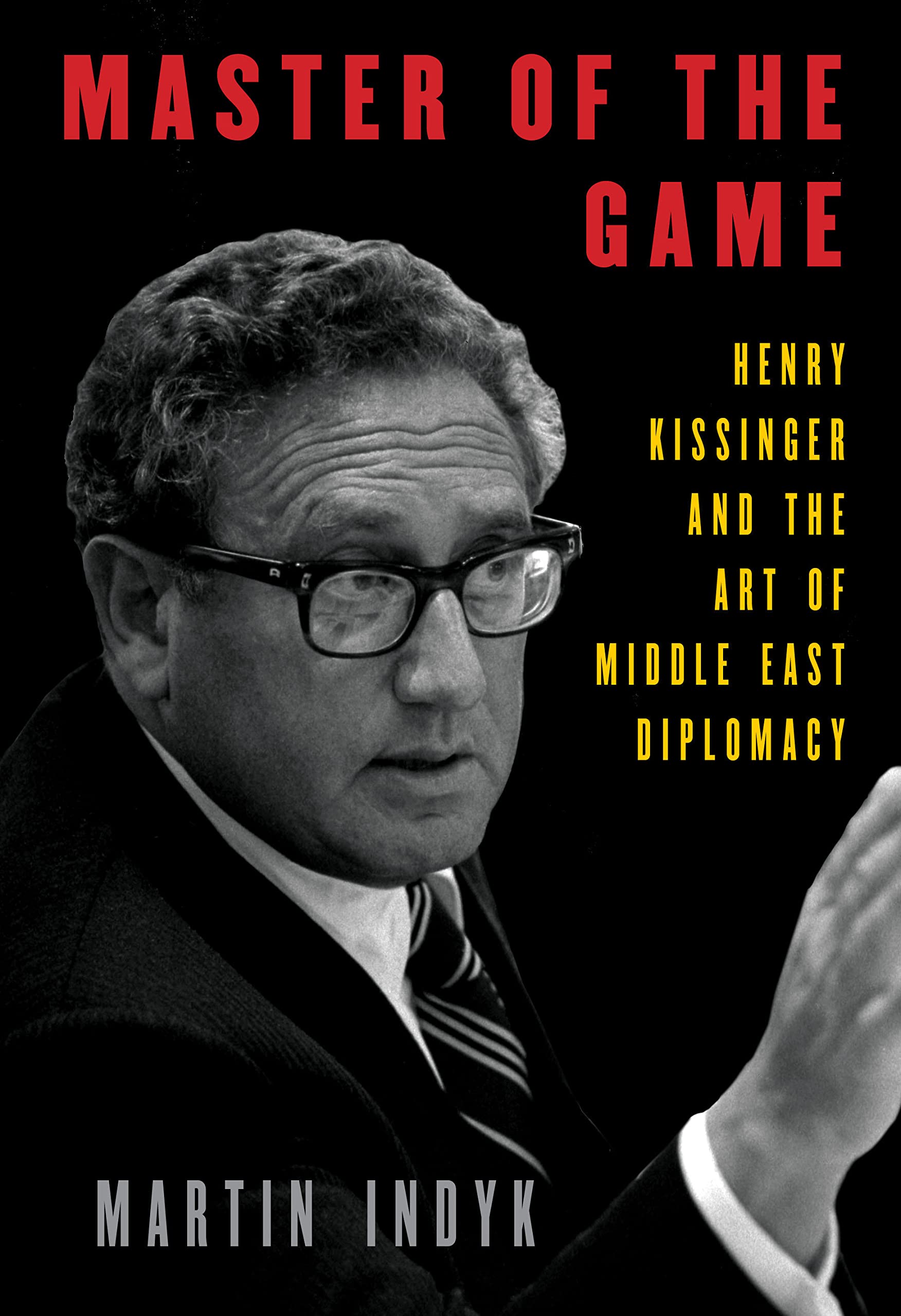
Master of the Game: Henry Kissinger and the Art of Middle East Diplomacy:  Indyk, Martin: 9781101947548

Evidence in the book should also dispel the view that Kissinger was heartless. On his way out of Israel without a peace treaty in March 1975, Kissinger started crying after declaring “we have no other goal except to enable the young people in this area to grow up without the fear of war” (478). While he has been criticized for his alleged callousness, this book shows that Kissinger, albeit unwaveringly devoted to his craft, was not immune to emotion.                 

Those who’ve had enough of America’s misbegotten adventures in the Middle East might be tempted to skip this book. That would be their loss. Master of the Game tells the story of an overall successful policy of negotiation. A superpower got many of its sought-after objectives by engaging a handful of middle powers. As great-power rivalry returns to Asia, Europe, and elsewhere, American policymakers would do well to learn from Kissinger’s example.  

In telling a remarkable story, Master of the Game proves it is possible to write well without sacrificing scholarly standards. The book includes its fair share of colloquial gems—Israeli Defense Minister Moshe Dayan “sounded like an excited bro planning a fraternity party” while talking to Kissinger, we’re told (256). Forgoing the heavy prose that can mar academic writing, Indyk makes this book accessible to the lay reader. That might be a function of his time in the government, where it pays to shun the abstract for the concrete.        

At the same time, Indyk’s book is firmly grounded in historical evidence. Among the archives Indyk consults are the Nixon and Ford Presidential Libraries, the Department of State’s Office of the Historian, and the Israel State Archives. He gives the sources their due. Policymakers in search of historical background and practical advice would do well to read this book. Inside they will find a road map for remedying seemingly intractable disputes, not only in the Middle East but perhaps in the world beyond.  


Daniel J. Samet is a Ph.D. student in History at the University of Texas at Austin, where he is a Graduate Fellow at the Clements Center for National Security.  

The views and opinions expressed in this article or video are those of the individual author(s) or presenter(s) and do not necessarily reflect the policy or views of the editors at Not Even Past, the UT Department of History, the University of Texas at Austin, or the UT System Board of Regents. Not Even Past is an online public history magazine rather than a peer-reviewed academic journal. While we make efforts to ensure that factual information in articles was obtained from reliable sources, Not Even Past is not responsible for any errors or omissions.
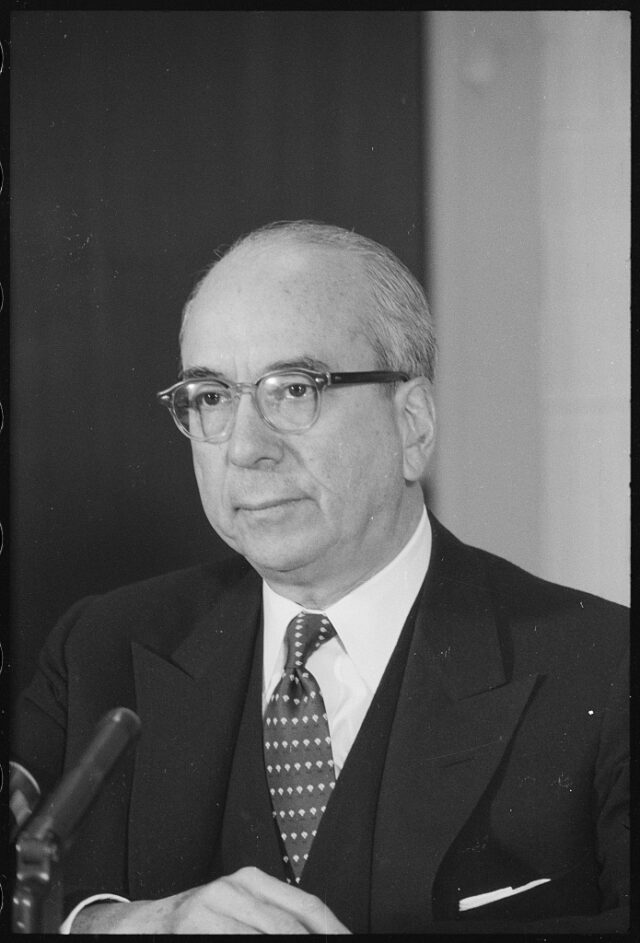
    

Review of Memory’s Turn: Reckoning with Dictatorship in Brazil by Rebecca J. Atencio (2014)

banner image for Review of Memory’s Turn: Reckoning with Dictatorship in Brazil by Rebecca J. Atencio (2014)

On November 18, 2011, Brazilian President Dilma Rousseff launched the National Truth Commission (Comissão Nacional da Verdade or, CNV). The CNV’s mandate included the investigation of torture, disappearances, executions, and other human rights abuses committed between 1946 and 1988. The commission’s period of inquiry covered twenty-one years of military rule, from 1964 to 1985.[1] The National Truth Commission began more than two decades after the dictatorship’s end, and this delay makes Brazil one of the last countries in Latin America to undertake a state-sponsored investigation of human rights violations committed during the Cold War.

Members of the National Truth Commission delivers its final report to President Dilma Rousseff in 2014
The National Truth Commission delivers its final report to President Dilma Rousseff in 2014.
Source: Isaac Amorim

Brazil, the third country in Latin America to undergo a democratic transition, has lagged behind many of its neighbors in the fight for truth and accountability. This occurred, in part, because of the gradual nature of the transfer of power. The military regime had achieved a relatively successful socioeconomic record and maintained a significant level of societal support. As a result, the armed forces exercised a high degree of control over democratization and successfully negotiated the conditions of this transition.[2]

Among the most substantial concessions won by the military was the 1979 Amnesty Law, which granted pardons for political or related crimes perpetrated between 1961 and 1979. Interpreted broadly since its passage, the 1979 amnesty has guaranteed impunity for state agents who committed human rights abuses. In Memory’s Turn: Reckoning with Dictatorship in Brazil, Rebecca J. Atencio, a professor of Brazilian literary and cultural studies, takes 1979 as democratization’s starting point and traces Brazil’s transitional justice process within a regional context.

The first book to analyze institutional and cultural responses in the aftermath of state terrorism in Brazil, Memory’s Turn (2014) seeks to understand the dynamic relationship between transitional justice mechanisms and exceptional cultural works (literature, television, film, and theater). Atencio’s innovative approach attempts to bridge two distinct fields: memory studies and transitional justice studies. Memory’s Turn asks readers to consider whether activity in one realm affects outcomes in the other. Atencio does not argue there is a causal relationship between artistic-cultural production and institutional mechanisms, but she does contend that interplay between the two realms can “magnify and prolong the impact of both and thereby lay the foundation for further institutional steps.”[3]

Memory's Turn Cover

Atencio primarily concerns her study with the public reception and framing of cultural works. This emphasis leads her to rely on mass media, scholarly criticism, and published interviews by artistic producers (memoirists, actors, network producers, screenwriters) as well as the cultural works themselves. Although Atencio consulted scholars, creators, and activists during her research, she does not include personal interviews in her analysis. The reliance on published statements reflects her desire to understand how cultural producers framed their works and agendas in public debates.

In order to study the interaction between cultural production and transitional justice, Atencio first selected key institutional measures and then identified “linked” works. She considers cultural and institutional acts linked when they launch around the same time, and the general public begins to associate the two events with one another. This creates what Atencio defines as an “imaginary linkage.” Once the public has paired cultural and institutional mechanisms, individuals or groups can leverage the connection in order to promote their agenda. Atencio refers to this multi-part process as a “cycle of cultural memory.”[4]

Over four chapters, Memory’s Turn traces four cycles of cultural memory that took place between the 1970s and early 2010s. Not all works that emerge concurrently with an institutional mechanism become paired, so Atencio focuses her analysis on a few exemplary artistic-cultural productions that achieved this imaginary linkage. Chapter one analyzes how Brazil’s Amnesty Law became associated with two memoirs published by former militants: O que é isso, companheiro by Fernando Gabeira and Os carbonários by Alfredo Sirkis. The following chapter explores the television mini-series Anos rebeldes, partially inspired by Sirkis’s memoir. The show coincided with the impeachment process initiated against Fernando Collor de Mello, Brazil’s first-democratically elected president following the dictatorship, and became tied to popular student protests. In chapter three, she examines Fernando Bonassi’s novel Prova contrária in conjunction with the commission formed to award reparations to the families of those disappeared under the military regime. The final chapter investigates the connection between the play Lembrar é resistir and the establishment of Brazil’s first official site of memory at a former torture center in São Paulo.

book cover for O que é isso companheiro
book cover for os carbonários
book cover for prova contrária

By evaluating individual cycles of cultural memory, Memory’s Turn moves chronologically from the dictatorship’s end to the present day. Atencio brings these case studies together in her concluding chapter, which analyzes the longer arc of transitional justice and collective memory processes in Brazil within a global context. Ultimately, Atencio concludes that the linkage between cultural works and institutional mechanisms can foster wider public engagement and new efforts to reckon with the past.[5] As a result, cultural producers, along with human rights groups and activists, have led the turn to memory in Brazil and pressured the state to abandon its politics of silence. 

Although Brazil’s long period of official silence presents some challenges to transitional justice studies, the Brazilian case emerges as a test case to assess the impact of delayed mechanisms. Unlike its regional counterparts, Brazil has adopted a more gradual approach to reckoning with its authoritarian past. The first institutional measure, a reparations program, did not arrive until ten years after the democratic transition. As trials and memory work continue to progress throughout Latin America, Brazil provides insight into how and why transitional justice approaches change over time. Shifting social and political landscapes influence trajectories and outcomes.

Memory’s Turn traces the evolution of Brazil’s transitional justice process and acknowledges its complexities without treating the Brazilian experience as unusual or exceptional. By placing Brazil within a regional context, Rebecca Atencio offers a unique theoretical insight for transitional justice studies. Memory’s Turn provides scholars a model for conceptualizing the dynamic relationship between legal mechanisms and cultural works in post-conflict societies. Over the long term, Atencio’s theoretical framework will apply to other national and regional contexts and help scholars better understand the long-term impact of transitional justice measures in post-conflict societies. 


[1] “Brazilian Truth Commission Has Historic Responsibility,” International Center for Transitional Justice, last modified May 11, 2012, https://www.ictj.org/news/brazilian-truth-commission-has-historic-responsibility.

[2] Zoltan Barany, The Soldier and the Changing State: Building Democratic Armies in Africa, Asia, Europe, and the Americas (Princeton, NJ: Princeton University Press, 2012), 128.

[3] Rebecca J. Atencio, Memory’s Turn: Reckoning with Dictatorship in Brazil, (Madison, WI: University of Wisconsin Press, 2014), 8.

[4] Ibid, 6-8.

[5] Ibid, 125.

The views and opinions expressed in this article or video are those of the individual author(s) or presenter(s) and do not necessarily reflect the policy or views of the editors at Not Even Past, the UT Department of History, the University of Texas at Austin, or the UT System Board of Regents. Not Even Past is an online public history magazine rather than a peer-reviewed academic journal. While we make efforts to ensure that factual information in articles was obtained from reliable sources, Not Even Past is not responsible for any errors or omissions.
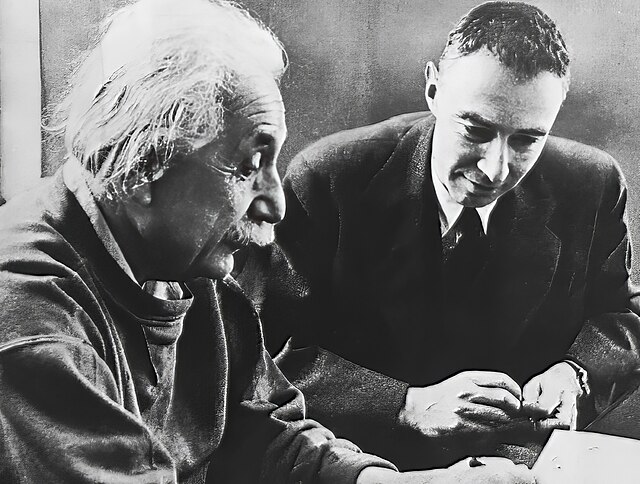
Our New History Ph.D.s

For so many students this year, the cancellation of commencement meant the lack of an important milestone. And in this unsettling time, with it many demands on our attention, it’s possible to overlook the extraordinary accomplishment involved in completing a PhD in History.  So we decided to take this opportunity to celebrate the 2019-2020 class of new UT Austin History PhDs and tell you a little about them and their work.

Each of these students completed at least two years of course work. They read hundreds of books and wrote dozens of papers to prepare for their comprehensive examinations. After that, they developed original research projects to answer questions no one had asked before. Then they did a year or so of research in libraries and archives, before sitting down to write their dissertations. They did all this while working, teaching, caring for their families, having at least a little fun, and, in some cases, writing for Not Even Past!

Here they are, with their dissertation titles (and abstracts, if we have them). CONGRATULATIONS DOCTORS!

Sandy Chang, Assistant Professor, Dept. of History, University of Florida
“Across the South Seas: Gender, Intimacy, and Chinese Migrants in British Malaya, 1870s-1930s”

Across the South Seas explores the migration of Chinese women who embarked on border-crossing journeys, arriving in British Malaya as wives, domestic servants, and prostitutes. Between the 1870s and 1930s, hundreds of thousands of women traveled to the Peninsula at a time when modern migration control first emerged as a system of racial exclusion, curtailing Asian mobility into white settler colonies and nation-states. In colonial Malaya, however, Chinese women encountered a different set of racial, gender, and sexual politics at the border and beyond. Based on facilitation rather than exclusion, colonial immigration policies selectively encouraged Chinese female settlement across the Peninsula. Weaving together histories of colonial sexual economy, Chinese migration, and the globalization of border control, this study foregrounds the role of itinerant women during Asia’s mobility revolution. It argues that Chinese women’s intimate labor ultimately served as a crucial linchpin that sustained the Chinese overseas community in colonial Southeast Asia.

Sandy Chang on Not Even Past:
Podcasting Migration: Wives, Servants, and Prostitutes
A Historian’s Gaze: Women, Law, and the Colonial Archives of Singapore

Chinese Lady-in-Waiting Attending to Her Chinese Mistress’ Hair

Chinese Lady-in-Waiting Attending to Her Chinese Mistress’ Hair, c.1880s (Courtesy of the National Archives of Singapore).

Itay Eisinger
“The Dystopian Turn In Hebrew Literature”

From its inception in Europe during the final decades of the nineteenth century, the Zionist movement promoted, leveraged and drove forward a utopian plan for a Jewish national revival, in the biblical Land of Israel, and in essence framed these plans as a pseudo divine right of the Jewish people. Numerous intellectual, cultural and literary historians therefore have focused on the role of utopian thinking in the shaping of Zionist ideology and Hebrew literature. By way of contrast, this dissertation focuses on the transformation, or evolution, of dystopian poetics within the realm of modern Hebrew literature. … Recent scholarship argues that while early “totalitarian” dystopias tended to focus on the dangers of the all-powerful state, tyranny, and global isolation as the main sources of collective danger to a prosperous and peaceful future, more recently published dystopias – both in the West and in Israel – have moved their focus to other topics and hazards, such as catastrophic ecological or climate disasters, patriarchy, sexism and misogyny, and the rise of surveillance and the integration of the  intelligence community into the all-powerful well-oiled capitalist machine. While I do not disavow such arguments completely, I argue that most Israeli dystopias are still driven primarily by the traditional depiction of an authoritarian-fascist regime run amok – in alignment with the Huxley-Orwell model – while at the same time, explore creatively a vision of Yeshayahu Leibowitz’s prediction in 1967 that the Israeli Occupation of the Palestinians would inevitably force Israel to become a “police state.” … I examine the common themes found in these novels, including the dystopian depiction of an instrumentalization of the Shoah and manipulative abuse of the memory of the Holocaust in order to promote political agendas, allusions to the nakba, the over-militarism and nationalism of the state, the effects of the Occupation on Israeli society, and Israel’s neoliberal revolution…. By examining these novels from this perspective, and creating a dialogue between these works and different critical scholars, this dissertation aims to contribute to the study of Israel by rethinking its history – through the prism of dystopia.

Itay Eisinger on Not Even Past:
Rabin’s Assassination Twenty Years Later

Carl Forsberg, 2019-2020 Ernest May Postdoctoral Fellow in History and Policy at the Harvard Kennedy School’s Belfer Center, 2020-2021 Postdoctoral Fellow with Yale’s International Security Studies Program and the Johnson Center for the Study of American Diplomacy. 
“A Diplomatic Counterrevolution: The Transformation Of The US-Middle East Alliance System In The 1970s”

This dissertation charts the agency of Arab, Iranian, and US elites in transforming the structure of Middle Eastern regional politics and constructing a coalition that persists to the present.  In the decade after the 1967 Arab-Israeli War, the regimes of Anwar Sadat in Egypt, King Faisal in Saudi Arabia, and Shah Mohamad Reza Pahlavi in Iran set out to overturn the legacy of Nasserism and Arab socialism.  Animated by a common fear that their internal opposition gained strength from a nexus of Soviet subversion and the transnational left, these regimes collaboratively forged a new regional order built around the primacy of state interests and the security of authoritarian rule.  They instrumentally manipulated a range of US-led peace processes, including Arab-Israeli negotiations, US-Soviet détente, and conciliation between Iran and its Arab neighbors to advance their diplomatic counter-revolution.  US administrations at times resisted these efforts because they read the region through the polarities of the Arab-Israeli conflict.  After the 1973 War, however, the opportunity to marginalize Soviet influence in the region proved too enticing for US officials to ignore.  My project deploys multi-lingual research conducted in Egypt, Israel, Lebanon, the UK, and the US.  To overcome the lack of open state archives in Arab countries, the dissertation examines US, British, Iranian, and Israeli records of discussions with Arab leaders, as well as memoirs, periodicals, and speeches in Farsi and Arabic, to triangulate the strategies and covert negotiations of Arab regimes.

Celeste Ward Gventer, Post-doc, The Albritton Center for Grand Strategy at the Bush School of Government and Public Service, Texas A&M University.
“Defense Reorganization For Unity: The Unified Combatant Command System, The 1958 Defense Reorganization Act And The Sixty-Year Drive For Unity In Grand Strategy And Military Doctrine”

Pres. Dwight D. Eisenhower and John Foster Dulles at the White House in 1956

This dissertation seeks to answer a deceptively simple question: why, in 1958 and as part of the Defense Reorganization Act (DRA) passed that year, did U.S. President Dwight D. Eisenhower remove the chiefs of the military services from the chain of operational command and instead empower the so-called “unified combatant commands” to lead American military forces in war? The answer, this dissertation will argue, is that Eisenhower had found himself competing with his military service chiefs for his entire first administration and the first half of his second over national (grand) strategy and military doctrine. Taking those service chiefs out of the chain of operational command would, in effect, diminish the role of those officers. Eisenhower had found that simply getting rid of refractory officers was insufficient to quiet their rebellion: only by suppressing their role permanently in the bureaucracy did he hope to unify American strategy- and policy-making. This interpretation is at odds with the few accounts of the 1958 DRA that do exist, which tend to take Eisenhower’s stated purposes—to enhance “unity of command”—at face value. The circumstances that led Eisenhower to take this step were decades, if not longer, in the making. … The situation resulted from the inherent pluralism in American military policy making … it was also a product of the decades that preceded Eisenhower’s administration during which the American military was consistently forced to “fill in the blanks” of national strategy. What drove matters to a head in the 1950s was the steady growth of American power after the 1898 Spanish-American War and, especially, after the Second World War. It is necessary to also appreciate several legacies Eisenhower confronted and that colored his own views: the history of American military thinking about command and about civilian control; the creation of military staffs and the process of reform and professionalization inside the military services during the twentieth century; and the development of independent service doctrines. … This work will trace these conceptual threads over the sixty-year rise of the United States to a global power, culminating in Eisenhower’s standoff with his service chiefs in the 1950s.

Lauren Henley, Assistant Professor, University of Richmond
“Constructing Clementine: Murder, Terror, and the (Un)Making of Community in the Rural South, 1900-1930”

Deirdre Lannon, Senior Lecturer, Department of History, Texas State University
“Ruth Mary Reynolds And The Fight For Puerto Rico’s Independence”

Ruth Mary Reynolds (Women in Peace)

This dissertation is a biography of Ruth Mary Reynolds, a pacifist from the Black Hills of South Dakota who after moving to New York City became involved in the movement for Puerto Rico’s independence…. She bucked the social norms of her conservative hometown to join the Harlem Ashram…. Her work within the Ashram connected her to the web of leftist coalition activism launched by the Popular Front era of the 1930s and 1940s, and to A. Philip Randolph’s March on Washington Movement for black equality. She became involved with organized pacifism, most notably through her membership in the Fellowship of Reconciliation, and her close friendship with its U.S. leader, Dutch-born theologian A.J. Muste. In 1944, Ruth decided to make the issue of Puerto Rico’s independence her own. She helped form a short-lived organization, the American League for Puerto Rico’s Independence, which was supported by Nobel Laureate Pearl S. Buck among others. She became close friends with Pedro Albizu Campos and his family, as well as other Puerto Rican independence activists. She traveled to Puerto Rico, and in 1950 found herself swept into the violence that erupted between the government and Albizu Campos’s followers. Her experiences in New York and Puerto Rico offer a unique lens into the ways in which the Puerto Rican independence movement functioned, and how it was quashed through governmental repressions. Her friendship with Pedro Albizu Campos, the fiery independentista who remains a figurehead of Puerto Rican identity and pride, helps to humanize the man behind the mission. Ruth never abandoned her friend, or their shared cause. She fought for Albizu Campos to be freed, bucking the climate of repression during McCarthyism. This dissertation traces her efforts until 1965, when Albizu Campos died. She remained an active part of the Puerto Rican independence movement until her own death in 1989.
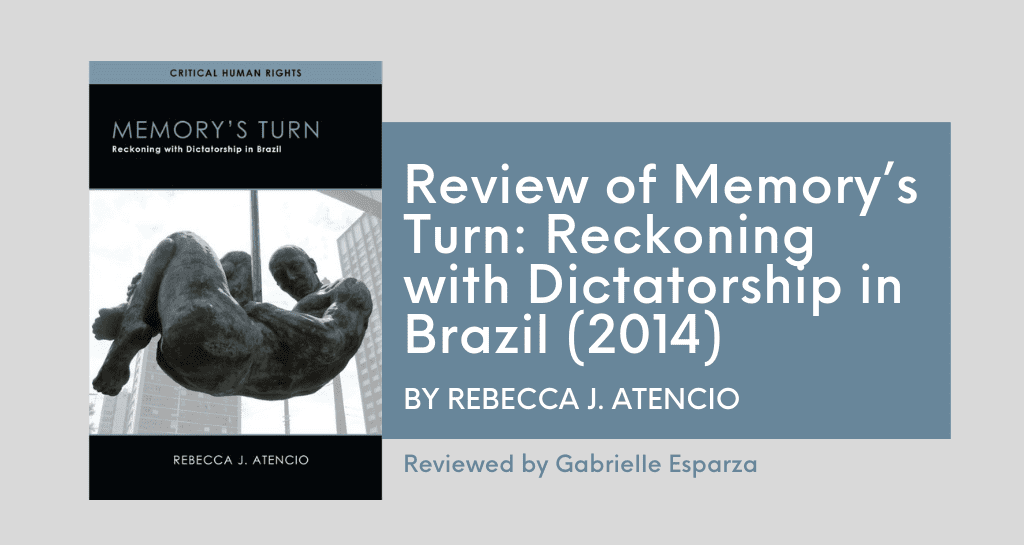
Holly McCarthy
“The Iraq Petroleum Company In Revolutionary Times”

Signe Fourmy, Visiting Research Affiliate, Institute for Historical Studies and Education Consultant, Humanities Texas.
“They Chose Death Over Slavery: Enslaved Women and Infanticide in the Antebellum South”

“They Chose Death Over Slavery,” … examines enslaved women’s acts of infanticide as maternal resistance. Enslaved women occupied a unique position within the slaveholding household. As re/productive laborers, enslavers profited from work women performed in the fields and house, but also from the children they birthed and raised. I argue that enslaved women’s acts of maternal violence bear particular meaning as a rejection of enslavers’ authority over their reproduction and a reflection of the trauma of enslavement. This dissertation identifies and analyzes incidents of infanticide, in Virginia, North Carolina, and Missouri. Using a comparative approach to consider geographic location and household size—factors that shaped the lived experiences of the enslaved—I ask what, if any, patterns existed? What social, economic, and political considerations influenced pivotal legal determinations—including decisions to prosecute, punish, or pardon these women? Expanding on the work of Laura Edwards and Paul Finkelman, I argue that public prosecution and legal outcomes balanced community socio-legal interests in enforcing the law while simultaneously protecting slaveowners profiting from their (re)productive labor. The existing scholarship on slavery, resistance, and reproduction shows that enslaved women were prosecuted for infanticide, yet the only book-length studies of enslaved women and infanticide center on one sensationalized case involving Margaret Garner. Infanticide was more prevalent than the secondary literature suggests. Building upon the work of historians Darlene Clark Hine and Jennifer L. Morgan, I explore how enslaved women re-appropriated their reproductive capacity as a means of resistance. In conversation with Nikki M. Taylor, Sasha Turner, and Marisa Fuentes, I ask what this particular type of violence reveals about the interiority of enslaved women’s lives. Additionally, I explore what these acts of maternal violence reveal about enslaved motherhood—or more specifically an enslaved woman’s decision not to mother her child.

Signe Fourmy on Not Even Past:
Driven Toward Madness: The Fugitive Slave Margaret Garner and Tragedy on the Ohio by Nikki M. Taylor

Sean Killen
“South Asians and the Creation of International Legal Order, c. 1850-c. 1920: Global Political Thought and Imperial Legal Politics”

This dissertation argues that South Asians used international legal discourse both for ideological disputation and to mount political challenges to the domination and subjugation that accompanied British imperial rule between roughly 1850 and 1920. South Asians instigated political and legal disputes in India and Britain, throughout the empire, and overseas, and gained promises and partial concessions to Indian opinions and demands that limited British options in imperial and international relations. In so doing, they compelled the British state to alter the ideology, the policies, and the practices of the state, in India and in its relations with other states both within and outside the empire. Britain’s power, ultimately, meant that South Asians’ argumentation and actions shaped the contours of global order after the First World War….Traditional histories of international law argue that international law originated in Europe and regulated European states’ relations until colonized states were granted international legal recognition at the time of decolonization. Recent revisionist scholarship argues that the existence and experience of empire and colonial rule shaped the development of international law and global order throughout the nineteenth and twentieth centuries. This dissertation approaches empire in a way that emphasizes the global exchange of ideas and the active connections between colonizers and the colonized. Elite, English-speaking South Asians acted as cultural translators or intermediaries. They engaged in debates as public intellectuals, and they carved out spaces for themselves in the social and political communities that created public opinion. Consequently, South Asians’ ideas about relations among different peoples and between states, and South Asians’ mobilization of these ideas throughout the empire and overseas to make political claims about the obligations of the imperial state and the rights of imperial subjects shaped ideas about global order and the structure of international legal relations.
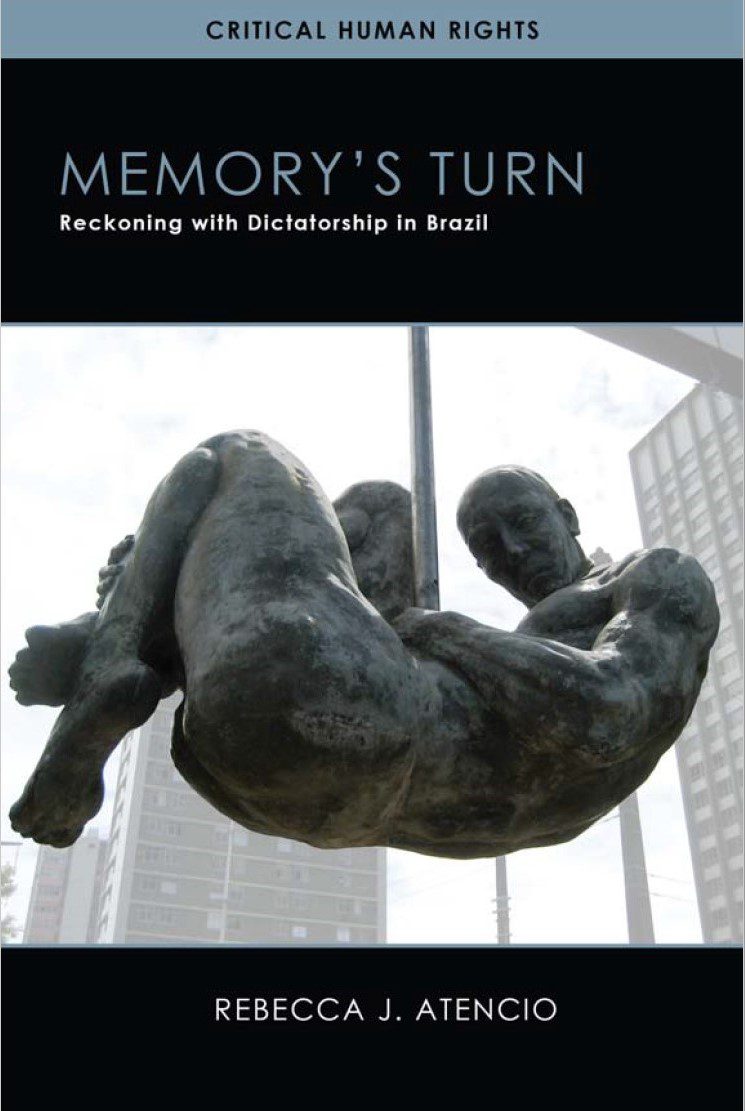
Jimena Perry, Teaching Instructor, East Carolina University
“Trying to Remember: Museums, Exhibitions, and Memories of Violence in Colombia, 2000-2014”

The Center for Memory, Peace, and Reconciliation, Bogotá, Colombia.

Since the turn of the century, not only museum professionals but grassroots community leaders have undertaken the challenge of memorializing the Colombian armed conflict of the 1980s to the early 2000s. In an attempt to confront the horrors of the massacres, forced displacement, bombings, and disappearances, museums and exhibitions have become one of the tools used to represent and remember the brutalities endured. To demonstrate how historical memories are informed by cultural diversity, my dissertation examines how Colombians remember the brutalities committed by the Army, guerrillas, and paramilitaries during the countryʼs internal war.  The chapters of this work delve into four case studies. The first highlights the selections of what not to remember and represent at the National Museum of the country.  The second focuses on the well-received memories at the same institution by examining a display made to commemorate the assassination of a demobilized guerrilla fighter. The third discusses how a rural marginal community decided to vividly remember the attacks they experienced by creating a display hall to aid in their collective and individual healing. Lastly, the fourth, also about a rural peripheric community, discusses their particular way of remembering, which emphasizes their peasant oral traditions through a traveling venue. Bringing violence, memory, and museum studies together, my work contributes to our understanding of how social groups severely impacted by atrocities recreate and remember their violent experiences. In addition, my case studies exemplify why it is necessary to hear the multiple voices of conflict survivors, especially in a country with a long history of violence like Colombia. Drawing on displays, newspapers, interviews, catalogs, and oral histories, I study how museums and exhibitions in Colombia become politically active subjects in the acts of reflection and mourning, and how they foster new relationships between the state and society. My work also analyzes museums and displays as arbiters of social memory. It asks how representations of violence serve in processes of transitional justice and promotion of human rights for societies that have been racked by decades of violence.

Jimena Perry on Not Even Past:
When Answers Are Not Enough: The U.S. Holocaust Memorial Museum
More Than Archives: Dealing with Unfinished History
Too Much Inclusion? Museo Casa de la Memoria, Medellin, Colombia
Time to Remember: Violence in Museums and Memory, 2000-2014
My Cocaine Museum by Michael Taussig
History Museums: The Center for Memory, Peace, and Reconciliation, Bogatá, Colombia
History Museums: The Hall of Never Again

Christina Villareal, Assistant Professor, Dept. of History, The University of Texas at El Paso
“Resisting Colonial Subjugation: The Search for Refuge in the Texas-Louisiana Borderlands, 1714-1803”

This dissertation is a history of the Spanish borderlands from the perspectives of subjugated people in the Gulf Coast. Based on colonial, military, and civil manuscript sources from archives in the United States, Mexico, Spain, and France, it traces the physical movement of Native Americans, soldiers, and African and indigenous slaves who fled conscription, reduction to Catholic missions, or enslavement in the Texas-Louisiana borderlands of the eighteenth century. It reconstructs geographies of resistance to understand how challenges to colonial oppression shaped imperial territory and created alternative spaces for asylum. While the overarching focus of the dissertation is political space-making at the ground-level, the pivotal change occasioned by the Treaty of Paris (1763) serves as the central arc of the dissertation. The treaty, in which Spain acquired Louisiana from France, signified a major imperial transformation of the Gulf Coast. Initiated “from above,” this geopolitical transition expanded the Spanish borderlands over former French territory and altered the locations where Native Americans, soldiers, and enslaved people could find or avoid colonial oppression.

Christina Villareal on Not Even Past
The War on Drugs: How the US and Mexico Jointly Created the Mexican Drug War by Carmen Boullusa and Mike Wallace

Andrew Weiss
“The Virgin and The Pri: Guadalupanismo And Political Governance In Mexico, 1945-1979”

This dissertation explores the dynamic relationship between Catholicism and political governance in Mexico from 1945 until 1979 through the lens of Guadalupanismo. Guadalupanismo (devotion to the Virgin of Guadalupe) is a unifying nationalistic force in Mexico. After 1940, Church and state collaborated to promote the Virgin of Guadalupe as a nationalist emblem following decades of divisive state-led religious persecution. Mexico, however, remained officially anticlerical sociopolitical territory. I analyze flashpoints of Guadalupan nationalism to reveal the history of Mexican Church-state relations and Catholic religiosity. These episodes are: the 1945 fiftieth anniversary of the 1895 coronation of the Virgin of Guadalupe; U.S. President John F. Kennedy’s 1962 visit to the Basilica of Guadalupe; the construction of the New Basilica in the 1970s (inaugurated in 1976); and Pope John Paul II’s trip to Mexico and the Basilica in 1979. Each of these occasions elicited great popular enthusiasm and participation in public ritual. And each brought politicians in contact with the third rail in Mexican politics: religion. The essential value of the Virgin of Guadalupe, as I show, is that as both a Catholic and a nationalistic icon, she represented an ideal symbolic terrain for the renegotiation and calibration of Church-state relations under PRI rule. I follow these Guadalupan episodes to track the history of Guadalupanismo and interpret the changing Church-state relationship at different junctures in the course of the single-party priísta regime. These junctures (1945, 1962, 1976, and 1979) are relevant because they are representative of classical and degenerative phases of priísmo (the ideology of the ruling party [PRI] that governed Mexico from 1929 until 2000) and cover the episcopates of three major figures who ran the Archdiocese of Mexico for over sixty years. The Church-state covenant was renegotiated over time as seen by the Guadalupan episodes I analyze.

Andrew Weiss on Not Even Past
Plaza of Sacrifices: Gender, Power, and Terror in 1968 Mexico by Elaine Carey

Pictured above (Clockwise from top center): Sandy Chang, Andrew Weiss, Deirdre Lannon, Jimena Perry, Celeste Ward Gventer, Christina Villareal, Itay Eisinger.
Not pictured: Signe Fourmy, Lauren Henley, Sean Killen, Holly McCarthy, Carl Forsberg,

2019 History PhDs on Not Even Past

This month on Not Even Past we are celebrating the accomplishments of seventeen students who completed their doctoral dissertations and received their PhDs in History in 2018-2019. Above you see some of them pictured. Below you will find each of their names and the title of their dissertations.

Many of these students were also contributors to Not Even Past throughout their time here, developing their skills as public historians alongside their training as a academics. Here we offer a comprehensive index to all our new PhDs’ publications on Not Even Past.  Congratulations to all!
Ahmad Tawfek Agbaria
Dissertation: The Return of the Turath: Arab Rationalist Association 1959-2000

Ordinary Egyptians: Creating the Modern Nation through Popular Culture by Ziad Fahmy (2011)

Israeli tanks advancing on the Golan Heights. June 1967 (via Wikipedia)

Christopher Babits
Dissertation: To Cure a Sinful Nation: Conversion Therapy in the United States

The Miseducation of Cameron Post (Dir: Desiree Akhavan, 2018)

Digital Teaching: A Mid-Semester Timeline

The Blemished Archive: How Documents Get Saved

Age of Fracture by Daniel T. Rodgers (2011)

Nature Boy, 30 for 30 (Dir: Rory Karpf, 2017)

Doing History in the Modern U.S. Survey: Teaching with and Analyzing Academic Articles

Finding Hitler (in All the Wrong Places?)

The Rise of Liberal Religion by Matthew Hedstrom (2013)

Encountering America: Humanistic Psychology, Sixties Culture, and the Shaping of the Modern Self by Jessica Grogan (2012)

Another Perspective on the Texas Textbook Controversy

Religious Book Week Poster from 1925 (via Library of Congress)

Bradley Joseph Dixon
Dissertation: Republic of Indians: Law, Politics, and Empire in the North American Southeast, 1539-1830

Facing North from Inca Country: Entanglement, Hybridity, and Rewriting Atlantic History

Map of Virginia, discovered and as described by Captain John Smith, 1606; engraved by William Hole (Via Wikimedia commons)

Luritta DuBois
Dissertation: United in Our Diversity: The Reproductive Healthcare Movement, 1960-2000

Historical Perspectives on Marshall (dir. Reginal Hudlin, 2017)

UT Gender Symposium: Women’s Bodies and Political Agendas

Thurgood Marshall in 1957 (Library of Congress)

Dennis Fisher
Dissertation: To Not Sell One Perch: Algonquin Politics and Culture at Kitigan Zibi During the Twentieth Century

The Many Histories of South Austin: The Old Sneed Mansion

A 1936 photograph of the Sneed House taken by the Historic American Buildings Survey (via Library of Congress)

Kristie Flannery
Dissertation: The Impossible Colony: Piracy, the Philippines, and Spain’s Asian Empire

A New History Journal Produced by Students

#changethedate: Australia’s Holiday Controversy

Acapulco-Manila: The Galleon, Asia and Latin America, 1565-1815

Notes from The Field: The Pope in Manila

Outlaws of the Atlantic by Marcus Rediker (2014)

Among the Powers of the Earth: the American Revolution and the Making of a New World Empire by Eliga Gould

Sixteen Months in a Leaky Boat

The Sapphires (2012)

2012 and the End of the World: The Western Roots of the Maya Apocalypse by Matthew Restall and Amara Solari (2011)

Imperial Subjects: Race and Identity in Colonial Latin America edited by Andrew B. Fisher and Matthew D. O’Hara (2009)

True History of the Kelly Gang by Peter Carey (2001)

Confederates in the Attic: Dispatches from the Unfinished Civil War by Tony Horwitz (1999)

detail of an 18c map depicting a pirate ship sailing near the Philippines.

Pedro Murillo Velarde and Nicolas de la Cruz Bagay. Mapa de las yslas Philipinas (1744) (Detail: Benson Latin America Collection, UT Austin)


Travis Michael Gray
Dissertation: Amid the Ruins: The Reconstruction of Smolensk Oblast, 1943-1953

Every Day Stalinism, by Sheila Fitzpatrick (2000)

Stalin’s Genocides by Norman Naimark (2011)

Soviets fighting during World War II (via wiki commons)

William Kramer
Dissertation: Faith, Heresy and Rebellion: Resisting the Henrician Reformation in Ireland, 1530-1540

Henry VIII, Elizabeth I, and Edward VI (via Art Institute of Chicago)

John Lisle
Dissertation: Science and Espionage: How the State Department and the CIA Deployed American Scientists during the Cold War

What Killed Albert Einstein

This New Ocean: The Story of the First Space Age by William Burrows (1998)

Soviet postage stamp celebrating the 10th anniversary of the launch of the Sputnik satellite

James Martin
Dissertation: In Search of the Nixon Doctrine on Latin America: Levers of Influence and Resistance in Hemispheric Relations

Vice President Richard Nixon’s motorcade drives through Caracas, Venezuela and is attacked by demonstrators, May 1958 (National Archives via Wikipedia)

Kazushi Minami
Dissertation: Rebuilding the Special Relationship: People’s Diplomacy and U.S.-Chinese Relations in the Cold War

Peeping Through the Bamboo Curtain: Archives in the People’s Republic of China

Cold War Crucible: The Korean Conflict and the Postwar World by Hajimu Masuda (2015)

Past and Present in Modern China

Historical Perspectives on Hayao Miyazaki’s The Wind Rises (2013)

shot from animated film of a boy looking up at airplane in the sky

from Hayao Miyazaki’s film The Wind Rises

Elizabeth O’Brien
Dissertation: Intimate Interventions: The Cultural Politics of Reproductive Surgery in Mexico, 1790-1940

Partners in Conflict: The Politics of Gender, Sexuality, and Labor in The Chilean Agrarian Reform, 1950-1973 by Heidi Tinsman.

Gendered Compromises: Political Culture and the State in Chile, 1920-1950 by Karin Rosemblatt

The Deepest Wounds: A Labor and Environmental History of Sugar in Northeast Brazil by Thomas D. Rogers (2010)

“Women Advance with the Flag of the Motherland” La Unidad Popular poster (1970).

Nakia Parker
Dissertation: Trails of Tears and Freedom: Black Life in Indian Slave Country,1830-1866

Popular Culture in the Classroom

The First Texans: An Exhibit in Jester Hall

Confederados: The Texans of Brazil

Black Slaves, Indian Masters: Slavery, Emancipation, and Citizenship in the Native American South by Barbara Krauthamer (2013)

Chickasaw Freedmen filing for allotment in Oklahoma (Oklahoma Historical Society)

Christopher Rose
Dissertation: On the Home Front: Food, Medicine, and Disease in WWI Egypt

You’re Teaching WHAT?

Wrong About Everything

Mapping & Microbes: The New Archive (No. 22)

Searching for Armenian Children in Turkey: Work Series on Migration, Exile, and Displacement

Industrial Sexuality: Gender in a Small Town in Egypt

Texas is Adopting New History Textbooks: Maybe They Should Be Historically Accurate

Exploring the Silk Road

The Ottoman Age of Exploration by Giancarlo Casale (2010)

What’s Missing from ‘Argo’ (2012)

Chris is also the co-founder and main force behind our podcast, 15 Minute History, where he has done many of our interviews.

Map showing typhus outbreaks in Egypt, September 1, 1914 – May 31, 1919 (created by Chris Rose)


Edward Flavian Shore
Dissertation: Avenger of Zumbi: The Nature of Fugitive Slave Communities and Their Descendants in Brazil


History and Advocacy: Brazil and Turmoil

Sanctuary Austin: 1980s and Today

Beyonce as Historian: Black Power at the DPLA

Remembering Willie “El Diablo” Wells and Baseball’s Negro League

The Public Historian: Giving it Back

The Quilombo Activist’s Archives and Post-Custodial Preservation, Part II

The Quilombo Activist’s Archives and Post-Custodial Preservation, Part I

An Anticipated Tragedy: Reflections on Brazil’s National Museum

The Public Historian: Quilombola Seeds

Getz/Gilverto Fifty Years Later: A Retrospective

Por Ahora: The Legacy of Hugo Chávez Frías

The Cuban Connection by Eduardo Saénz Rovner (2008)

Che: A Revolutionary Life by Jon Lee Anderson

Narco-Modernities

Photo from Edward Shore’s Collection

Eyal Weinberg
Dissertation: Tending to the Body Politic: Doctors, Military Repression, and Transitional Justice in Brazil (1961-1988)

Our History Mixtape: Embracing Music in the Classroom

Ex Cathedra: Stories by Machado de Assis: Bilingual edition (2014)

For Social Peace in Brazil: Industrialists and the Remaking of the Working Class in Sao Paulo, 1920-1964 by Barbara Weinstein (1996)

The Works Progress Administration’s music project employed musicians as instrumentalists, singers, concert performers, and music teachers during the Great Depression (via Library of Congress)

Zhaojin Zeng
Dissertation: Nourishing Shanxi: Indigenous Entrepreneurship, Regional Industry, and the Transformation of a Chinese Hinterland Economy, 1907-2004


Capitalism with Chinese Characteristics: Entrepreneurship and the State by Yansheng Huang (2008) 

Cantonese bazaar during Chinese New Year at the Grant Avenue, San Francisco, circa 1914 (via Wikipedia)

Pictured in photo: Dr. John Lisle, Prof Daina Berry, Dr. William Kramer, Dr. Nakia Parker, Prof. Ann Twinam, Dr. Christopher Rose, Dr. Elizabeth O’Brien, Dr. Eyal Weinberg.

« Previous Page
Next Page »

Recent Posts

  • NEP Author Spotlight – Aidan Dresang
  • Lesson Plans: The Vietnam War and American Society
  • Lesson Plans: Protest and Social Unrest
  • Lesson Plans: Radio and Communications Technology
  • The Long-Lasting and Perpetuating Effects of Lynching Postcards and Photography
NOT EVEN PAST is produced by

The Department of History

The University of Texas at Austin

We are supported by the College of Liberal Arts
And our Readers

Donate
Contact

All content © 2010-present NOT EVEN PAST and the authors, unless otherwise noted

Sign up to receive our MONTHLY NEWSLETTER

  • New
  • Features
  • Reviews
  • Texas
  • Teaching
  • Digital
  • Watch & Listen
  • Authors
  • About